Showing posts with label mythology. Show all posts

08 March 2021

International Women's Day


For International Women's Day it is always useful to remind ourselves that, even in the Viking Age, women were approximately half of the population. There seems to persist an idea that both Vikings and everything that went on in the Viking Age were somehow entirely a masculine domain. Naturally, I have been trying to nuance this picture for at least thirty years (this year being the anniversary of my Women in the Viking Age (1991), still to my amazement in print after all this time. I suppose it is still useful to people though I hope my ideas have moved on a bit since then.

Although I haven't been publishing on this topic too much recently, I still often get asked to talk about it, or write in a popular context. So here are some links to what I have said or written about women and other female figures in the Viking Age during the last few years:

  • 'In Praise of Queen Astrid' 10-minute talk from the British Academy (March 2021)


[the image above is how the late nineteenth-century artist Christian Krohg envisaged Queen Astrid's speech at the Swedish assembly, public domain via Wikimedia Commons]

  • ‘Inghen Ruaidh, the Birka Grave and Viking warrior women’ podcast on Not What You Thought You Knew with Fern Riddell and guests (September 2020)


  • ‘Valkyries: Fierce women of war’ on BBC World Service, Forum with Bridget Kendall and guests (July 2020)


  • 'Viking women at home and at war', History Extra (March 2019)

 https://www.historyextra.com/period/viking/vikings-women-home-matriarchs-traders-artisans/


For those particularly interested in shield-maidens, I do have an article forthcoming in the journal Viking. 

05 September 2020

Runes in Our Troubled Times


Back in the day when this blog was nobbut a baby blog, one of my first posts gave a quick mention to the Odinic obsessions of a certain Julian Cope, ageing musician and antiquarian who grew up in Tamworth. Twelve years later, the Other Half is still keeping not-very-musical me up to date with Cope's antics, especially when they have a Viking flavour, as they often do, such as his 2017 album Drunken Songs with a cute Viking ship on the cover. So I couldn't help noticing that his latest album, Self Civil War, includes a runic inscription which is very familiar to me (pictured above). It is of course one of the graffiti from the chambered tomb of Maeshowe, on the mainland of Orkney, which I have had occasion to mention one or two times before. Not that you would know this from the album, which nowhere explains what these funny marks are...

The runes read utnorþr : er fe · folhit · mikit, which in standard Old West Norse is Útnorðr er fé folgit mikit, meaning 'In the north-west is great wealth concealed.' What it actually means is anyone's guess, though I suspect there is a strong element of joke about it, like many of the other graffiti in Maeshowe, several of which play with the idea that there was once treasure in the mound. Why this inscription is on this album is also anyone's guess, though Cope has a long history of being interested both in ancient monuments and Norse stuff. A quick internet search shows that he was writing a version of this message (with what looks like a felt-tip pen) on a plastic-looking stone at the Lunar Festival in Tamworth in 2015. OK, so he wrote 'buried' instead of 'concealed', and 'north', instead of 'north-west', but he is forgiven for thinking that treasure is always buried and for not knowing the concept of útnorðr, which only features in my more advanced Old Norse classes. Like many Old Norse words it reveals a fascinating way of looking at the world, but would require altogether another blogpost to explain.

But Cope does appear to have been doing his Scandi homework, since the album also contains a song 'Lokis sympati' in Danish. I don't pretend to understand what it's about, even though my reading Danish is excellent. If you have any thoughts, let me know! The credits say 'All words by Julian Cope' so I have to assume he knows Danish. Good lad. I suppose this goes back to his interest in 'lost Danish music' which started in a charity shop in Melksham in 1999...


The title of the album is however not Cope's but taken from a poem from the 1630s, 'Self Civil War' by a certain Reverend Roger Brearley. This one I do understand, all too well, and also Cope's comment that it 'seems to sum up the psychic and political divisions that many modern Brits share with their Cavalier and Roundhead counterparts.' This is even more true now than when the album came out at the beginning of this year. Let us hope we can somehow find that elusive treasure, wherever it is.


17 December 2019

Viking Warrior Women - More of the Same? II

Reproduction dice and a gaming piece
made by Adam Parsons
(c) University of Nottingham
CC-BY-4.0
In my previous blog post, I looked at two recent television programmes on this perennially popular topic. I found a few things to like but on the whole concluded that the programmes were still very much driven by a strong desire to prove at all costs that there really were Viking women warriors (without really defining what those might have been). I also came to realise that what is essentially an academic debate was being carried out in the televisual sphere rather than in more academic fora, to the detriment, I think, of the discussion. Basically, when a TV programme has a particular message to sell (as both of those did), there is no real discussion, apart from a few knee-jerk references to 'debate' and 'controversy', which are not explored. I'm not even sure I think there's that much of a controversy, so one-sided have most of the discussions been - these are straw men to stir up interest in the programmes. What there certainly hasn't been is any nuanced discussion of the fragmentary, ambiguous and complex evidence, let alone the challenges of defining our terms, and reaching conclusions through interdisciplinary explorations.

I've never denied the possibility of female Viking warriors and, in case anyone still believes I am a warrior-woman denier, they should refer to what I wrote in 2015, even before the current discussions blew up in 2017 (The Viking Diaspora, pp. 104, 107):
...people in the Viking Age and its aftermath were perfectly capable of imagining women as warriors, or at least as imagining them carrying and using weapons, whether this occurred in real life or not. Doubtless it did occur in real life, since human beings are capable of most things, whether or not it is considered 'normal' for them to do so, but the strong emphasis on gender distinctions in Viking Age society already outlined suggests that it did not happen very often.
... that the very few women buried with weapons were warrior women in life seems the least likely explanation of all. 
I may have moved slightly on the last point, but not that much. But really, being the nerd that I am, what I am most interested in is not the answers but the questions. I'm fascinated by the past because we know so little about it, we have to piece things together using, as I have just said, fragmentary, ambiguous and complex evidence. I also relish the challenges of defining terms, and of interdisciplinary explorations. And there is no doubt that such things are hard to put across in a television show. Which doesn't mean we shouldn't try. And I was heartened to come across yet another Swedish TV programme on Viking women warriors that shows signs of a more nuanced approach than the ones I discussed in my previous post. Even though it takes its starting point in the Bj 581 burial, and features some of the same experts as other shows, and despite its oddly provocative title, it does seem to be moving slowly towards that kind of more nuanced (and much more interesting) discussion that I have been looking for all along.

The programme was first aired in October and comes from the series Vetenskapens värld 'The World of ???' Unfortunately, we don't have an English word for vetenskap (as for German Wissenschaft). Although a literal translation would pick up on the root (from veta 'to know') and translate it as 'knowledge', it is a bit more than that, implying science, scholarship and all those kinds of things that go on in universities (sometimes), and sometimes elsewhere too. The actual programme is called 'Sanning i sagorna?' or something like 'Truth in the sagas?' but again it doesn't translate well since the 'sagor'  of the programme go beyond what we tend to think of as the (Icelandic) sagas. In this case, the anonymous Old English Beowulf, the Latin-writing Dane Saxo Grammaticus and the Byzantine historian Skylitzes all get a mention, and I would call none of their works sagas. So that is stretching it a bit, but despite the title, the programme takes an intelligent approach, at least to the female warrior question.

My advice is to skip the first 40 minutes of the programme (some self-indulgent stuff about Beowulf not relevant to my topic today) and just watch the last 18 minutes which takes up the question of Viking women warriors again, in supposed contrast to the 'masculine world' of Beowulf. After a brief repetition of the scientific identification of our old friend Bj 581 as a woman, the camera shows Tommy Kuusela, identified as a historian of religion at Uppsala, w ith quite a pile of books. The voiceover states by way of introduction that there are a lot of 'more or less' trustworthy textual accounts of female viking warriors. Kuusela reads out the usual bits of Saxo, and then the relevant bit of Skylitzes, which the voiceover narrator claims is more more reliable than Saxo because written down in the 11th century (not quite correct, but I'll leave all that pesky detail for another occasion). But when challenged about the textual basis for Viking warrior women, Kuusela admits that there is no 'certain' evidence. This is then immediately contrasted with Charlotte Hedenstierna-Jonson claiming that the evidence of Bj 581 is 'certain' evidence for female warriors. But interestingly she straightaway modifies this by emphasising that this evidence does not mean that this was a common phenomenon. Also, unlike some other presentations, the programme recognises that the evidence could potentially be undermined by some of the find circumstances in which the bones might have been mixed up. Even though the osteologist Anna Kjellström reassures us that the remaining bits of the skeleton do in fact belong together and are from the right grave, it is still interesting to see these various admissions of potential uncertainty.

There then follows a bit in which our heroine the presenter sets out to demonstrate what might be required physically of a female Viking warrior by meeting a combat trainer. Compared to a similar episode in the National Geographic programme, this seems much more realistic and the presenter concludes that it was not that simple to become a female viking warrior after all. The emphasis is very much on the physical training that would have been required to wear all that armour and swing those weapons, not to mention wielding the shield. This leads into the point that the Bj 581 skeleton shows no traces of such physical training, or indeed of wounds that might have come from fighting. Kjellström does point out the fragmentary nature of the evidence, that not much of the skeleton survives, so we cannot say for sure, but again it's good that these counter-arguments are aired. Back to Hedenstierna-Jonson and we get once again the argument that the playing pieces suggest someone whose role in war is a strategic one, as a senior officer, for example. The suggestion is made that the nature of the grave-goods suggest a member of the elite and that it was such elites that could 'break the gender mould'. Hedenstierna-Jonson brings up the parallels of patriarchal societies where women could nevertheless rule because they belonged to a particular dynasty (presumably she is thinking of the likes of Benazir Bhutto).

It is then proposed that the spear in the Bj 581 burial was a kind of ticket to Valhalla for the deceased, but, importantly, it is stressed that this does not mean that she actually participated in battle in life. Kuusela's concluding suggestion is that she was the wife of a military leader who accompanied him on his expeditions (here I'm reminded of Admiral and Mrs Croft in Jane Austen's Persuasion) and who was buried in this way to follow him in the next world too. I'm not sure I really buy that argument, partly for lack of evidence of women in Valhalla (apart from valkyries, but they're another story...), but it's a thought.

Just when you think the programme is over and the credits roll, there's a curious postscript. Our friend Leszek Gardeła pops up again and gives a better brief summary of the Åsnes burial than in the National Geographic programme (where it was supposedly a centrepiece), and, unlike there, with at least a hint of why the skeleton has been identified as female (it is slight and gracile). On being questioned about the Birka burial, Gardeła admits that the lack of trauma on the skeleton complicates the warrior interpretation, and that gaming boards might have had other meanings than indicating military commanders or strategists.

All in all, I would say there is some considerable backtracking going on in this short programme from the original bombastic claims of 'A Female Viking Warrior Confirmed by Genomics' back in 2017. There is some recognition of potential problems with both the physical and the textual evidence, there is an emphasis on what being a 'warrior' (however that is defined) involves by way of training, and there are alternative suggestions put forward as to why a woman might have been buried with what is traditionally regarded as male equipment. And all in 18 minutes. Well done Vetenskapens Värld.

03 December 2019

Some Viking Reading


Rune-stick N B644 (late 12thc.) from Bryggens Museum, Bergen. Photo Judith Jesch

It's quite common for various media and/or internet sites to put up a list of suggested book titles for people wanting to learn more about the Vikings. A recent one is this on Medievalists.net entitled 'Which Books About the Vikings Should I Read'? A couple of years ago the Guardian did 'Top Ten Books About Vikings'. I know I'm a bad person for shuddering when I looking at these lists. Well, maybe not quite shuddering, but having mixed feelings about them. The lists often include books which are not about Vikings at all, but are for example modern fiction, or fourth-hand retellings of myths and legends. Such lists often mix books aimed at different audiences without really specifying what kinds of audiences they are aimed at. And, I'm afraid to say, some of the books on those lists are just not very good. I recognise it is not easy to put such lists together - there are so many books about Vikings out there and it is impossible to read them all. It's also quite hard to judge them, precisely because some which are suitable for some audiences are not suitable for other audiences. Some books are written by experts, and some are put together by jobbing writers trying to make a living. Or people who have just discovered the Vikings and are taking you the reader on their rocky journey finding out about them. Or, some of them written by experts having an off day. Or by people who are an expert in something completely different (you'd be surprised how much of that goes on).

So my list of recommended reading might be just as unsatisfactory as those that I turn my nose up at. Nevertheless, I am going to have a go, since those other lists have inspired me to try to do better. Far be it from me to tell you what you 'should read' - the internet is already too full of people telling other people how to think or behave. But I offer my list for a very specific audience: those who genuinely want to learn about Vikings but are still relative beginners. Intelligent and interested beginners. I'm afraid this list is particularly aimed at those who are thinking of making this a fairly serious study, whether in an educational institution or not. I am going to avoid the myriad of coffee table and popular books which in my view provide entertainment rather than instruction, even though some of these are very good. But they're often a one-stop shop - people might read them (or flick through the pics) once and then never think about Vikings again. Other people read as many such books as they can get their hands on but don't really learn very much because these books often just say the same things, re-use the same images, and, in some cases, peddle the same myths. Just because a lot of books say something doesn't mean it's true. You'd be amazed how many 'serious' books by experts get a bit muddled when trying to explain the word 'Viking'.

What I'm interested in are books that help you engage with the evidence and thereby to think about the process of how we find out about the Viking Age, not just what the 'answers' might be. I'm going for the popular but not the populist. I'm mainly interested in books that have something new to say, have new ways of saying it that make us think, even if they might at some level be 'wrong'. I'm generally very much in favour of thinking. But thinking requires time and commitment, which is why I'm sticking to the more serious end of the market, though you'll see that seriousness can be found in all kinds of places! And yes, I do still, somewhat against the current tide, believe in experts. All I can promise is that, if you read some of the books below, you will be well-equipped to evaluate all the other books about Vikings out there. I have provided some comments to help you identify those you really want to read, just in case you can't get through all of them.

Another word of warning: aficionados will notice that many books that might have made it onto this list are simply not there. There are two possible reasons for this: I might not have read them (I certainly haven't read everything), or I have read them and was not impressed! And I'm not telling which. Other books, while excellent, might be missing because they just are not the kind of book I had in mind for this particular list, which is, I admit, quite personal. I have therefore also avoided books which are too obviously trying to be clever and iconoclastic, or genuinely trying to say something new but which are not well-written or well-argued - life is too short for them.

It's not that easy to find one good book that will tell you everything, or almost everything, you need to know. There's a simple reason for this, which is that Vikings and the Viking Age are complex topics that are not easily reduced even to 300 pages. Also, definitions of what constitutes the Viking Age. or what 'Vikings' really are, do differ, and rightly so. The terms cover a wide variety of people and places over quite a long period of time, and within those places and that time there is a lot of variation. Studying those people, places and times requires a serious commitment to multi-disciplinarity (no, archaeology is not always the only answer, let alone archaeological science), a knowledge of several languages, and the general ability to deal with evidence that is always fragmentary and often elusive. There are really very few geniuses out there who can do this, though quite a few make a noble effort. So what should you read as a general introduction?

Well, if you live in, or have an interest in, Britain or Ireland, you could do worse that start with Jayne Carroll, Stephen Harrison and Gareth Williams, The Vikings in Britain and Ireland (British Museum Press, 2014). What I most like about this book is that the three authors come from different disciplines: Carroll is a philologist and onomast, Harrison an archaeologist and Williams a numismatist and museum curator, so you are in good hands when they evaluate the evidence. There is indeed a good focus on evidence and what it does, or does not, tell us, with some well-chosen illustrations which go beyond the ones that usually appear in such books. It's a good place to start though obviously its coverage is geographically limited..

Having sailed around the northwest European archipelago, you'll probably want to find out more about Scandinavia, where the Vikings came from, next. It's not actually easy, especially if you don't read any Scandinavian languages. Let's hope that by 2025, when the new museum of the Viking Age opens in Oslo, there will be some decent introductions to Viking Age Scandinavia. In the meantime, Anders Winroth, The Age of the Vikings (Princeton University Press, 2014) is quite a good place to start. It takes a broad view of the Viking Age, focusing on the period as transformational for Scandinavia and largely from a Scandinavian point of view. It starts with a fictional vignette of a Scandinavian chieftain and his followers back home celebrating their successes abroad in both raiding and other activities. The core of the narrative is however closely linked to the primary sources, which it brings to life successfully, while keeping a keen critical sense and often emphasising what the sources do not reveal. The book is thematically organised (with chapters on violence, emigration, ships, trade, etc.) which means the author tends to whiz around different times and places, often without a very clear chronology (a bit surprising in a historian). It's also quite light on the important evidence of archaeology, especially excavated sites, with the historian preferring written sources even when they are post-Viking Age. But the Swedish author does love his rune-stones! In general, it does the job in an engaging way.

Although Winroth's book is well-illustrated, it can usefully be supplemented by the perfect picture book, Steve Ashby and Alison Leonard, Pocket Museum: Vikings (Thames and Hudson, 2018). It is literally like carrying a museum around with you, with nearly 200 artefacts pictured, with brief but useful explanatory texts. A picture book that is also educational.

Moving from there to a more specialised archaeological study, I can't resist recommending Steven P. Ashby, A Viking Way of Life (Amberley, 2014). It's a book about - wait for it- combs! And hair! The author does a great job of showing how a simple, everyday object opens up all kinds of meanings in the Viking Age. It starts with the question of how you actually make a comb. First you have to catch your animal whose antler or bone you will use as raw material. And it's not as easy as you think. From these beginnings a complex and fascinating narrative emerges. A book that everyone can relate to, even if you no longer have much hair you probably had some once! The author is not fully reliable when it comes to the literary sources, but he has a good go, and I forgive him for otherwise producing such an exciting book.

While archaeologists occasionally stumble over sagas and poetry, the literary scholars are similarly uncertain when it comes to material culture. Thus, Christopher Abram, Myths of the Pagan North: Gods of the Norsemen (Continuum, 2011) is really quite vague on the material evidence for the pre-Christian beliefs of the Vikings. But he comes into his own discussing the medieval Icelandic literary sources. I particularly liked his emphasis, and detailed analysis, of some skaldic poetry which is almost certainly genuinely from the pagan period. In particular, he moves his gaze away from the fixation with Iceland that the written sources tend to bring, and makes some controversial but stimulating suggestions about religious conflict in tenth- and eleventh-century Norway.

Beliefs, myths and religion are an important aspect of studying the Vikings, so I am also happy to recommend Carolyne Larrington, Norse Myths: A Guide to the Gods and Heroes (Thames and Hudson, 2017). Of all the myriad books about the myths, this one is I think most successful in keeping a balance between retelling the undeniably attractive stories and actually giving the reader a sense of the significance of and relationships between the sources. While this is a book aimed at the general public, Larrington successfully steers her mythological ship with the firm hand of the expert scholar.

While we are on the topic of literature, all study of the Vikings has to grapple with the Icelandic sagas. Scholarship has veered between believing them to be written records of Viking Age oral tradition to discounting them as literature 'because all literature is lies' (direct quote from a senior Norse specialist). Nowadays, saga scholarship often ignores the problem and prefers to study the sagas without considering if, whether, or how they might provide insights into the Viking Age. To me that is the interesting question, which is far from resolved. Since no one has resolved it, the best thing do to is first to get to know this fascinating corpus and the best way of doing that is by reading Margaret Clunies Ross, The Cambridge Introduction to the Old Norse-Icelandic Saga (Cambridge UP, 2010). This is the best place to find out what exactly a saga is, how many types there are, and indeed every saga gets at least a mention. But there are also some really useful close readings of extracts which will help the reader develop a good idea of how sagas work. Though Clunies Ross doesn't explicitly see it this way, I also think this is the first step to an understanding of how sagas relate to the Viking Age (the short answer is, in many complicated ways, and it's never straightforward!).

A much-neglected literary topic is the afterlife of the Vikings in medieval English literature. This is expertly presented in Eleanor Parker, The Dragon Lords: The History and Legends of Viking England  (I.B. Tauris, 2018). Starting with contemporary poems like The Battle of Maldon, Parker traces how Vikings are presented in a wide range of medieval texts in English and Latin, many of them little-known, even to specialists. She sets out to complicate the narratives of historians past and present for whom the Vikings came 'not to govern but rather to destroy'. She does this by examining how literature and popular traditions told more complex stories of England’s Viking Age, demonstrating both the lasting impact and legacy of, and the regional diversity of English responses to, the people most of the texts figure as ‘Danes’. The very complexity of these divergent responses to England's  Viking past is clear, if indirect, evidence of just how important an impact the Scandinavians had.

It's not possible to study Vikings without some grasp of runes and runic inscriptions and Martin Findell, Runes (British Museum Press, 2014) is the best place to start. Admittedly, Findell has more of a soft spot for the runes of Anglo-Saxon England, rather than the far more copious Scandinavian corpus (unbelievable!). But he gives a nicely pedagogical and well-illustrated account of the significance and study of these absolutely contemporary, if occasionally rather laconic, texts.

Words, words, words. For those who are most comfortable with pictures, and for a different kind of thinking, there is nothing better than Dayanna Knight, The Viking Coloring Book (Arizona Center for Medieval and Renaissance Studies, 2017). The author is a trained archaeologist and, like many an archaeologist, good at drawing. Except that she is far better than most, being a quite exceptional artist who can bring the Viking world to life in a way that goes far beyond the technical drawings of the average archaeological report, while still being as accurate as it is possible to be. Plus, colouring pictures is a very relaxing thing to do in our stressful world, and you really get inside the Viking mind while doing it.

Disclaimer: It is true that I am personally acquainted with every single author mentioned above, so there may be a wee bit of bias in my choices. But then, I wouldn't be doing my job very well if I didn't know all these great scholars and fabulous communicators, so I hope I can be forgiven. Enjoy!


15 October 2017

Baby Vikings

Heimdall and his nine mothers
by W. G. Collingwood 1908
My North American correspondent has alerted me to a news item in which some 'celebrity' or other refers to her infant daughter as a 'baby Viking' because she celebrated her first birthday by 'feasting on steak'. As it happens, I am not aware that the eating or not eating of steak is one of the aspects of how we define Vikings. Nevertheless, I thought it might be of interest to see what some Old Norse texts see as the defining features of baby Vikings.

Starting with the youngest, there is the legendary hero Helgi Hundingsbani, who is celebrated in two poems of the Poetic Edda. The first of these describes his birth, and quotes this conversation between two ravens who are rejoicing at it:
Stendr í brynju / burr Sigmundar, / dœgrs eins gamall, / nú er dagr kominn; /hvessir augu / sem hildingar, / sá er varga vinr, / vit skulum teitir. (Eddukvæði II, ed. Kristjánsson & Ólason, 2014, p. 248)
'He stands in his mail-coat, the son of Sigmundr, one day old, now the day has come! He sharpens his glance as leaders do; that one is a friend of wolves, we two will be cheerful.'
The ravens are of course, anticipating the carrion that the warrior will provide for them and the wolves during his martial career. He does indeed have a varied and interesting career and eventually grows up enough to fall in love with a valkyrie. But that is another story...

Next up is Magni, son of Thor. In one of his many giant-fighting episodes, Thor manages to fell Hrungnir, but in such a way that the giant's leg lay across his neck, pinning him down. Young Magni saves the day by being the only one strong enough to remove the giant's leg, after all the other Æsir have tried and failed. Magni was three years old at the time (and his name means 'strength'). He clearly felt he could have done more:
Sé þar ljótan harm, faðir, er ek kom svá síð. Ek hygg at jötun þenna mundak hafa lostit í Hel með hnefa ef ek hefða fundit hann. (Skáldskaparmál, ed. Faulkes, 1998, p. 22)
'It is a awful shame, father, that I came so late. I think I would have struck this giant into Hel with my fist if I had encountered him.'
His father is impressed and predicts a glowing future for his son, and gives him Hrungnir's horse Gullfaxi as a reward. This irks  Odin, who thinks he, as Thor's father, should have had this gift, rather than Magni the 'son of a giantess'. Presumably it was Magni's maternal giant heritage that made him strong enough for the deed. Magni's fate is to survive Ragnarök, but that is another story...

Another precocious three-year-old is the hero of Egils saga. We meet him first in ch. 31, ugly, black-haired and clever with words, but a bit obstreperous in playing with other children. When the family sets out for a party at the grandparental home, Egil's father refuses to take him, saying that he can't be trusted to behave when there is drink being taken, indeed he is hard enough to deal with when he's sober. The toddler won't have this, grabbing a horse to follow the party. At the party, grandfather Yngvar welcomes Egil and gives him three sea-snail shells and a duck's egg as a reward for a verse he composed in a drinking game which involved competitive poetic composition:
Kominn emk enn til arna / Yngvars, þess's beð lyngva, / hann vask fúss at finna, / fránþvengjar gefr drengjum; / mun eigi þú, þægir, / þrevetran mér betra, / ljósundinna landa / linns, óðar smið finna. (Egils saga, ed. Nordal, 1933, pp. 82-3)
'Still I have come to the hearth of Yngvar, he who gives to warriors gold (the bed of the gleaming thong of the heather). I was anxious to find him. You will not, giver of the twisted, shining gold (land of the snake) find a better three-year-old craftsman of poetry than I am. [Thong of the heather is a snake, and the snake's bed, according to tradition, is gold]. (Egils saga, tr. Christine Fell, 1975, p. 182).
It's quite a sophisticated poem for a three-year-old. Egil doesn't however, kill his first man until he is in his seventh year, the victim being a boy of ten or eleven who had bested and humiliated him at a ball game. This killing led his mother to declare that Egil was a víkingsefni 'the makings of a Viking'. Indeed Egil goes on to fulfil his destiny, but that is another story...

Anyway, six is a bit beyond babyhood and nearing the age of reason. This little tour of baby Vikings does not suggest that steak played any part in their achieving that status, but then it is not recorded what they ate and only hinted at what they drank. From the legendary poetry of the Edda to Snorri's prose mythology and the historical fiction of the saga, we do find an admiration for exceptional individuals, expressed in their baby Vikinghood. But I do not expect any time soon to read articles claiming that the Vikings started training their warriors at one day old. At least I hope not.


15 January 2017

The Towering Goddess

The Viqueen, I can report, is beyond excited at her upcoming trip to extremely northern latitudes in Norway in a couple of days' time. Heading north in January means that there are two desiderata above all, snow and the northern lights. It is true that the Viqueen has seen quite a lot of snow in her lifetime, and she even finally achieved one of her all-time goals when she saw the aurora borealis on a trip to Iceland last November (as proven by the rather murky photo, right). But global warming means snow is not as reliable as it once was, while one glimpse of some rather faint northern lights can only whet a Viqueen's appetite for even more, and perhaps even more spectacular, displays.

So what does a Viqueen do? Well she knows to pray to Skaði for snow, for the skiing goddess/giantess just cannot do her thing without it. But what about the northern lights? The Viqueen duly consulted her friend the Snowqueen on this important matter, and the oracle suggested that an appropriate deity to propitiate would be the otherwise not very well known goddess Gná. This sent the Viqueen back to her books to remind herself about this rather obscure figure, and what she found there is rather interesting.

Like many other obscure goddesses, Gná occurs a few times in kennings, where she is mostly just a synonym for 'goddess', in those woman-kennings where a goddess, any goddess, depending on the requirements of rhyme or alliteration, forms the base-word. Still, it is interesting that Gná appears in kennings in both very early poetry (Ölvir hnúfa, one of the poets of Haraldr Finehair in the 9th century) and quite late poetry (in the Jómsvíkingadrápa by the Orcadian bishop Bjarni Kolbeinsson, in the late 12th or early 13th century), suggesting a longevity in the minds of those who cared about these things.

Another bit of evidence that she was better-known in those days than she is now is the way in which she is mentioned in Snorri's Edda. There, she appears as no. 14 in the list of goddesses and her main characteristic seems to be as a kind of errand-girl for the top goddess Frigg (aka Mrs Óðinn). But then Snorri tells us a bit more, that she has a horse, called Hófvarfnir, that can run on both the sky and the sea. Snorri also goes on to quote a couple of stanzas from a poem occasioned by her riding through the air. On being seen by 'certain Vanir' doing this, one of them asked:
'Hvat þar flýgr? / Hvar þar ferr / eða at lopti líðr?'
What flies there? What goes there, or travels in the air?
to which the goddess herself answers:
'Né ek flýg / þó ek fer / ok at lopti líðk / á Hófvarfni / þeim er Hamskerpir / gat við Garðrofu.'
' I do not fly, though I go and travel in the air on Hófvarfnir, whom Hamskerpir conceived on Garðrofa.'
  (quoted from Snorri Sturluson. Edda. Prologue and Gylfaginning, ed. Anthony Faulkes, 1982, p. 30, my translation)
Just a little snippet of mythological knowledge there, not unlike the many names, of mythological horses as well as many other things, that we find in Grímnismál. But what is perhaps more interesting than that is the fact that these two stanzas are among the very few Eddic, mythological stanzas in Snorri that must derive from longer poems that do not otherwise survive, again suggesting that this goddess was once better known than she is now.

Snorri then goes on to add, in some guesswork etymology, that 'From the name of Gná, a thing which goes up high is said to tower (gnæfa)'. So, indeed, an appropriate deity for the northern lights up there in the sky. The Viqueen can only hope that she recognises this humble approach and arranges things accordingly next week.

P.S. If you want to read a much more learned disquisition on the possible significance of Gná and other flying females in Norse myth and superstition, then do have a look at Stephen Mitchell, 'Gudinnan Gná', Saga och Sed (2014), 23-41.

12 March 2016

Darkness and Light at Midsummer

Nikolai Astrup
St. Hansbål ved Jølstervatnet
Wikimedia Commons
In London on Norse and Viking business yesterday, I took a bit of time to go to the splendid Dulwich Picture Gallery and check out their Nikolai Astrup exhibition. Publicity for the exhibition has tended to stress how little known he is outside of his native Norway, but those of us who have lived in Norway couldn't possibly have escaped being fascinated by his paintings. Apart from a few short visits to the capital or abroad to study, Astrup spent most of his life in the same place, the farming communities in the district of Jølster in Sunnfjord, and his motifs all derive from the landscape and the people around him. The paintings and prints look pretty good on the page, or the screen, but there is nothing like seeing them in the flesh.  Seeing a large number of his works together really brings home how careful and subtle his use of paint is - there are so many different shades of blue and grey for the water and the sky, and of green for the foliage. Almost every painting has a little luminescent glimmer in it somewhere, be it the summer night's reflections on the lake, or a full moon, or the warm light of a house window shining through the trees. These effects can only be appreciated by seeing the actual paintings.

One of Astrup's best-known and -loved motifs is found in his several works (such as the one pictured above) on the theme of Sankthansaften, or Jonsok, the pan-Scandinavian custom of big midsummer bonfire parties, on the 23rd of June, the eve of the feast of St John the Baptist. Growing up in a country parsonage, Astrup wasn't allowed by his strict father to participate in such 'pagan' practices, and clearly made up for this by painting the scene many times later in life (often with a wistful figure looking on from the edge of the scene). Which raises the question of just how 'pagan' these celebrations were.

Well it does not stretch the imagination to accept that northern countries, with their great contrasts of darkness and light, would mark the time of year when the days were at their longest, but starting to get short again, just as they celebrated the time of year when the days were at their shortest and getting longer again. But actual evidence for such celebrations is hard to find. One of the labels at the Astrup exhibition suggested that the St John's Eve bonfires went back to pagan times and were a recreation of the funeral of the god Baldr. But I don't think this idea is much older than 1858 when it was suggested by the Norwegian language reformer Ivar Aasen, who grew up a little north of Astrup, in Sunnmøre. The basis for this suggestion is not clear, though it is true that Baldr is 'so bright that light shines from him' (according to Snorri), and it is easy to equate his death with the turning of the sun.

The main medieval evidence for the festival comes from ch. 19 of Ágrip, a historical work written in Norway in the late twelfth century, where it says of the missionary king Óláfr Tryggvason that he (edition and translation by Matthew Driscoll):
felldi blót ok blótdrykkjur, ok lét í stað koma í vild við lýðinn hátíðardrykkjur jól ok páskar, Jóansmessu mungát, ok haustöl at Mikjálsmessu.
abolished pagan feasts and sacrifices, in place of which, as a favour to the people, he ordained the holiday feasts Yule and Easter, St John's Mass ale, and an autumn-ale at Michaelmas.
This suggests, though not definitively, that these new Christian feasts took place more or less at the same time as the traditional celebrations, but it says nothing about the traditional midsummer feast being a celebration or recreation of Baldr's funeral. So that must remain a rather speculative hypothesis.

Nevertheless, it is quite likely that Astrup shared Aasen's romantic viewpoint, and the picture above does seem to echo the myth. Unlike most of Astrup's other Sankthans paintings, this one has no dancing couples and the mood seems to be quite sombre. According to Snorri, Baldr's funeral took place by the sea, on a ship which was launched and then burned. It is not I think too fanciful to see the bonfire, the boat on the shore, and the lone figure sitting by it, as echoes of this story, at least in Astrup's mind.

26 December 2014

Viking Women

In my self-appointed role as Viqueen, I not unnaturally take a great interest in the doings of all my Viking sisters in this most apparently masculine or even masculinist of historical periods. But when I indulge this interest, I do sometimes feel like a still, small voice amidst all the popular (and even academic) fascination with the war and the violence, the boyish obsession with transport (horses and ships), and all the shiny, shouty stuff like bling and skaldic poetry. At a conference just over a year ago in connection with the Copenhagen leg of the great Viking exhibition (currently in its final days in Berlin), I was amused to hear from one of the curators that one topic that was firmly excluded from their exhibition concept was that of 'daily life on the farm'. (Another was Viking art, but that's perhaps another blog topic, one day). Which is a pity, because I find 'daily life on the farm' just as fascinating as all the violent and blingy stuff, and perhaps just as foreign to the modern world, if not more so. After all, we still live in a violent and blingy world but how many in the western world at least still have to produce their own food, build their own houses and make their own clothing from sheep or linseed through to garment?

If there are any budding scholars out there, there is certainly still plenty of scope to research the role of women in the Viking Age, along with children, men, animals and all the accoutrements of daily life. And there are signs of renewed interest in the roles of women, as evidenced in a book just out, Kvinner i vikingtid (Women in the Viking Age), edited by Nancy Coleman and Nanna Løkka. The book has seventeen articles, in Danish, English, Norwegian (both nynorsk and bokmål) and Swedish, on a wide range of aspects of women's experiences in the Viking Age and after. I particularly liked Pernille Pantmann's chapter on women and keys, deconstructing the hoary old chestnut that keys in female graves represent the mistress of the house (an old idea that I have been guilty of myself in the past...). I'm less convinced by Pernille's alternative explanation, but she is properly cautious about putting it forward, and her piece certainly opens up the whole question for renewed discussion. We need more work like this.

Another recent publication, In Search of Vikings: Interdisciplinary Approaches to the Scandinavian Heritage of North-West England, edited by Steve Harding, David Griffiths and Elizabeth Royles, also has a couple of papers relevant to the understanding of female roles and experiences. In particular, Christina Lee's chapter shows the range of information that can be gleaned from textiles and textile working implements. The production of clothing, and other textiles (such as sails for Viking ships) was probably the one job that took up most of most women's time in the Viking Age, and studying this evidence again opens up all kinds of interesting questions about craft production, agriculture, family life, and artistic expression, not to mention the symbolic roles of weaving and spinning in Old Norse mythology.

Which reminds me that, nowadays, the most obvious profile of Viking Age women in both the popular media and much academic research is that of the possibly more glamorous but certainly minority (and in some cases fictional) roles of sorceresses, valkyries and warrior women. Or queens. All of these have their interest, of course, and I have expressed my views about both valkyries and warrior women before. I blame Game of Thrones, myself. I have to confess I haven't read the books, but I have watched a few of the TV episodes and, from my limited watching, it is clear to me that the female characters are mostly a pretty clever, capable and attractive bunch, usually more so than the male characters. This is how we like to see women from the dark and distant past in the twenty-first century, and it is certainly an improvement on the embarrassingly almost female-free twentieth-century equivalent, the fantasy works of Professor J.R.R. Tolkien.

But fantasy is just that, it's fantasy. When it comes to studying the past, I always struggle, both for my own part and in my teaching, to understand and to explain the paradox that, while human beings are human beings and always have been and always will be, the past really is another country. That's what's so fascinating about studying it - in what ways were people then just like people now, and in what ways were they different? Pinning that down in detail is the fun part.

On the whole, I think it's a shame that those interested in the Viking Age find it less interesting nowadays to explore the lives of real women, both those who stayed at home to cook, clean and bring up the children, and those who went out on great adventures, as settlers in the Hebrides or Iceland, or traders in Russia, with or without their menfolk or children. Maybe these new books will bring some redress. And at least some of these questions will be addressed in The Viking Diaspora, to be published next summer. But there is still plenty to do!

27 June 2014

Languages, Myths and Finds

Just wanted to give a little plug to a project I have had some involvement with. This has very much been the Year of Vikings, and in particular the splendid exhibition at the British Museum, now sadly finished, about which I have blogged before.

In connection with the exhibition, the Languages, Myths and Finds project had the aim of encouraging conversations between specialist university academics and advanced research students in Old Norse and Viking Studies, and local communities around Britain and Ireland who were interested in knowing more about their Viking heritage. The communities chosen for the project were Cleveland, Dublin, Isle of Lewis, Isle of Man and Munster. Five small teams of six academics and students were chosen to work with each community, in each case developing and researching topics most suited to that locality, as identified in dialogue with the community.

The result is now five gorgeous booklets, each very different, which can be downloaded in pdf form and for free from the project website.

Enjoy!

10 March 2014

Vikings: Life and Legend

Tjørnehøj brooch
©Nationalmuseet, Copenhagen
The Mega Viking Show has finally come to town, and your faithful blogstress was honoured and privileged to be present when Margrethe, Queen of Denmark, and various other dignitaries opened it last Thursday, as well as to get an early viewing of the whole thing. I don't propose to review the exhibition - there are plenty of reactions of all types to be read in the media. The exhibition is designed for the general public, rather than the expert, and I firmly believe that the outsider's view is the one to seek out. Interestingly, the reactions vary enormously - do read more than one review to get a sense of it all. Another reason I would find it hard to review is that so many of the objects are almost too familiar. This is not only because I saw a version of the same exhibition in Copenhagen last September, but also because some of them I saw last time the British Museum did a Viking exhibition, in 1980, and in other exhibitions in various places since. Yet others are familiar from the many illustrated coffee-table books about the Vikings that flood the market on a regular basis.

But some of the exhibits are relatively new and I thought I'd pick out a few of my favourites at random, for my and your delectation. My top favourite is probably the valkyrie figure discovered in 2012, but I have blogged about that before. Several other 'valkyrie' images can be seen in the exhibition, and they are a fascinating group, mostly relatively recent metal detectorist discoveries. Another recent (2007) metal detectorist find from Denmark of which I am inordinately fond is the ship-brooch pictured above and extensively used by the British Museum in its publicity for the exhibition. It is sometimes said to represent a dragon-ship, but it is quite clear to me that the two figureheads are those of horses, as indicated by their ears and manes. Although similar brooches are known, this is the only one I have come across on which the animals seem very definitely to be horses' heads, and is thus a unique representation of that figure so commonly found in skaldic poetry, by which ships are called 'horses of the sea'. I also like the little face between the horses' heads, though quite what he represents I do not know.

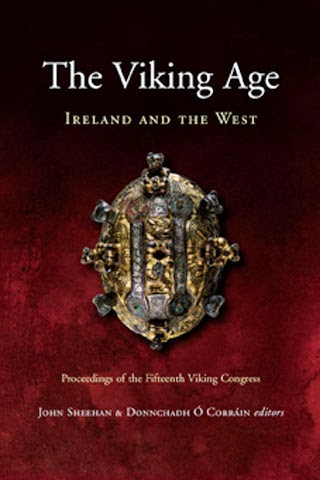
Oval brooches have always fascinated me because they are typical of Scandinavian women's dress, and when we find them around the world, they raise interesting questions about the role of women in Viking migrations. Many thousands of them are known, from a broad geographical and chronological range, and in a variety of styles. For me, the one that tops them all is definitely that found in 2004 in an archaeological investigation at Finglas, in Dublin. There's an interesting photo of how it looked when it first came out of the ground on the website of Icon Archaeology, but it can only truly be appreciated in its cleaned-up form, which shows very clearly its 'protruding animal ornament', as the archaeologists say. These include both whole animal figures, and animal heads, all of which strongly resemble bears. Although similar brooches with small animal figures are known, I think these are the only ones which are clearly bears. They look quite cute to us today, though the bear was of course a feared and fearsome animal, and widely significant in Viking language and culture. I haven't found a good photo of the brooch to show you, but it adorns the cover of The Viking Age: Ireland and the West (2010), edited by John Sheehan and Donnchadh Ó Corráin, shown above, and is discussed at length by Maeve Sikora in that volume.

Finally, although the exhibition is not strong on runic inscriptions, it was a real pleasure to see the Kirk Andreas III stone from the Isle of Man, with its simple (and incomplete) inscription 'Þorvaldr raised this cross'. While not the most exciting inscription, it is of interest because, along with most of its fellow Manx inscriptions, it records the earliest uses of the word kross in Old Norse, a word with a fascinating history which appears to be borrowed from Latin crux into Gaelic, from there into Old Norse (as suggested by the Manx inscriptions) and from there into English, as suggested by some place-names in the north-west of England. Oh, and the stone, which is clearly a Christian cross-slab, also has those well-known images of what appear to be Odin at Ragnarok on one side, and a Christian figure on the other (above, left). It was particularly nice to see it in London last Thursday, because on Friday I went off on another runological field trip to the Isle of Man, where we had to make do with a replica in St Andrew's church, Andreas, instead. But the display in the church did have a nice picture of the last time the stone went to the British Museum, for the 1980 exhibition (above, right).

08 February 2014

The Original Biathlete

Photo from Wikimedia Commons
It may have escaped your notice that Ragnarok will apparently take place on the 22nd of February 2014, if so, consider yourself warned! The Jorvik Viking Festival will be recreating this event, and their description cleverly plays on the ambiguity in the Old Norse sources as to whether this cataclysm is in the future, and therefore to be feared and anticipated, or has already happened in the past, so that we are now living in the brave new world that arose out of the ashes of the old one. This is all a fascinating topic to which I may return in another context.

In the meantime, I am a bit gutted that Jorvik's page on the Norse gods misses out Ullr, the god of skiing and hunting. As the Winter Olympics start, it seems appropriate to give a mention to this earliest paragon of what the Guardian today described as 'One of the more bewildering of the many perplexing disciplines to be contested in Sochi', the biathlon, which combines cross-country skiing and shooting. The case of Ullr, however, shows that this combination of skills is essential in the north. Snorri says of Ullr that hann er bogmaðr svá góðr ok skíðfœrr svá at engi má við hann keppast 'he is such a good archer and so good on skis that no one can compete with him'. Obviously a gold medal prospect then! His spiritual descendant is Earl Rögnvaldr of Orkney, also a whizz at both skiing and shooting.

Although Ullr is not so often mentioned in the mythological texts of medieval Iceland, there is plenty of evidence that he was widely venerated in the Viking Age, particularly in Norway, where place-names like Ullern and Ullevål, both in Oslo, and Ullensvang, in Hardanger, perpetuate his name. The Norwegians have won more medals at the Winter Olympics than any other nation, so may the spirit of Ullr live on in their efforts in Sochi!

But it has to be admitted that the Swedes are also pretty good at winter sports, they are 7th in the Guardian's all-time medals table. And to prove this, I offer an image above of the Böksta rune-stone (U 855) from Uppland in Sweden, which shows Ullr himself, bottom left, with both his bow and his skis.

24 January 2014

Ice and Fire: The Viking Condition

'
Some say the world will end in fire / some say in ice'. Despite his name, the American poet Robert Frost was inclined to 'favor fire' for bringing about the end of the world, but acknowledged 'that for destruction ice / is also great / and would suffice'. His thoughts were not new, as they were anticipated a millennium or so earlier by people in the Viking Age, whose myths show a full awareness of the destructive powers of both fire and ice. But the Norse myths also envisage creative possibilities in these unavoidable natural forces. In Snorri Sturluson's version, at least, the first creature in the world, Ymir, ancestor of the primeval race of frost-giants, was created in the encounter between rime and heat. These frost-giants reappear at Ragnarök, on the side of destruction, along with Surt and his flaming followers.

I was pondering these questions on a recent two-week visit to Oslo on runological business. There's nothing like some close(ish) encounters with these opposing forces to make you realise their power. For even in the twenty-first century, in the capital city of one of the richest countries on the planet, December and January are not for the faint-hearted. This year the snow was particularly late in arriving, so despite a little snow in December which melted quickly, Oslo just continued dark and cold until the day I arrived in January, when an overnight snowfall left much of the city looking like the photograph, above. It certainly felt like a blessing. At this time of year, snow makes a real difference, lightening the long dark days, muffling the sounds of the city, and generally providing great pleasure for children and skiers. I like it too. But once the snow arrives, large quantities are hard to shift, despite the multitude of devices of various sizes available for this purpose, and once packed down, the snow can become icy and treacherous to those unprepared. Both people and vehicles need to make provision - you can buy special cleats for all kinds of shoes, including trainers and high-heels (!), and the television was full of stories about foreign lorry drivers coming a cropper because their trucks weren't properly 'shod', as they charmingly put it. And to leave the house you have to factor in a lot of time to put all the requisite layers on, and then you feel a bit like the Michelin man when you do.

Ice and snow are certainly a nuisance and can be deadly but, as Frost acknowledged, fire is the more obviously destructive force. While I was in Norway, a devastating fire exacerbated by high winds destroyed thirty-odd buildings, including seventeen dwelling-houses, in the village of Lærdalsøyri. Mercifully, no lives were lost, there weren't even any serious injuries (although deaths in house fires are quite common in Norway, there was one elsewhere in the country a day or two later). But several of the buildings were historic and, apart from the seventeen families who lost everything, the character of the place (and therefore its livelihood, which depends heavily on tourism) is severely dented. It's a beautiful and charming place that I last passed through in 2010, and it was heartbreaking to watch the destruction as it unrolled. On the plus side, the inhabitants seemed all to be remarkably resilient and supporting each other to the hilt and, at this early stage, determined to rebuild in the same place. Let's hope it works out for them.

It's clear that the treacheries of both ice and fire have always been a part of the Norwegian experience, and one can only begin to imagine the vicissitudes of life at those latitudes, and lived largely in wooden houses, over the last few millennia. Human beings have always had to be heroic to survive, but different geographies demand different kinds of heroism, and it has always seemed to me that the Scandinavians have always coped particularly heroically with these ever-present dangers, and even made them into positives. After all, who else would choose to live in a place called Iceland, less icy than its name suggests, but certainly plagued by volcanic fire? Or optimistically give the name Greenland to a land mostly under ice at the time? Just surviving in northern Norway for several millennia is truly heroic.

I have always had a deep admiration for the Vikings, for many reasons, but particularly for their hardiness and courage in the face of physical extremity. In this great Year of the Viking, with excitement about the upcoming British Museum exhibition reaching fever pitch, it is wonderful to see the enthusiasm of many. Yet there is also the danger of it all being treated as a bit of a joke. Over the years I have endured many snide comments about my professional title. More recently, people have enquired as to my views on Viking gymnastics, or Viking helmet knitted hats (complete with knitted hair and beard), or the Jorvik Viking Festival's claim that Ragnarök will arrive on the 22nd February. Even the Daily Mail has written some rubbish (when does it write anything else?) about runes (I won't provide a link because I don't want people to read it!). I don't mind a bit of fun myself, and even hope this blog occasionally provides it. But, like the Vikings themselves, I am quite a serious person, and my interest in the Vikings is pretty serious too (the 'fun' of skaldic poetry is certainly an acquired taste for many). Not least of my admiration is for their bravery in the face of ice and fire. Our ultimate destruction, by whichever means, is inevitable, but we can have a jolly good fight against it first.

29 July 2013

Valkyries Revisited

Picture stone from Tjängvide, Alskog, Gotland.
Wikimedia Commons
 
Martin Rundkvist's recent blog on shield maidens has inspired me to air in a little more detail my views on women warriors by looking first a bit more closely at their close cousins, the Valkyries.
 
The valkyrie is a mythological being with widespread currency, since she appears in art, archaeology and a wide range of literary texts. Valkyries (valkyrjur lit. ‘choosers of the slain’) were defined by Snorri Sturluson as figures:
 
whose job is to serve in Valhall, bringing drink and looking after the tableware and the drinking vessels ... These are called valkyries. Óðinn sends them to every battle, they choose who is to die and allot victory. (my translation)

Snorri does not specify that they bear arms, though this might be deduced from the second aspect of their role. The figure is further developed in Old Norse literature, often with a strong romantic angle involving love between a valkyrie and a male warrior, and Snorri himself testifies to the enduring popularity of this figure in the thirteenth century. But the two functions of valkyries identified by Snorri have their origins in the Viking Age, where they can be traced in the material culture, as well as in both Eddic and skaldic poetry.

The first of the functions identified by Snorri is most easily identified in pictorial representations. Some of the earliest examples are scenes on several Viking Age (8th to 11th centuries) picture stones from the Baltic island of Gotland, which show female figures proferring drinking horns to warriors about to enter a building that can be interpreted as Valhall, the mythological hall of the slain, as in the Tjängvide stone shown above. This image is repeated in art, particularly metalwork, but also sculpture, from across the Viking world. Even the scene of Mary Magdalene at the Crucifixion on the tenth-century Gosforth cross in Cumbria has been seen by most scholars as owing something to this visual tradition.

Images of armed female figures are less common. However, the exciting metal detectorist discovery from Hårby on the island of Fyn in Denmark in 2012 appears to represent just such a figure, as discussed here some months ago. This is a very rare, perhaps unique, visual representation of a female figure with a sword. When valkyries are represented in literary texts as being armed, their weapons of choice tend to be a spear and protective armour, but not swords, as in stanza 15 of the Eddic poem Helgakviða Hundingsbana I. There, the valkyrie Sigrún arrives with some of her mates in the middle of Helgi's battle with Hundingr, and they are said to have helmets, blood-spattered mailcoats, and shiny spears. The figurine from Hårby has none of these attributes.

However, a closer study of skaldic poetry does show an occasional association of valkyries with swords, though mostly indirectly, in kennings. In a large number of kennings, battle is figured as a storm, or tumult, or din, or meeting, which is further determined by a term for weapons, or for a valkyrie, either her name, or a further kenning for her. Using examples from vol. I of Skaldic Poetry of the Scandinavian Middle Ages, there are simple kennings which call battle þing hrings ‘assembly of the sword’ or gný Gunnar ‘din of Gunnr’, with Gunnr a valkyrie-name. A more complex battle-kenning such as snerra geirvífa ‘onslaught of the spear-women’ incorporates a valkyrie-kenning with her traditional attribute of the spear. Occasionally, such valkyrie-kennings do associate them with swords, though most often embedded in more complex kennings where the direct association of valkyries and swords is less clear. Thus, a kenning for ravens or eagles figures them as the gjóðir dísar dolgeisu ‘ospreys of the woman of battle-fire’, in which ‘battle-fire’ is an embedded kenning for sword. But in the same way, valkyries can be associated with other weapons such as bows, or just with weapon-points in general. Thus, the skaldic evidence suggests the possibility that any female figure associated with weapons of any kind can be interpreted as a valkyrie.

In themselves, though, these figures from art and literature do not yet prove the case for warrior women, or for any association between women and the weapons of war other than as an aspect of myth and ideology. It would be difficult in any case to pin down any such association in real life, though burials, despite their heavily symbolic nature, might give a clue. We know that warriors were men, and we know that many men were buried with weapons. This does not make every man buried with weapons into a warrior, but the association is widespread and consistent. There are a few examples of women buried with weapons, though their number is not great. Most of these burials are problematic in some way, many of them antiquarian finds with inadequate contexts. Nevertheless, it seems likely that occasionally people could be buried with items more commonly associated with the opposite gender (and of course there are many grave-goods that are gender-neutral). The reasons for these very occasional deviations from the norm are difficult to discern from this distance, and could be various, including the items belonging to someone else in a double or mass burial, or the finds from two adjacent burials becoming mixed, or even people being buried with items belonging to their (deceased?) partner. But that the very few women buried with weapons were warrior women in life seems the least likely explanation of all.

24 June 2013

From Another Place I Take My Name

Once upon a time, when I was an undergraduate, I met a fellow student who rejoiced in the glorious name of Kjartan Poskitt. Kjartan pronounced 'Ka-djartan', by the way, rather than 'Kyartan' (excuse my phonetics). I remember coming fresh from an Old Norse class and somewhat disingenuously asking him where he got his name from; his reply was that his mother had been reading 'some old book' when he was born, and he seemed to know no more about it, and I don't think I enlightened him. I see now that he is a successful author for children (there can only be one of him, surely), and have no doubt whatsoever that his fine name, however pronounced, has contributed to that success.

Why have I suddenly thought of him again after all these years? Well, I read in yesterday's Observer that no. 2 among the top 5 currently popular names for girls is Freya. Now I've been aware that Freya is quite popular, as I know a few myself, and often ask students if they know someone of that name, and many of them do. Most of these though are lasses in their late teens or twenties, so it's interesting that the name has continued to climb the popularity ladder. Of course it has always been around - the bestselling author Freya North is a wee bit older than 30, I believe, and of course there was the redoubtable Dame Freya Stark, explorer and author, who was born in 1893 and lived to be 100. Doubtless they were all named after the Norse goddess Freyja, quite frequently mentioned in this blog, though occasionally I have asked bearers of the name where their name came from and they professed not to know (a sure sign that the name has been fully adopted into the anthroponymicon).

Are Norse names becoming more popular in this country? Orkney and Shetland have had their fair share of Thorfinns, Erlends, Sigurds and Magnuses in the last century or so, the phenomenon interestingly manifesting itself mainly in boys' names. Also, the Victorian fascination with all things Norse and Viking has lived on until the present day and spawned the occasional outlandish name elsewhere in the country, viz. Mr Poskitt, but I do wonder if the trend is increasing? If so, it is quite the opposite in the Scandinavian countries. Statistics of the most popular baby names there show that none of the top names is actually a Scandinavian name, instead they prefer international, often anglicised, names such as Emma and Victor (Denmark), Eva and Lukas (the Faroes), Emelía/Emilía and Aron (Iceland), Nora and Lucas (Norway), and Alice and William (Sweden) (I've taken this information from a splendid Wiki called Nordic Names, by the way, well worth a browse if you are interested).

The history of personal names in Scandinavia has always been very interesting. Many 'pagan' Norse names survived the conversion and lived alongside the Europe-wide 'Christian' names, some of them in continuous use until the present day, often in much changed form. Nationalist movements, e.g. in nineteenth-century Norway, led to a revival of the Old Norse names, which have been pretty popular throughout the twentieth century, too. But new names always creep in. I remember when I lived in Norway in the 1980s and some friends of mine had a baby they called Carina, I was both horrified that they were naming her after a Japanese car, but also reassured that this was really just an updated version of that very popular Scandinavian name Karin (made exotic with that 'c'), ultimately of course from the international name Katherine (and all its variants). In fact, names can often be hard to pin down to a particular language or culture, and often develop peculiar local forms even when originally imported. Thus, we mustn't forget that Kjartan is a Scandinavianisation of a name that was originally Irish. Imported names have a habit of becoming acclimatised (cf. Freya, above) and have curiously different distributions - just compare the top names in the Scandinavian countries cited above - all 'foreign' names, but different ones in each country. I know that my own given name is much more common in the country in which I was born than in any other country with which I am familiar, even though it is an 'international' name with biblical origins.

A little bit of crowd-sourcing here, just for fun: if you are not Scandinavian, but have a name that is linguistically of Scandinavian origin, I'd be interested to hear why you were given that name!

11 March 2013

Location, Location, Location

Today's Guardian review of BBC 1's Shetland, based on Ann Cleeves' Red Bones, concludes that 'Sometimes ... a place is as compelling as a plot'. Which is pretty much what I said on this blog some time ago.

I suppose it was the need to establish the place more obviously that led the producers to introduce an Up-Helly-Aa subplot, making it all somewhat incongruous, since the story revolves around an archaeological dig (hardly likely in Shetland in January). Still, let's not get too fussy. This also gives the producers a chance to introduce various Norse mythology references that weren't in the original book. Shetland is, after all, as Viking as they come.

29 January 2013

Sword-Girl

Most Vikingologists will already be aware of the small metal figurine (apparently it's silver) found by a detectorist last year on the island of Fyn in Denmark, and depicted on Martin Rundkvist's Aardvarchaeology blog earlier this month (from where I have 'borrowed' the photo, taken by Jan Hein). It is there described as a 'valkyrie' and indeed the figure, as far as I can tell from the photo, has long hair and is wearing a long dress with an apron (?), while carrying a shield in its left hand and holding a drawn sword in its right. I say 'its' because I do think we always have to reserve judgement, and I was amused to see that the first comment on Martin's blog post asks whether we are sure it isn't a man. Good question. Having said that, it looks fairly female to me, so let's go with the idea that it does indeed represent a valkyrie, that enigmatic figure who plays a wide variety of roles in Old Norse literature and mythology. The interesting question is, how to link the various material 'valkyries' found in recent years with their literary sisters. Now there's a fruitful topic for some aspiring student...
 
One thing that struck me about the Hårby figure is that it is holding a sword, as is the one on another, rather indistinct, brooch from Jutland also pictured in Martin's blog (where I do think there is a greater chance the figure is intended to be male). For some reason, I had always had it stuck in my head that swords were very much a male weapon, and that valkyries, when armed, were armed with shields and spears (the latter a weapon particularly associated with Odin), as well as protective armour, but not swords. I'm not sure where I got this idea from, though probably from st. 15 of Helgakviða Hundingsbana I. There, the valkyrie Sigrún arrives with some of her mates in the middle of Helgi's battle with Hundingr, and they are said to have helmets, blood-spattered mailcoats, and shiny spears. Later on, in st. 54, the valkyries are said to be 'helmet-creatures'.
 
But clearly I wasn't paying that much attention, since there is in fact a valkyrie-kenning sverðman 'sword-girl' in a poem I once wrote an article about. Oops. The poem is Hallvarðr háreksblesi's Knútsdrápa (to be published next month, edited by Matt Townend in vol. I of Skaldic Poetry of the Scandinavian Middle Ages). There, the valkyrie-kenning is embedded in a raven/eagle kenning ('gull of the sword-girl'), but the sword is clearly there. There is at least one other valkyrie kenning with a sword-word as a determinant in a Viking Age poem, so the connection exists, even if it is not especially common.
 
Finally, I did wonder whether this detectorist find was genuine - it's almost too good to be true. But archaeologists I have asked seem to have no doubts. It will be great to read a detailed analysis of it some time. In the meantime, it provides lots of food for thought in the emerging discipline of valkyrieology.