A few
'tweets' from a 'tweep' whom I follow (god, the terminology) reminded me that I failed to add a blog about my trip to Shetland, which followed on from the Orkney visit described in my last blog (shamefully over a month ago). Although I've been to Orkney many times, this was my first visit to Shetland in over a decade, and only my second visit ever (about time too). It's always good to be reminded of both how similar and how different the two island groups are. Visually, they are linked by Fair Isle - I could see it both from North Ronaldsay, and then again from the living-room window of the friends I was staying with on Westside in Shetland. The visit was quite a short one, though I managed to see lots of interesting things. Here, I'll just mention a couple of places well-known to me through sagas and poetry, and then another wee couple of things.

Girlsta Loch (pictured left) is quite a gloomy and forbidding place, and it's easy to imagine the death by drowning there of Geirhildr, daughter of Flóki, the
víkingr mikill who, according to
Landnámabók,
was one of the three main discoverers of Iceland. The name is oddly appropriate, though the 'Girl-' in Girlsta has nothing to do with her maidenhood, as the name seems to be the reflex of an original
Geirhildarstaðir. This means then, of course, that the story doesn't quite add up, since
Geirhildarstaðir implies that she was there long enough to give her name to the farm and not, as
Landnámabók suggests, that she just fell into the loch while her father was anchored in
Flókavágr, wherever that is. But then the anecdotes of
Landnámabók are generally lapidary, and you get a sense that they convey some fundamental truth, even though they don't know all the details. At any rate, it shows that 13th-century Icelanders knew that there was a place of that name in Shetland.

Especially exciting for me was to see Gullberwick (pictured right), where, according to
Orkneyinga saga, Earl Rögnvaldr was shipwrecked, probably in the autumn of 1148, and composed several witty stanzas about it and the aftermath - they lost all their goods, but luckily no lives, so he could laugh about it. I particularly like the stanza in which he complains about the deleterious effect of the shipwreck on his clothing, and his promise to be properly dressed next time he arrives somewhere by ship:
Skekk hér skinnfeld hrokkinn;
skrauts mér afar lítit;
stórr, sás stendr of órum,
stafnvöllr yfirhöfnum.
Nærgis enn af úrgum
álvangs mari göngum
- brim rak hest við hamra
húns - skrautligar búnir.
I shake out here a wrinkled leather garment; it provides me with very little finery; the prow-field [sea] which surrounds our outerwear is big. Some day we'll go more finely dressed from a spray-swept horse of the eel plain [sea = ship]; surf drove the stallion of the mast-head [ship] onto cliffs.

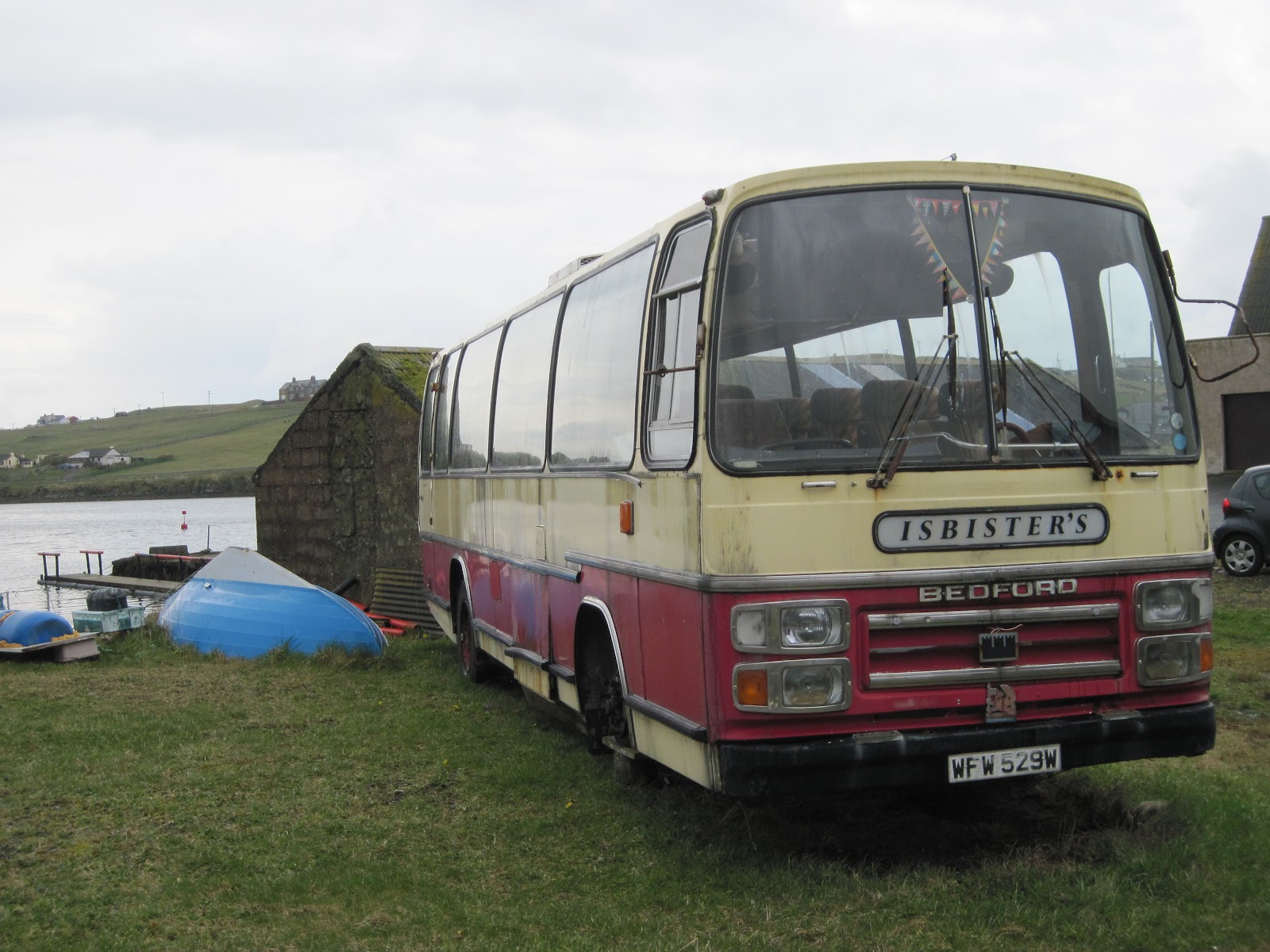
Regular readers of my blog will know I like coming over old buses and tractors on my island voyages. This time round, I not only got to see a lovely old bus (pictured left), but to meet the gentleman (Pat Isbister) who used to drive it and own the company. Pat is the husband of my friend's Cousin Betty, who gave us coffee and cakes and, most wonderful of all, a copy of
the calendar depicting many of their old buses through the years - heaven! The calendar was made for a worthy cause, the
Shetland Stroke Support Group - check them out if you can. And thanks to everyone for their wonderful Shetland hospitality.

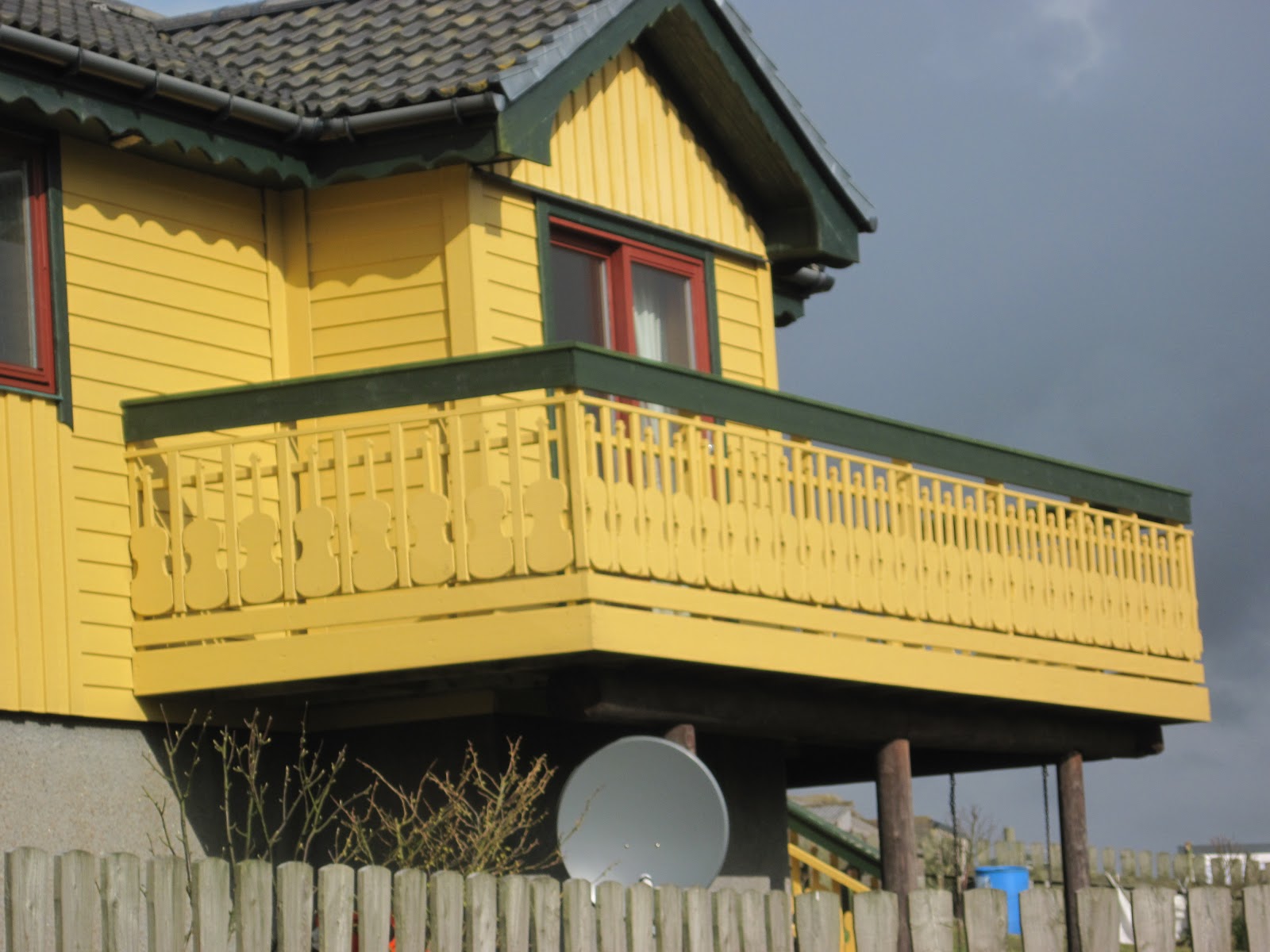
One final thing which I hope will raise a smile is this house, built for a well-known fiddler, proclaiming his passion to everyone who passes by:
 I'm just back from a lightning visit to Iceland. The educational business that took me there and the shortness of the trip didn't allow for too much sightseeing, and my biggest disappointment was missing the Northern Lights which apparently put on a good show on the first night I was there, while I was too ensconced in the hotel bar to notice. It's embarrassing in my profession never to have seen the Northern Lights, but there was at least a certain Northern Cats theme to my visit. The picture shows a sachet of the Icelandic cat food I brought back for my own little friend - notice that even this is marketed using a Viking ship! Iceland has to import quite a lot of things, but I guess all their livestock farming gives them the wherewithal to make their own ekta íslenska framleiðsla fyrir köttinn þinn 'genuine Icelandic product for your cat' from the more unspeakable bits of sheep and cows. I think my own furry friend prefers Sheba, but she didn't entirely turn her nose up at Murr kattamatur.
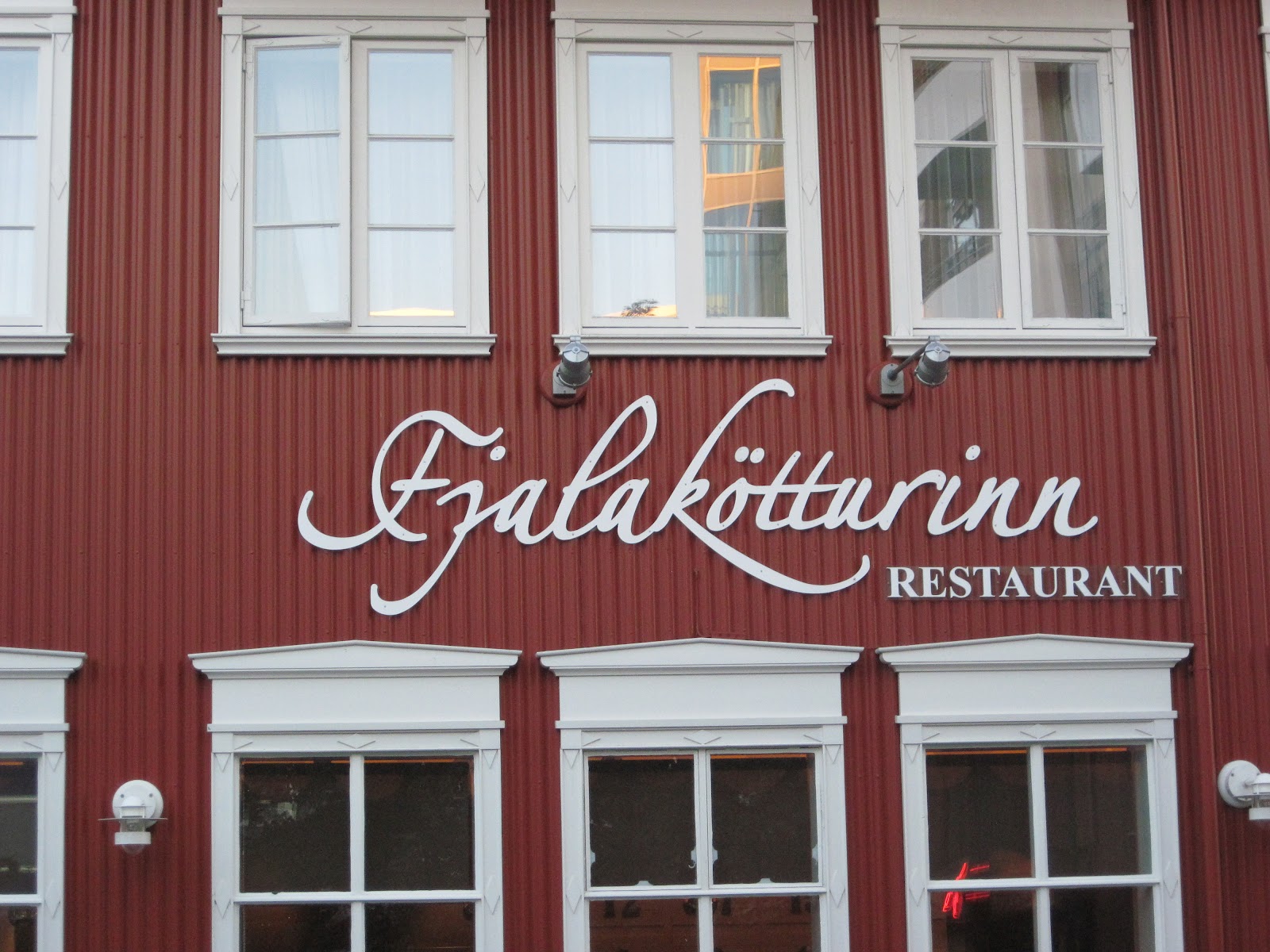 I, too, was well-fed in Iceland, about which the less said the better. More importantly, I photographed, but did not eat at, the splendidly-named restaurant Fjalakötturinn. This word seems to be a variant on the mousetrap-kenning I discussed in an earlier post, where the medieval version was a tréköttr 'wooden cat', whereas this one is better translated as 'plank-cat'. I'm not entirely sure it's the best name for a restaurant, but it's good as ever to see kennings still in use. Apparently, the building is modern, but built on the site of an earlier one with the same name (I haven't been able to discover why), and even earlier there was a Viking longhouse on the site, not surprisingly, as the restaurant is right next to the Reykjavík 871±² settlement exhibition.
 On my last evening I photographed this rather beautiful pussycat (right) on the seashore near my hotel. It is standing in front of a monument celebrating the fact that the football club Þróttur was founded on that very spot. The club's name means 'strength', and some think it is one of Odin's names. The word also appears mysteriously on some rune stones in Sweden, about which I have written recently, but I digress. The spot in the photograph is actually rather interesting, since there are some old (or not even so old) fishermen's huts, known as Grímsstaðavör, still standing (see below, in the romantic gloaming), the last remnants of the fishing heritage of the area before the complete suburbanisation of Reykjavík. What with cats, Norse mythology, ruins and much more, there was plenty to catch my interest in that short evening walk along Ægissíða. Even better than the Northern Lights, though I still hope to see those one day.