29 July 2026

I Wrote This on Ólafr's Day, or the Saint in Runes

Door from Rauland church with runic inscription on the upper iron fitting.
Photo J. Jesch 2023.

Today is the feast day of the holy King Ólafr Haraldsson, who died on this day in 1030 at the battle of Stiklestad and subsequently became both Saint Ólafr and rex perpetuus Norvegiae 'eternal king of Norway'. As a widely-known figure, he not unnaturally appears in quite a few runic inscriptions, in various guises.

There is the heartfelt cry of someone carving 'Saint Ólafr pray for me' into the plaster of the church dedicated to the saint in Simrishamn in Skåne, now in Sweden but then in Denmark, some time in the fourteenth or fifteenth century.

Then there is the curious message on a runestone from Stedje in Sogndal, Norway, which informs us that 'King Ólafr shot between these stones'. Why? Who or what? Where is the other stone? Which of several kings of the same name is referred to? It is most likely our saint, since there is quite a lot of folklore about him doing things in the landscape, which is what this also sounds like. The dating of the stone to ca. 1100 also fits quite well, not too long after he was canonised and his cult spread (which it did quickly).

Almost equally mysterious is the runestick from Bergen which declares that 'Ólafr the holy owns'. Presumably this refers not to the stick but to something more valuable or important, but we do not know what it was!

Probably the most common form of reference to our saint in runic inscriptions relates to the calendar. Today, commemorated as his death date, was a day in the year familiar to everyone, useful to orient yourself when you didn't have a smartphone or even a calendar to tell you what day it was. My heading above alludes to an inscription on a wooden plank found in the church at Angershestra, in Småland, in Sweden. The plank has been extensively damaged by woodworm since it was found in 1910, but we can still read that someone, whose name has not yet been interpreted, 'wrote me on Ólaf's day'.

But one of my all time favourite runic inscriptions is the church door from Rauland in Telemark, Norway. The door is now kept in the store of the Historical Museum in Oslo, where I was lucky enough to have a look at it in 2023. Here it is in transliterated, normalised and translated form, taken from runor.raa.se:

hake ⁓ beanar⁓sun ⁓ a mik ⁓ suæn ⁓ os-(u)-dar⁓sun ⁓ slo ⁓ mik ⁓ osofar ⁓ ræs⁓t ⁓ mik ⁓ auk ⁓ læiste ⁓ oþesndhen ⁓ nesta ⁓ eptir ⁓ olafs ⁓ foku ⁓ a seta ⁓ are ⁓ rikes ⁓ f(o)s ⁓ firþulhs ⁓ hæra ⁓ mahnusar ⁓ norihs ⁓ konohs

 Haki Bjarnarsonr á mik. Sveinn Ás[m]u[n]darsonr sló mik. Ásulfr reist mik ok læsti óðinsdaginn næsta eptir Ólafsvǫku á sétta ári ríkis várs virðulegs herra Magnúsar, Noregs konungs. 

Haki Bjǫrn's son owns me, Sveinn Ásmundr's son hammered me, Ásulfr carved and read me on the first Wednesday after Ólafr's-vigil in the sixth year of the reign of our worthy Sire Magnús, King of Norway.

I love this inscription for the beauty of the object and the insight it gives into all the people connected with making the door (and, presumably, the whole church), as well as the fact that it is one of the few runic inscriptions that dates itself. Working it out, and assuming the king in question was Magnús VII Eiríksson (ruled 1319-43), gives the date of the 31st of July 1325 (and I should have written this blog post last year on its 700th anniversary!). Even more wonderful to my mind is the use of three different types of time reckoning: firstly the day of the week established using óðinsdagr 'Wednesday', incorporating the name of the pagan god (a usage that had been banned in Iceland in the twelfth century); secondly the day and month established in relation to the ubiquitously-known feast day of our saint, Ólafsvaka (modern Norwegian olsok); and finally the year established by the regnal years of the king.

And here, to celebrate the day today, is the part of the inscription that mentions Ólafsvaka (comparing with the texts given above, what you can see is nesta ⁓ eptir ⁓ olafs ⁓ foku ⁓):

Detail of inscription N 179 Rauland, as described above.
Photo J. Jesch 2023.


11 July 2026

Erling's Home

Photo of Bryne by Rune Sattler CC BY 3.0, https://commons.wikimedia.org

One of the most famous footballers today is the still very young Erling Braut Haaland, born in Leeds, but firmly rooted in his home town of Bryne, south of Stavanger, in the Jæren region of southwest Norway. Today's lecture is about his surname.

Like many Norwegians, Erling's surname derives from what was originally a farm-name. According to Wikipedia, his name was originally spelled Håland, which would be the normal modern spelling. Haaland is an alternative, usually older, way of spelling it, which was perhaps adopted by his father when working in Leeds so as not to scare the poor monoglot English with a foreign letter.

According to Rygh's Norske Gaardnavne, there are 31 farms in Norway called Håland or Haaland. The name itself means 'High Land' and it is interestingly quite common in Orkney, too, where it is usually spelled Holland.

Young Erling Braut Haaland grew up in the small town of Bryne, in the municipality of Time. One of the 31 Norwegian farms called Håland or Haaland is actually right on the edge of Bryne, to the southwest, and it is very likely that is where his surname derives from.

And how should it be pronounced? The closest I can get to how an English speaker can get it more or less right is 'Hawlund' ('haw' as in 'jaw' and 'lund' as in 'fund').

There is also a place called Braut, now subdivided into Nord- and Sør- (North- and South-), not far to the northwest of Bryne, which I'm assuming is where his middle name comes from, presumably from his mother's side as is often the custom in Norway nowadays.

So now you know.

The Norwegians Row the Snake

Illustration by Wilhelm Wetlesen for Harald Hardrådes saga, Heimskringla 1899-edition: «Kvinner frå Nidaros står og ser på at skipet vert drive fram med sytti årer.»

Well, tonight is when it happens - Norway meets England in the World Cup. I have already pointed out in a previous blogpost that Erling Braut Haaland's namesake, the eleventh-century Erlingr Skjalgsson, said, before a battle, that 'eagles should fight face to face'. Since he was from the same part of Norway as today's Erling, I am sure that will happen tonight.

A lot of attention has been paid to the 'Viking Row' as practised by the Norwegian fans to encourage the team and by the team itself to celebrate. Indeed, a recent blogpost on the History Extra website by David Musgrove explains the origins of this phenomenon in the fact that (a) vikings did row and (b) they chanted while doing it. Part of the evidence cited is an old article by my PhD supervisor, Dr Richard Perkins (here is a link to a better version of the article, it's on pp. 155 ff.) on rowing chants. Now Richard was mainly interested in arguing that rowing chants were an important influence in the development of skaldic poetry, and particularly the version known as dróttkvætt, the metre in which most of the poetry in praise of Viking Age kings and chieftains was composed. The argument is long and complex but what is relevant here is that some of the poetry describes the rowing process on the way to battle.

Probably the best poem for understanding viking rowing and sailing is by Þjóðólfr Arnórsson, an Icelandic poet who composed in praise of the Norwegian king Haraldr Sigurðarson. Haraldr famously died in England in 1066, at the battle of Stamford Bridge (a non-football connection, that, since it was the one in Yorkshire, not Chelsea). Þjóðólfr's poem, which inspired the illustration above, describes Haraldr's war-fleet. The poem includes the following stanza, as edited and translated by Diana Whaley:

Sorgar veit, áðr slíti
sæfang ór mar strǫngum
herr, þars heldr til varra,
hár sjau tøgum ára.
Norðmeðr róa naðri
neglðum straum inn heglða
— úts, sem innan líti
arnarvæng — með jarni.

Anguish will be felt, before the troop whips the sea-gear [oar] out of the powerful sea, where the oarport holds [each of] the seventy oars in place for the stroke [lit. strokes]. The Norwegians row the snake [ship] nailed with iron on the hail-beaten current; [looking] out, it is like seeing an eagle’s wing from within.

I've always loved that last bit, that looking out of the ship while the men are rowing is 'like seeing an eagle's wing from within' - what a perfect image! It also fits nicely with Erlingr's rallying cry, as noted above, that 'eagles should fight face to face'. The idea of the ship as a snake or dragon is quite common in this poetry, derived, I think, not so much from the dragon figureheads on some ships, but from the slithering flexibility in the water of viking ships.

If Erling Braut Haaland is as interested in his Viking ancestry as seems to be the case, he would do well to read some of this eleventh-century poetry and draw some inspiration from that. So let's hope that tonight the Norwegians do indeed 'row the snake' to victory.

17 May 2026

All Erling Together

Erling Skjalgsson by Theodor Kittelsen (public domain)
It seems to be Erling Haaland weekend. The most famous contemporary Norwegian and footballing superstar's club, Manchester City, won the FA Cup yesterday. Perhaps a premonition of this was an item in the Guardian on Friday (actually in the print version yesterday) announcing that he was to make his acting debut, playing a Viking in a forthcoming film. This item caught my eye, as the film is to be called Viqueens. Have they appropriated my alias, which I have had since 2008? Somehow, the story line as cited doesn't suggest they have read my book on Women in the Viking Age, or even any of this blog:
two courageous Viking girls go from Norway to China. Discovering secrets, becoming proficient with dragon kites, fireworks and kung fu, and realising that friendship’s gifts surpass anything taken from adversaries
Ah well. Actually, I was more interested in another Erling Haaland story not so long ago. Back in March, it was announced that Erling and his dad had bought, and gifted to their home municipality of Time, a 1594 printed version of Mattis Størssøn's chronicle of the kings of Norway. This is a rather free retelling, not a translation, of various kings' sagas and other medieval works. The surviving manuscripts show that the work was completed by about 1570, and the 1594 printed version, published in Copenhagen, has been somewhat Danified, changing some of the Norwegian and Old Norse vocabulary used in the original. Erling H. must know that he shares his name with Erlingr Skjalgsson, also from the district of Jæren, who features in the medieval sagas and so in this work too. Here is a little snippet about Erlingr in the 1962 edition (based on the manuscripts, not the printed version) of Mattis Størssøn's chronicle by Mikjel Sørlie:

My photo, p. 39

There is a brief biography of Erlingr in the Introduction to volume I of Skaldic Poetry of the Scandinavian Middle Ages and I edited a poem in praise of him in the same volume. The poem focuses chiefly on Erlingr's conflict with the Norwegian king, later saint, Óláfr Haraldsson and, unlike his footballing namesake, Erlingr doesn't come out of it well. Still, 'eagles shall fight face to face' in this stanza might be an appropriate war-chant for the young Erling Haaland:
Ǫndurða bað, jarðar, Erlingr, sás vel lengi geymði lystr, — né lamðisk landvǫrn — klóask ǫrnu, þás hann at sig sǫnnum — sá vas áðr búinn ráða ats — við Útstein hizi Ôleif of tók môlum.
Erlingr, who, joyful, ruled the land well for a long time — his defence of territory did not fail — said eagles should fight face to face, when he addressed Óláfr with true words after the battle there by Utstein; he was previously ready to carry out the attack.
I note that the eleventh-century Erlingr was both defender and attacker!


Arkeologisk Museum Stavanger CC BY-NC-ND


Oh, by the way, Happy Birthday, Norway!

19 August 2023

One Day Towards the End of Summer

The following is an extract from something I am working on at the moment - an analysis of the killing of Earl Rǫgnvaldr of Orkney, as reported in chapter 103 of Orkneyinga saga, on the 20th of August, in 1158 (all translations my own):

Replica of a statue possibly of Earl Rǫgnvaldr, Kirkwall, Photo © Judith Jesch 

It was one day at áliðnu sumri 'towards the end of summer' that the two joint earls of Orkney, Rǫgnvaldr, originally called Kali Kolsson, and Haraldr Maddaðarson, sailed over to Caithness to go deerhunting. By the end of the following day, the 20th of August, or five nights after Assumption Day as Orkneyinga saga has it (ch. 103), Rǫgnvaldr was dead and Haraldr was in sole charge of the earldom. For Haraldr, this was the beginning of a very long period of rule which is given rather short shrift in the saga. As for Rǫgnvaldr, it was some 34 years before his holy relics were taken up, ostensibly after some miracles and with the Pope's permission, and he was sanctified, though there is no official record of this. In the Icelandic annals, the death of Rǫgnvaldr is dated to 1158 and his translation to 1192. Discussion of this episode has tended to focus on its implications for politics, both ecclesiastical and secular. Whatever the politics of it all, the episode describing the killing of Rǫgnvaldr in chapter 103 deserves some more detailed attention.

Already the first words of chapter 103 are remarkable enough: 'When Rǫgnvaldr had been earl for twenty-two years since Earl Páll was captured...'. This reminds us that Rǫgnvaldr's grip on the Orkney earldom was consolidated when his rival Páll Hákonarson was eliminated through the actions of Sveinn Ásleifarson (chs 74-75). On that occasion, Rǫgnvaldr managed to keep a low profile despite clearly benefiting from Sveinn's actions. This first sentence is a clear signal that this chapter, too, will result in a similar situation: the reduction of two earls to one, with the survivor escaping any real responsibility for the events.

There is another echo of earlier events in the lead-up to the killing. Chapter 100 tells how Rǫgnvaldr and his eventual killer, Þorbjǫrn Cleric, get involved in a feud between their respective followers which turns violent after some drinking in Kirkwall. This feud was never settled and the implication is that this unfinished business contributed to the events that led to Rǫgnvaldr's death. This episode echoes a longer one back in chapter 61 in which there is a similar feud between followers of respectively Rǫgnvaldr and a Norwegian called Jón, also arising during some drinking, but this time in Bergen. This feud is eventually settled by no less than the king of Norway, who also uses the occasion to grant half of the earldom to Kali and to bestow on him the name of Rǫgnvaldr. This echo of an earlier episode at a crucial moment in Rǫgnvaldr's career serves to suggest that his luck has now run out, that what once served him well will no longer do so. This is further emphasised by two ominous events. On the first night in Caithness, Rǫgnvaldr sneezes, and on the next day when he sees Þorbjǫrn and wants to dismount to engage with him, he unfortunately catches his foot in his stirrup. Both of these are typical saga-motifs of omens signalling the death of the person to whom they happen. Other omens have happened before in the saga: in chapter 29, Rǫgnvaldr's namesake Rǫgnvaldr Brúsason anticipates his own death with the fateful misspeaking '"We will be fully old when these fires have burned out." But what he wanted to say was that they would then be fully warmed up'. And in chapter 47 a wave engulfs Magnús Erlendsson's ship as he is approaching Egilsay where he will eventually be martyred.

Rǫgnvaldr however does not come out of his 'martyrdom' quite as well as his uncle Magnús did. Or at least the story of Rǫgnvaldr's killing lacks the hagiographical tinge that one might expect of a future saint and there are some details which suggest that the narratorial sympathy is not entirely with him. Interestingly, it is Rǫgnvaldr's killer who is presented as a heroic figure in this account. Þorbjǫrn Cleric is the one who manages, despite severe injuries, to leap nine ells across a ditch. The extent of his injuries only becomes clear after his death: 'and when Þorbjǫrn’s wounds were inspected, his intestines had slipped out through the wound that Jómarr had given him'. The wound in question was given right at the beginning: 'And at that moment Jómarr thrust a spear into Þorbjǫrn’s thigh and the lunge continued into his intestines'. After receiving that wound, Þorbjǫrn and his men cross a swamp and defend themselves manfully, Þorbjǫrn makes a long impassioned speech to Haraldr and then jumps across the ditch, and he and his men make for some deserted shielings where again they defend themselves manfully, before eventually Þorbjǫrn expires. No one else in this chapter is said to have defended themselves manfully, certainly not Rǫgnvaldr, but the defence of Þorbjǫrn and his men is twice described this way in the chapter.

Þorbjǫrn's speeches are also extraordinary. In asking Haraldr for a truce, his grounds are that the surviving earl is going to benefit from his crime: 'And this deed that I have done is a great crime, and I am responsible, but all the territory has fallen into your power'. It is only at this point, as Haraldr is dithering about what to do, that some of Rǫgnvaldr's followers intervene and put an alternative argument, emphasising Haraldr's potential role in the killing:

...if Þorbjǫrn is given a truce after this deed and also that he dares to tell you to your face in every word that he had done this evil deed for you or to honour you, it will bring everlasting shame and dishonour to you and all the earl’s kinsmen if he is not avenged. I think that Earl Rǫgnvaldr’s friends believe that you will have for some time been advising the killing of Rǫgnvaldr, which has now happened.'

In the end, Haraldr takes the easy way out, refusing to do anything to Þorbjǫrn but tacitly allowing him to be killed.

Stepping in at this late stage to chase Þorbjǫrn and his men are the sons of Hávarðr Gunnason, including one called Magnús, who made that speech, but it is noteworthy that these supporters of Rǫgnvaldr take no part in the earlier encounters. The only followers of Rǫgnvaldr mentioned when he is first attacked are two complete unknowns, a young Norwegian called Ásólfr who gets petulant when he loses a hand in the fight, and Jómarr, said to be a kinsman of the earl. Jómarr could be said proleptically to have carried out the vengeance for Rǫgnvaldr with his spear-thrust to Þorbjǫrn's intestines which was the ultimate cause of his death. It is therefore odd that he is not more celebrated for this, rather the focus is on Þorbjǫrn for heroically persisting despite such a grave injury.

This reading suggests that the narrative of Rǫgnvaldr's death did not come from his camp. He does not cover himself in glory, but then neither does Haraldr. Indeed, Haraldr's prevarications stand in contrast to the way in which Rǫgnvaldr himself managed totally to evade any responsibility for the elimination of his rival Páll Hákonarson twenty-two years earlier. It has been suggested that the narrative derives from the eyewitness account of the sons of Hávarðr, but as already noted these only come into the story at a slightly later stage. Certainly the close attention to landscape and place-names in chapter 103 does suggest origins in an account by someone who knew the area and perhaps even was present at the events. But the real import of the narrative is in the speeches of both Þorbjǫrn himself, and Magnús Hávarðarson, as cited above. These are both deeply political speeches, encapsulating what must have been a matter of much local discussion, at the time or afterwards, about responsibility and benefit in situations where a leader is ousted.

By contrast, the rather glowing obituary for Rǫgnvaldr in chapter 104 presents him as quite the paragon:

Earl Rǫgnvaldr’s death was much lamented, because he was very popular there in the isles and widely elsewhere. He had been of assistance to many people, generous with money, calm and loyal to friends, a man of many skills and a good poet.

This can presumably be seen as official church or court propaganda, especially since it follows the reference to his translation many years later, and so is likely to represent a later, whitewashed picture. There is little sense of this person in the chapter describing his killing and, as already suggested, Haraldr does not necessarily come off much better either. Chapter 103 resonates with a feeling of 'a plague on both their houses', the response of an exasperated population who is not particularly enchanted with the leadership available to them.

Street named after Earl Rǫgnvaldr, Lerwick. He had connections in Shetland. Photo © Judith Jesch


This is for all 'exasperated populations' around the world....


24 April 2022

On Oak Hill I

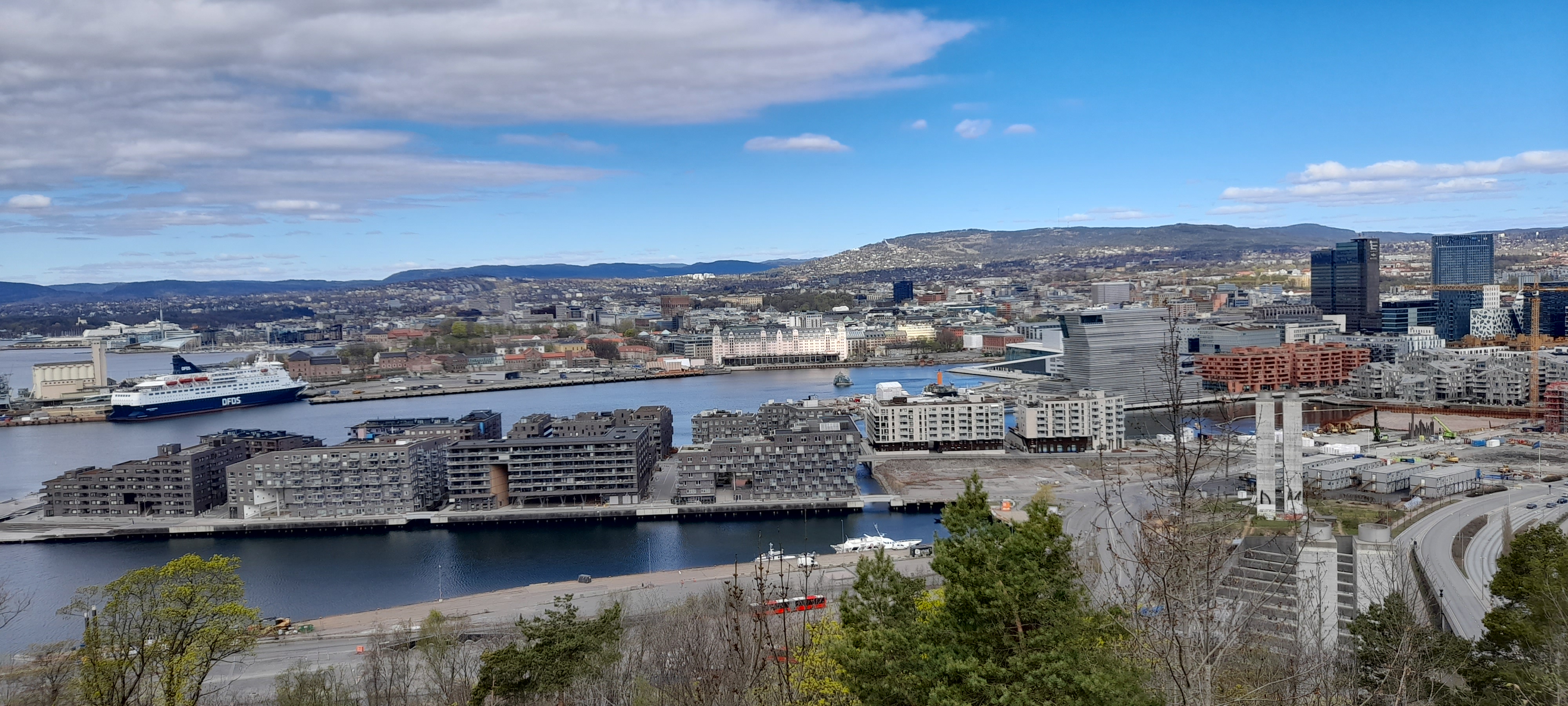
It's good to be in Norway again on Norse and Viking business and today I had a free day in Oslo. I'm almost ashamed to say that despite coming here regularly for many decades and even living here a long time ago, I had never been up to Ekeberg. Until, that is, when, on a previous trip in a brief Covid lull last December (on different Norse and Viking business), our group was taken up there for dinner one night, and a very fine dinner it was too. Seeing what a fabulous view there is from up there of the city, particularly the newer parts of the city in Bjørvika, I decided I really needed to go back up that hill on my next visit. So there I was today in Ekebergparken, on a slightly chilly but still beautifully sunny spring day, ready for both friluftsliv and cultural experiences. And, wow, there are certainly a lot of those!


Today, most of Ekeberg is a part of Ekebergparken, which is primarily a sculpture park, and more about these in a moment. But the area has associations and antiquities from the Stone Age to the twentieth century, all within a fascinating morning's walk. There's a good website explaining it all here. In the Stone Age, the plateau was actually an island, but as the ice receded and the land rose up, gradually it came to be the prominent hill it is today, rising up to 200m. above the sea level of the Oslofjord. There are rock carvings galore, including a helleristning (petroglyph) with hunted animals, and quite a few cup marks, those slightly more boring but still mysterious rock carvings. There are burial mounds, some possibly from the Bronze Age, most probably later, into the late Iron Age (early Viking Age to you and me), all as far as I know still unexcavated. Mostly they are not particularly visible except with the eye of archaeological faith (or expertise). Easier to see are a stone circle (or what remains of one) and a ship setting (ditto, and now reconstructed, as it was destroyed in the war). I particularly liked the way the ship setting was set off by a metal structure drawing attention to it and explaining it, even down to the little ship-shaped holes (click on the photo above to enlarge it and see!). There are dry stone walls from 2000 years ago and a cemetery wall which relates to the second World War. The Germans used a part of the area as a memorial cemetery for their fallen soldiers, with some monumental steps. These steps were removed and replaced with modern steps, and the spot has the most glorious view of the blue Oslofjord. 


Two nineteenth-century houses in the 'Swiss Villa' style beloved in Oslo at the time, and the slightly Art Decoish restaurant from 1929 complete that strong sense of travelling through time. All of these are to be seen in a glorious wood carpeted (today at least) in wood anemones. Now you might just wonder about the name of the place, for Ekeberg (Old Norse Eikaberg) means 'oak hill' but there are very few oak trees about. I could identify spruce and birch, and the lovely (free) museum on the site informed me there are also willow, ash, pine, black alder and maple. Oak is of course a very useful timber and so most of the oak trees which once distinguished the hill enough to give it this name were felled and used to build things. The whole area was opened as a scuplture park in 2013, and there are currently 43 sculptures dotted about along the paths that wind through this wood (as well as a 44th, a horrendous enormous red Santa at the bottom of the hill).


The sculptures are both traditional and modern, and it's fair to say whoever chose them has a fondness for the female form (by both male and female sculptors), as these seem to predominate. There are some pretty big names here, ranging from Salvador Dali to Damien Hirst via Gustav Vigeland, and many other names that even a non-sculpture person like me has heard of. The sculptures themselves are a pretty mixed bunch, as might be expected, but they often appear in unexpected places, or in startling ways that certainly make it an experience to walk around and look at them. Some of the best ones are by female sculptors:  Louise Bourgeois' couple, dangling from the trees, and Tori Wrånes' traveller both surprise and delight, while Ann-Sofi Sidén's self-portrait urinating is more engaging than you might think.


My favourite sculpture though was Sean Henry's 'Walking Woman', slightly larger than life, and confidently striding along the footpath as her slightly smaller real-life counterparts were doing around her.

From the Stone Age to the twenty-first century, with glorious views and a wonderful place for a walk, there is certainly something for everyone here. If you are ever in Oslo at a loose end, I highly recommend jumping on the no. 19 tram to Ekebergparken and checking it all out.

'On Oak Hill II' to follow in due course ...


19 March 2022

Tooley Street Delight


On academic business in London the other day, I chanced upon Tooley Street, just near London Bridge Underground station. Now, I've known about Tooley Street for a long time, but never actually visited it, which was clearly remiss of me, as you will understand below.

Tooley Street takes its name from St Óláfr of Norway, or rather from a church dedicated to that saint, as explained by Bruce Dickins in a classic article in Saga-Book in 1940 (pp. 67-68). As Dickins shows, there are quite a few churches dedicated to the saint in London, but this one is special, since its site is very close to one of Óláfr's youthful exploits, as recorded in the poem Víkingarvísur by the king's Icelandic poet Sigvatr Þórðarson, and edited by yours truly some years ago.

The poem recounts, in a numbered list of battles, the future king's youthful adventures in England and across the European continent.  Stanza 6 is as follows:

Rétts, at sókn in sétta,
(snarr þengill bauð Englum
at) þars Ôleifr sótti
(Yggs) Lundúna bryggjur.
Sverð bitu vǫlsk, en vǫrðu
víkingar þar díki;
átti sumt í sléttu
Súðvirki lið búðir.

It is correct that the sixth battle [took place] where Óláfr attacked the wharves of London; the valiant prince offered the English {the strife of Yggr <= Óðinn>} [BATTLE]. Frankish swords bit, and vikings defended the ditch there; some of the troop had huts in level Southwark.

At the end, he returns to Norway to become king and eventually martyr, Scandinavia's first royal saint, and rex perpetuus Norvegiae (Norway's forever king). 

It is of interest that stanza 6 mentions two specific place-names, giving the location of the battle, firstly Southwark and then the bryggjur of London. I have argued that this does not refer to London's bridge(s), as one might think, but to the wharves of London (as depicted on the cover of the book pictured above; follow the link above to read more about this question, there are also some comments there on the name Súðvirki and on the possible meanings of the word víkingar in this context).

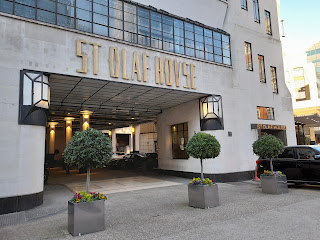
But getting back to Tooley Street, imagine my delight to discover that one part of London Bridge Hospital is the unbelievably splendid (and grade II* listed) St Olaf House. This was built on the site of the old church, which stood until 1737, then was rebuilt and eventually demolished in 1928 to be replaced by this amazing edifice in 1932. It was originally built for the Hay's Wharf Company and became a part of the hospital in the 1980s. It's a lovely example of Art Deco, with lots of gorgeous details and quite a splendid entrance. I'm surprised it hasn't appeared in one of the Poirot episodes (or perhaps it has?).

An inscription on the corner of the building gives a brief history of the site and mentions Óláfr's military activities in the vicinity. However the exact history of all this is difficult to determine. Back in 2013 I wrote: 'Although Óláfr appears to have fought for the English King Aðalráðr (Æthelred) after the death of Sveinn tjúguskegg ‘Fork-beard’ in 1014, Snorri’s claim that Óláfr’s earlier battles were fought in support of him ... is probably erroneous ... His earlier English campaigns seem rather to have been fought alongside Þorkell inn hávi and the Danes ..., and it appears that Óláfr ‘like his friend Þorkell, changed sides and became a supporter of Æthelred’ (A. , 12). The skaldic stanzas do not in themselves clarify who Óláfr’s allies and opponents were, nor exactly where and when he fought; even when they are considered in conjunction with the English and Norse prose sources much remains uncertain ...' And it goes without saying that the idea that Óláfr’s exploits are commemorated in the nursery rhyme 'London Bridge is falling down' is most likely fanciful.

The other corner of the building depicts the royal saint in all his regal majesty, rather than as a young attacker (or possibly defender - the stanza is a bit ambiguous) of a muddy ditch. It is this subsequent saintly and regal figure, rather than the youthful warrior on his gap year abroad, that is commemorated in this very fine building. I'm glad to have discovered it for myself and can recommend it as a must visit for anyone who loves both Art Deco and royal Viking saints....

29 July 2021

St Olaf and Orkney

Doorway in Kirkwall
photo by Judith Jesch
Today is the feast day of Óláfr Haraldsson, king of Norway and saint, who died in battle, killed by his political enemies at Stiklestad, on this day in 1030. He soon became a popular saint in many parts of northern Europe and further afield, as can be seen in some interesting contributions on Twitter today (they tend to turn up every year on this day, and I have been guilty of some blog posts on this theme too). Thus, St Óláfr was venerated in England (Eleanor Parker and Francis Young), Denmark (Steffen Hope) and Ireland. So it is no surprise that he was an important figure in Orkney, too. The doorway pictured is what is thought to be left of a medieval church (possibly from the eleventh century) dedicated to St Óláfr in Kirkwall.

As an important saint and historical figure, Óláfr gets quite frequent mentions in Orkneyinga saga, the text I'm mainly working on these days. That he was considered to have a special bond with some of the earls of Orkney is also clear. Thus, in chapter 29, Earl Rǫgnvaldr Brúsason travels to Papa Stronsay to get some malt for the brewing of ale for the upcoming Christmas feast. While they were sitting by the fire there one evening, 
....he who was stoking the fire spoke about how the firewood was running out. Then the earl misspoke and said this, ‘We will be fully old when these fires have burned out’. But what he wanted to say was that they would then be fully warmed up. And as soon as he noticed, he said this, ‘I have not misspoken before, as far as I remember. What occurs to me is what my foster-father, King Óláfr, said at Stiklestad, when I heard him misspeak, if it ever happened that I misspoke, that I should prepare myself that I would stay alive for only a short time. It might be that kinsman Þorfinnr is alive.’ [my translation]

And indeed, Rǫgnvaldr's uncle and rival earl, Þorfinnr Sigurðarson and his men turn up and make short work of killing him to consolidate Þorfinnr's power.

South doorway
St Magnus Cathedral, Kirkwall
photo by Judith Jesch
The earls of Orkney were often in the habit of killing their kinsmen to ensure their own grip on power. The most notorious example involved the feud between Þorfinnr's grandsons, the cousins Hákon Pálsson and Magnús Erlendsson. The former killed the latter on the island of Egilsay at Easter, creating another much loved Scandinavian aristocratic saint, to whom the very beautiful cathedral in Kirkwall is dedicated, replacing the smaller church dedicated to St Óláfr.

Magnús' connection to St Óláfr is perhaps not quite as clear as that of his father's cousin Rǫgnvaldr, though the saga does connect their deaths chronologically, stating somewhat confusedly that the killing of Magnús happend 74 years after that of St Óláfr (ch. 51) - although we don't know the exact year it happened that is out by at least a decade.

As can be seen from the quotation above, Rǫgnvaldr Brúsason had been present at the battle in which Óláfr was killed, while Magnús in his turn became a saint like Óláfr, his cathedral sponsored by his nephew, also called Rǫgnvaldr, who was in his turn murdered by his political enemies in the interminable internecine warfare of those times. Despite his saintly powers, Óláfr could no more keep his Orcadian earls alive than he could keep himself alive, but it may have comforted these political martyrs that he was on their side. Certainly, through the powers of sanctity and the church they are remembered more than the kinsmen and compatriots who killed them.


03 April 2021

The Tale of the 'Holiday Shocker'


Christine Fell in 1965
from a photo
kindly provided by
Gillian Fellows-Jensen 
One of my most treasured possessions is my copy of Sigurður Nordal's scholarly edition (1913-16) of Orkneyinga saga, which has been my constant companion for over two decades now, ever since I inherited it from my former colleague and friend Professor Christine E. Fell OBE (1938-1998; you can read about her on pp. 214ff. of this link). I have treasured this volume for its mere existence, because this edition is not always easy to get hold of and it is essential to my work on this saga and on Orkney generally. As a result, it's started to get a bit battered. Using it regularly always reminds me that it was Chris who encouraged me to go to a conference in Kirkwall in 1987, celebrating the 850th anniversary of St Magnus Cathedral. It was my first visit to Orkney and so she can be held responsible for my subsequent obsession with the place. But, although I have always been aware that the book has an interesting history, I've only just recently started to explore that history in more detail through the clues in the book itself.

The book bears the mark of Weeks & Co. Binders. London. N.W.1., and it was when it was bound that the letter that explains the book's provenance was bound into it. Loosely inserted into the book (it's a miracle that I still have it) is a small, neatly written note that explains who that letter was from. More on the letter later, but first the note. It is signed (but not dated) by Edith C. Batho. The name rang a faint bell with me, so with the help of Wikipedia, I discovered that she was the Principal of Royal Holloway College of the University of London from 1945-62. There I thought I had a possible connection with Chris Fell, as she got her BA in English from Royal Holloway in 1959, and Batho was an English specialist. Chris Fell went on to do an MA in Old Norse at UCL, awarded 1961, and presumably her interest in the subject began during her undergraduate years. However I have not been able to find any evidence that the two met then, though it is quite possible - in the late 1950s, there were apparently fewer than 400 students in the college. There's a nice painting of Edith Batho in 1961 here and I would like to imagine that Batho had given Fell the book around then, but it could equally have been at a later date. I'm told by an authoritative source that Batho was a regular attender at meetings of the Viking Society for Northern Research until her death, suggesting that she was still interested in Old Norse topics even after her retirement. This could have been where they met if not before and it gives an extended window during which Batho could have given Fell the book, perhaps especially when Chris was the Society's President 1980-82. But I also know that Chris was an assiduous purchaser of secondhand books and had built up an impressive library before her own death in 1998, so she might have bought the book after Batho's death in 1986. At the same time, Chris was keen for her books to be passed on to people who would find them useful, which is how I and some other younger colleagues and students had the privilege of selecting items from her library after her death. I suspect that this attitude reflected her own experience as a grateful young scholar on the receiving end of important books, which is why I like to think she got it directly from Edith Batho, whenever that was.

But why did Edith Batho have this book in her possession? Well, she had a degree in English and, although Wikipedia only mentions her publications on Wordsworth and the Victorians, she also had an interest in Scottish texts. She published on James Hogg, the 'Ettrick Shepherd' (more on this below) and co-edited John Bellenden's 1531 translation into Scots of Hector Boece's Chronicles of Scotland for the Scottish Text Society. And she published an article on Sir Walter Scott and the sagas in the Modern Language Review for 1929. Well, that's more than enough to explain why she might want the edition of Orkneyinga saga, but how did she get it?

The answer is in the letter, which Edith's note explains is from Olivia Stuart Horner, 'my friend for 50 years'. While the note is not dated, the letter is, to '10.11.25', so the note cannot have been written any later than 1975 and could be quite a bit earlier. In 1925, Edith was 30, and Olivia a bit older (the note states that she married Sir Ernest Barker a year or two after writing the letter and the census records that she was baptised in 1891, though elsewhere it is suggested that she was born in 1894). Googling Olivia Stuart Horner certainly gave me a clue to what the letter says about the book. Olivia was the god-daughter of no less than William Paton Ker, a distinguished literary scholar usually known as W.P. Ker, who was himself Scottish and who wrote on both Old Norse and other medieval topics. Among his many achievements was the establishment of the teaching of Scandinavian Studies at University College London in 1917. Olivia was with him when he died on a walking tour of Italy, at a place called Macugnaga.

According to the letter, Olivia is sending Edith what she describes as 'W.P.'s "holiday shocker" as he called it in 1923 at Macugnaga'. The reason she had it was because 'it got among other paperbacked books' which she discovered as her family was moving house. Clearly Edith thought highly enough of this rough paperback (the original paper covers are bound into the back of my copy) to have had it bound in London, with the letter also bound in to indicate its provenance. Olivia notes that 'you are the right person to have it'. This is explained by the fact that not only did Edith get her degree in English from University College London in 1915, while W.P. was Quain Professor of English there, but her book The Ettrick Shepherd (1927) is posthumously dedicated to him. The preface makes clear that it is based on work she did for her MA, and one could surmise that he was her supervisor for it, but then perhaps these things worked differently in those days. I'm wondering if it was W.P. who introduced his promising student to his god-daughter.

W.P. Ker's literary interests were very wide, and when he wrote about Old Norse texts it was usually to place them in a broader literary context. Typical is his inaugural address when he became President of the Viking Society for Northern Research (then still known as the Viking Club) printed in its journal Saga-Book as 'Iceland and the Humanities'. He was very active in the Viking Club during the first two decades of the twentieth century and his obituary in Saga-Book notes that 'The thing for which he cared most was the study of what Scandinavia had given to the world' (p. 410).

Although Olivia Barker is less well-known than the other actors in this little saga, there's actually quite a bit more to say about her and her family, even if it is not especially relevant to my book and its history. She was born in Cheshire, but by the 1911 census was living in Surbiton, and may have spent time in the family's ancestral home of the Manor House in Mells, Somerset. At the time of writing the letter she was, on the testimony of the letter itself, still living in Surbiton but about to move to Sussex. One of her brothers, Maurice, was murdered in London in 1943, a murder that was never solved. Another, David, wrote a novel based on this murder and was the long-term partner of no less than Osbert Sitwell.

I still need to find out whether the Scot W.P. Ker had a particular interest in this 'Scottish' saga, or whether he was just omnivorous when it came to Old Norse-Icelandic literature. So far I have not discovered any specific references in his works (but there are very many!) to Orkneyinga saga, but maybe he was reading it for the first time on that fateful Italian holiday. After all, it had only quite recently been published. So there may still be more to be found out about my treasured book. In the meantime, I'm delighted to have learned a bit more about its adventures.

So it's wonderful to think that my copy of this book has been to northern Italy with W.P. Ker, sat on the shelves first of Edith Batho and then of Christine Fell, and here I've been bashing it about for 20-odd years. I really must take better care of it! And from a personal point of view, I am delighted that this book links three Past Presidents of the Viking Society (Ker, Fell and myself) and three women scholars (Batho, Fell and myself), and that it is all down to Olivia Stuart Horner's clearout.

08 March 2021

International Women's Day


For International Women's Day it is always useful to remind ourselves that, even in the Viking Age, women were approximately half of the population. There seems to persist an idea that both Vikings and everything that went on in the Viking Age were somehow entirely a masculine domain. Naturally, I have been trying to nuance this picture for at least thirty years (this year being the anniversary of my Women in the Viking Age (1991), still to my amazement in print after all this time. I suppose it is still useful to people though I hope my ideas have moved on a bit since then.

Although I haven't been publishing on this topic too much recently, I still often get asked to talk about it, or write in a popular context. So here are some links to what I have said or written about women and other female figures in the Viking Age during the last few years:

  • 'In Praise of Queen Astrid' 10-minute talk from the British Academy (March 2021)


[the image above is how the late nineteenth-century artist Christian Krohg envisaged Queen Astrid's speech at the Swedish assembly, public domain via Wikimedia Commons]

  • ‘Inghen Ruaidh, the Birka Grave and Viking warrior women’ podcast on Not What You Thought You Knew with Fern Riddell and guests (September 2020)


  • ‘Valkyries: Fierce women of war’ on BBC World Service, Forum with Bridget Kendall and guests (July 2020)


  • 'Viking women at home and at war', History Extra (March 2019)

 https://www.historyextra.com/period/viking/vikings-women-home-matriarchs-traders-artisans/


For those particularly interested in shield-maidens, I do have an article forthcoming in the journal Viking. 

29 November 2020

If You Want to Listen

Shameless self-promotion has not generally been the main purpose of this blog. I've tended to aim for the slightly quirky, or even personal, just recording things that I have found interesting. But I have also enjoyed bringing to light various Norse and Viking things that I have observed in my studies or my travels. And every once in a while I am minded to comment on books or other phenomena from the academic world of Viking studies. Over the last few years (and especially during the pandemic) I have increasingly been doing this in the form of podcasts and other audio discussions or interviews. While my preferred medium is still the written word, I have noticed that more and more people seem to like listening to something more than reading something (and unlike reading it's something they can more easily do while doing something else). So I have enjoyed this way of communicating with people who might not otherwise read anything I have written. The audio experience is also different from this blog (and from much of what I write) in that in these contributions I am not necessarily following my own nose but more likely responding to questions or topics suggested by those who produce them, and this can force me to look at things differently.

So, for those who think this blog has been a bit thin of late, or who can't be bothered to browse in it, here are some links to the things that I have been broadcasting to the world in recent times, in reverse chronological order:

The Viking Diaspora - podcast interview with two of the guys who run the Seven Ages website, 'Exploring History, Archaeology, Science and Culture' (November 2020)

Inghen Ruaidh, the Birka Grave and Viking Warrior Women Not What You Thought You Knew with Fern Riddell and one other guest (September 2020)

Valkyries: Fierce women of war BBC World Service, Forum with Bridget Kendall and two other guests (July 2020) 

Everything you ever wanted to know about the Vikings, but were afraid to ask History Extra podcast with David Musgrove (May 2020)

The Danelaw In Our Time BBC Radio 4 with Melvyn Bragg and two other guests (March 2019) 

Runes: The Vikings in their own Words  on The History of Vikings podcast with Noah Tetzner (October 2018) 

By the way, the title of this blog post is a quotation from the first stanza of Háttalykill 'Key of Metres' by Earl Rǫgnvaldr Kali Kolsson and Hallr Þórarinsson, ed. by Kari Ellen Gade for the Skaldic Poetry of the Scandinavian Middle Ages project.


19 September 2020

The Children of Ash and Elm

In what now seems like a completely other world, less than a year ago I wrote a blog post listing some recommended Viking reading. If I had been writing that blog post now, I would certainly have had to consider this very recent offering (it was published last month), all 599 pages of it, with the rather curious title The Children of Ash and Elm and the more prosaic subtitle A History of the Vikings. This book is by Neil Price, one of the best-known Viking specialists working today. He is professor of archaeology at the University of Uppsala in Sweden, and leader of a massive 10-year project called The Viking Phenomenon. By any account, this book, one of the outputs of that project, deserves serious attention.

I have to admit that not long ago I declined an opportunity to review the book, though this was only for practical reasons and not from any disinclination. Since then no one else has asked. So I thought I'd share some thoughts here. In fact, I rather like the freedom of writing as many (or as few) words as I like, and not having to follow the conventions of book reviews, or worry about who I was writing for, or explain the book to those who haven't read it and are wondering whether they should or not (the short answer is yes, though there's a longer and more complicated answer below). So this is not a review. Just some thoughts, mainly on those aspects of the book which particularly interest me, and which may or may not be of interest to others.

The first thing to note is that not only have I read it, but I have read it carefully and in its entirety and enjoyed doing so. You might think this goes without saying, but I can assure you that when it comes to popular or trade books about the Viking Age, this is very rarely the case for me... Too many books about the Vikings, aimed at a general audience, just say the same old things, in the same order, and in the dullest possible way. They might have their uses in providing the basics for those who know nothing, but I can rarely get past the first few pages... I assume this one is intended for a wide audience, as it is published by Allen Lane and will I guess eventually become a Penguin paperback, presumably to replace Else Roesdahl's The Vikings, which has now been around for quite a long time. So the very fact that I enjoyed reading it, and with attention, tells you a lot. However, its destiny as a popular book also makes it a bit difficult to review. How much should we expect of it? Who is it really for? We all know that it is really hard to encompass the whole of the Viking Age without making some mistakes, but how significant is that in this context? Does anyone care? I'm always being told that our first priority is to engage as well as inform the general public. But how far do we go in this process?

Well, this book is certainly very engaging. So what do I like about it? A variety of big and small things. Most important to me is how Neil's love of his subject shines through every word on these 599 pages. Here is someone who likes Vikings and the Viking Age a lot, as much as I do, almost certainly even more than I do, although probably for very different reasons. He resists the dreary tendency of some archaeologists to insist on the calling it the 'Viking period' and instead argues cogently (p. 9) for the validity of the notion of a 'discrete Viking Age'. He even admits that he is 'promoting the Vikings' worldview' (p. 26), something that sounds potentially dangerous these days. But it's not sinister, rather it is clear that his aim is deep understanding, an attempt to get inside the skin of the Vikings. Overall, I like this attitude. This is not a book for those who want battles and bling, rather I see it as an attempt to work out what motivated battles and bling (and of course much else).

Another good thing is that some of the book is about the centuries before the Viking Age, a period which is given a variety of names in different archaeological traditions (usefully tabulated on p. 66) and which is less well studied outside the circles of Scandinavian archaeology than the Viking Age itself. Very few books about the Viking Age consider this preceding period in any detail and it is illuminating to see both the continuities and the changes. In fact, you could argue that the author's idea of a 'discrete' and in many ways unified Viking Age is justified by that very contrast with the preceding period, with its multiple monikers and lack of a unifying narrative. Despite his over-fondness for Beowulf and the sixth-century 'dust veil', this focus on the pre-Viking period is still an important aspect of this book. I would also say the author is generally good on religion, even if I shudder at his adoption of the term 'religiolect' (p. 207), or when he overstates the evidence for worship of the Norse deities in England (p. 408).

I am of course very pleased that the author recognises the usefulness of the concept of 'diaspora' in understanding the Viking Age - this word is the title of the whole of chapter 13. Unlike many others, he is also alert to the fact that it is a difficult word to use and needs explanation and exploration rather than just appropriation (see especially pp. 363-5 and 555).

So, overall, this is a book which has many new and interesting things to say about Vikings and the Viking Age and already for that reason it is well worth reading. It's also a book which stimulates both thought and occasional disagreement, and I wouldn't be me if I didn't have some Thoughts about some of what Neil says.

The book is definitely the product of an archaeologist's mind, as indeed his predecessor Else Roesdahl's is. Allen Lane/Penguin still seems to belong to the class of publisher who believes only archaeologists are qualified to write about this topic. However, Neil is one of those archaeologists who is not only not embarrassed to use Old Norse texts to help understand his subject, but is also pretty knowledgeable about them. Indeed he has been supporting his archaeological interpretations with textual evidence for most of his career. This is laudable, but has some dangers. I have sometimes noticed that not only MA dissertations and PhD theses but also papers by more senior archaeologists have a tendency to use his work as a primary source to access these texts. While it is understandable that archaeologists cannot also be textual specialists, I think there is still some educating to be done here. But that is not this author's fault, rather that of those who use him in this way. This book is upfront about its use of sagas in particular, more than once urging its readers to 'read the sagas' - which can only be a good thing. I'm also totally with Neil when he notes (p. 23) that 'skeptical literary researchers' are probably too skeptical since they do not explain where all the Viking Age material in the sagas comes from, though his own justification (e.g. p. 222) is a bit thin. Let's by all means have more exchange and discussion of this topic which is sorely needed.

So I am disappointed to have to say that this book is not a particularly good advertisement for the use of sagas, or indeed any old texts, in archaeological narratives. At the most basic level, there are too many errors, often of a linguistic variety. So not only are we introduced to those weird Anglo-Norse hybrid dynasties the 'Ynglingas, Skjöldungas, and Völsungas' (p. 92) but, even more egregiously, the Saga of the Ljósvetningas (p. 160). I think our author has been reading too much Beowulf and not enough sagas. Constantine Porphyrogenitos' De Administrando Imperio is, despite the title, written in Greek not Latin (p. 366). Miðjarðarhaf  is a literal translation of 'Mediterranean Sea' and nothing to do with Miðgarðr (p. 374). A few such errors are forgivable but there are a little too many for my taste. Especially because they could easily have been eradicated by asking someone who knows about these things to read through the manuscript. But despite two pages of Acknowledgements to the Great and the Good of Norse and Viking Studies (pp. 574-6), this appears not to have been done, at least not successfully. The hubris of thinking you know everything affects us all in the end...and it's those who really do know a lot who have to be particularly careful. (I'm looking at myself here, too).

Similarly, some of Neil's reading of Old Norse texts is at least debatable and sometimes just wrong. On p. 55, he conflates without notice the texts of the poem Darraðarljóð and the prose narrative of Njáls saga in which it is cited. This is a pity for the argument because many people believe the poem is a genuine Viking Age product, while the saga definitively is not, and is therefore unlikely to be a reliable guide to what the poem really means. (I've more than once heard archaeologists at conferences claim they are citing the saga when in fact they are using the poem - when making a point about textiles, for example, this is an important distinction). Individual texts are in danger of being overinterpreted. Thus, Neil says (p. 110) that  Rígsþula 'describes an elaborate high-status wedding with fine linens and much ceremony',  but there is no such thing, only a very sketchy reference in st. 38 (40 in Larrington's translation) to Erna marrying Jarl and wearing linen. On the same page, he refers to the 'impotence' of Hrútr in Njáls saga, whereas most readers would I think say this character's marital problem was too much potence. We're told that 'sagas and poems are utterly saturated in magic' (p. 221). Well, yes, there is a fair bit of magic in these texts but 'utterly saturated'? Not in my experience. 'Professional mourner' is an odd concept to link to the Eddic heroine Guðrún (p. 253) in a context in which it is clear that she is mourning her own daughter - surely a genuine tragic figure rather than a hired weeper. It all smacks a bit too much of making the evidence fit the argument.

Runes are also not well-represented in this book, despite many of them being, unlike the sagas but like some poetry, contemporary texts from the Viking Age or earlier. It's disappointing when the author misses several opportunities to mention that important archaeological finds he discusses actually have runic inscriptions on them, such as some of the pre-Viking weapon deposits at Illerup (p. 70). Even more scandalously, the carved stones of the Isle of Man are mentioned for their Christian iconography beside images from Old Norse cosmology (p. 417) without any reference to their (more frequent, but perhaps less obviously exciting) runic inscriptions. Two Swedish rune-stones which Neil alleges (p. 112) provide evidence for men having two wives simultaneously are not only rather slim evidence for polygyny but could also be read in a variety of ways, even before we consider the problems of using these laconic inscriptions to write social history. And no, Ingibjörg did not have 'sex with me when I was in Stavanger' (p. 192). The medieval (not Viking Age) Bergen rune-stick N B390 M says that Ingibjörg unni mér þá er ek var í Stafangri or 'Ingibjörg loved me when I was in Stavanger'. You might argue that the verb unna is a euphemism here (though not always in runic inscriptions where it does seem to indicate romantic love). But I would argue that is interpretation which needs to be argued for, ideally with a consideration of how the word is used in other contexts. In this context, what is needed rather is just to get the translation right. Norse-speaking people are not known for euphemisms and did not shy away from the f-word when they needed it, as can be seen from several runic inscriptions including a famous one in Maeshowe (also post-Viking Age). 

Any one of these slips, individually, is not significant on its own, but there are rather a lot of them when it comes to the texts. What is more concerning is the overall pattern, of exaggeration and dramatisation, of literally sexing up things that were originally perhaps more mundane. Too much of this ends up with a slightly cartoonish view of the Vikings which both feeds into and panders to the ways they are portrayed in popular culture. Boring as I am, I would argue that the Vikings are fun enough without having to exaggerate what they were up to, they don't need all this showmanship. The end result is that the book sits very uneasily on the border between scholarship and yet another 'popular' version of the Viking Age. This is a worrying tendency in several aspects of Viking studies today, one example being the controversial Viking display at the National Museum of Denmark, though this book is not I think in that league, mercifully. And yet many people will regard this book as the 'defnitive' view of the Viking Age (as can be seen from both journalistic reviews, and consumer reviews on Amazon). Once again, the drive to 'engage' the public seems to be at the forefront of all public-facing scholarship and is in danger of overshadowing the actual scholarship.

This popularising tendency may be responsible for the author more or less ignoring certain forms of evidence which are not so easily tied into a colourful narrative (though others do manage it). So, place-names, a really important source of evidence, get very short, and sometimes inaccurate, shrift. It is simply not true that there are 'no non-Norse place-names in the Hebrides' (p. 404). I wonder if the author meant the Northern Isles in this instance, but even there this is not true. According to him, place-names provide the 'greatest evidence for the Scandinavian presence' in Normandy, 'as in several areas in the British Isles' (p. 419), but this point regarding the latter (and especially England) is not taken up elsewhere. The author could, I would suggest, also do with reading up on some of the recent (and older) discussion about the  name of Norway which I,  in agreement with others, no longer believe means the 'North Way' (p. 86). It's perfectly understandable that this is an area in which our multi-talented archaeologist author feels less confident, but I would really have liked to have seen more about this in a 599-page book which calls itself 'A History of the Vikings'.

Even in areas where he is more knowledgeable, the author is not always entirely reliable. I didn't know that ringed pins were a 'uniquely Norse invention' (p. 135) and I doubt it, but admittedly that's not my area of expertise. Snaptun (the find location of a carving beloved of my students which ostensibly shows Loki with his mouth sewn up) is not 'near the Norwegian border' (p. 136) - Denmark does not share a land border with Norway. It did in the Middle Ages, but that is still not where Snaptun is. I do wonder how we can be sure that Sámi traditions recorded in early modern times go back to the Viking Age and beyond (p. 89). This could well be true, but I'd welcome some comment on the question, especially in light of the author's semi-skepticism about the (earlier-recorded) sagas. His disappointingly brief comments on genetic research (p. 381) add nothing to what is an important and current discussion.

So, despite the stated commitment to interdisciplinarity, and a voluminous bibliography (in which I have happily discovered many items I knew nothing about), I'm not convinced that the author has fully digested everything he has read, especially in other disciplines. The saga-references in particular read a bit like someone who once read a saga some years ago and is retailing it from memory. Personally, I do not mind these errors, they are easily made and I can recognise them and filter them out. I can also tell when the narrative slips from fact to speculation and I for one enjoy speculation even when I do not fully agree with it, because it stimulates thought. A case in point is the author's new-found conviction that the Vikings were non-binary or queer, which seems a bit tacked on here and there to a narrative which otherwise still assumes a highly gendered society (my considered views on shield-maidens will, I hope, be published elsewhere soon, in the meantime you can get an idea from this recent podcast). The speculation is not always signposted though careful reading will reveal it. But I do wonder how many students and less experienced readers will look at the range of evidence cited and assume the author is equally expert in all of it. And then continue to cite him, rather than the original sources, for literary and linguistic detail... I'm almost tempted to say that you should study the Vikings for a few years before reading this book - you'll get more out of it and not be led astray. But is this the right kind of book for The Penguin Book of the Vikings? I'm already dreading some of Neil's more colourful exaggerations turning up in student essays for years to come.

Despite these disappointments, I do still really like this book. I hope it is recognised that engagement at this level of detail is a form of praise for this book - there are very few books I would take so much trouble to write about, especially in this informal way. I fantasise that I could even use this slightly uneven character of the book to train students in distinguishing between old news, new news and fake news, but it wouldn't be easy. The narrative is, I imagine, pretty seductive to those (almost everyone) who have less knowledge than Neil Price.

To end on a more positive note, the book has some insights or generalisations that are sufficiently interesting and provocative that I want to take them away and really chew over them, which is one reason I like this book. While it should not always be taken literally, the following random selection of observations shows some of the ways in which this book successfully stimulated my thought processes at least:

  • 'trickster ... nomenclature may not help in understanding [Loki] from the point of view of the Vikings themselves' (p. 46)
  • 'The mythology of the Vikings is one of only a tiny handful in all world cultures in which the divinities also practised religion' (p. 50)
  • [with reference to the Migration Period, but also relevant to the Viking Age, and here's looking at you 2020] 'Some were fleeing, and others were those they fled from. Most were looking for economic security, safety, and a quieter life while a powerful minority were trying proactively to shape a world more to their liking' (p. 68)
  • 'it is the man's gender that was limited and intensive, while the gender of women was to a degree unlimited and extensive' (p. 172)
  • 'the Rök stone ... was deeply socially embedded (and visible) in a way that the book cultures of the Continent never wished to be' (p. 195)
  • the importance of planning and preparing for Viking expeditions (p. 308)
  • the 'armies' in England were 'continuously evolving migratory communities' (p. 339) or 'armed family migrations' (p. 357)
  • 'There is little evidence of racism in Viking society' (p. 398)
  • 'the Vikings live on today primarily as tourist magnets, as the draw of heritage trails and "experiences". The Scandinavians of the Viking Age were acutely concerned with memory; they might have been happy at this.' (pp. 498-9)