Showing posts with label Sweden. Show all posts

29 July 2026

I Wrote This on Ólafr's Day, or the Saint in Runes

Door from Rauland church with runic inscription on the upper iron fitting.
Photo J. Jesch 2023.

Today is the feast day of the holy King Ólafr Haraldsson, who died on this day in 1030 at the battle of Stiklestad and subsequently became both Saint Ólafr and rex perpetuus Norvegiae 'eternal king of Norway'. As a widely-known figure, he not unnaturally appears in quite a few runic inscriptions, in various guises.

There is the heartfelt cry of someone carving 'Saint Ólafr pray for me' into the plaster of the church dedicated to the saint in Simrishamn in Skåne, now in Sweden but then in Denmark, some time in the fourteenth or fifteenth century.

Then there is the curious message on a runestone from Stedje in Sogndal, Norway, which informs us that 'King Ólafr shot between these stones'. Why? Who or what? Where is the other stone? Which of several kings of the same name is referred to? It is most likely our saint, since there is quite a lot of folklore about him doing things in the landscape, which is what this also sounds like. The dating of the stone to ca. 1100 also fits quite well, not too long after he was canonised and his cult spread (which it did quickly).

Almost equally mysterious is the runestick from Bergen which declares that 'Ólafr the holy owns'. Presumably this refers not to the stick but to something more valuable or important, but we do not know what it was!

Probably the most common form of reference to our saint in runic inscriptions relates to the calendar. Today, commemorated as his death date, was a day in the year familiar to everyone, useful to orient yourself when you didn't have a smartphone or even a calendar to tell you what day it was. My heading above alludes to an inscription on a wooden plank found in the church at Angershestra, in Småland, in Sweden. The plank has been extensively damaged by woodworm since it was found in 1910, but we can still read that someone, whose name has not yet been interpreted, 'wrote me on Ólaf's day'.

But one of my all time favourite runic inscriptions is the church door from Rauland in Telemark, Norway. The door is now kept in the store of the Historical Museum in Oslo, where I was lucky enough to have a look at it in 2023. Here it is in transliterated, normalised and translated form, taken from runor.raa.se:

hake ⁓ beanar⁓sun ⁓ a mik ⁓ suæn ⁓ os-(u)-dar⁓sun ⁓ slo ⁓ mik ⁓ osofar ⁓ ræs⁓t ⁓ mik ⁓ auk ⁓ læiste ⁓ oþesndhen ⁓ nesta ⁓ eptir ⁓ olafs ⁓ foku ⁓ a seta ⁓ are ⁓ rikes ⁓ f(o)s ⁓ firþulhs ⁓ hæra ⁓ mahnusar ⁓ norihs ⁓ konohs

 Haki Bjarnarsonr á mik. Sveinn Ás[m]u[n]darsonr sló mik. Ásulfr reist mik ok læsti óðinsdaginn næsta eptir Ólafsvǫku á sétta ári ríkis várs virðulegs herra Magnúsar, Noregs konungs. 

Haki Bjǫrn's son owns me, Sveinn Ásmundr's son hammered me, Ásulfr carved and read me on the first Wednesday after Ólafr's-vigil in the sixth year of the reign of our worthy Sire Magnús, King of Norway.

I love this inscription for the beauty of the object and the insight it gives into all the people connected with making the door (and, presumably, the whole church), as well as the fact that it is one of the few runic inscriptions that dates itself. Working it out, and assuming the king in question was Magnús VII Eiríksson (ruled 1319-43), gives the date of the 31st of July 1325 (and I should have written this blog post last year on its 700th anniversary!). Even more wonderful to my mind is the use of three different types of time reckoning: firstly the day of the week established using óðinsdagr 'Wednesday', incorporating the name of the pagan god (a usage that had been banned in Iceland in the twelfth century); secondly the day and month established in relation to the ubiquitously-known feast day of our saint, Ólafsvaka (modern Norwegian olsok); and finally the year established by the regnal years of the king.

And here, to celebrate the day today, is the part of the inscription that mentions Ólafsvaka (comparing with the texts given above, what you can see is nesta ⁓ eptir ⁓ olafs ⁓ foku ):

Detail of inscription N 179 Rauland, as described above.
Photo J. Jesch 2023.


17 December 2019

Viking Warrior Women - More of the Same? II

Reproduction dice and a gaming piece
made by Adam Parsons
(c) University of Nottingham
CC-BY-4.0
In my previous blog post, I looked at two recent television programmes on this perennially popular topic. I found a few things to like but on the whole concluded that the programmes were still very much driven by a strong desire to prove at all costs that there really were Viking women warriors (without really defining what those might have been). I also came to realise that what is essentially an academic debate was being carried out in the televisual sphere rather than in more academic fora, to the detriment, I think, of the discussion. Basically, when a TV programme has a particular message to sell (as both of those did), there is no real discussion, apart from a few knee-jerk references to 'debate' and 'controversy', which are not explored. I'm not even sure I think there's that much of a controversy, so one-sided have most of the discussions been - these are straw men to stir up interest in the programmes. What there certainly hasn't been is any nuanced discussion of the fragmentary, ambiguous and complex evidence, let alone the challenges of defining our terms, and reaching conclusions through interdisciplinary explorations.

I've never denied the possibility of female Viking warriors and, in case anyone still believes I am a warrior-woman denier, they should refer to what I wrote in 2015, even before the current discussions blew up in 2017 (The Viking Diaspora, pp. 104, 107):
...people in the Viking Age and its aftermath were perfectly capable of imagining women as warriors, or at least as imagining them carrying and using weapons, whether this occurred in real life or not. Doubtless it did occur in real life, since human beings are capable of most things, whether or not it is considered 'normal' for them to do so, but the strong emphasis on gender distinctions in Viking Age society already outlined suggests that it did not happen very often.
... that the very few women buried with weapons were warrior women in life seems the least likely explanation of all. 
I may have moved slightly on the last point, but not that much. But really, being the nerd that I am, what I am most interested in is not the answers but the questions. I'm fascinated by the past because we know so little about it, we have to piece things together using, as I have just said, fragmentary, ambiguous and complex evidence. I also relish the challenges of defining terms, and of interdisciplinary explorations. And there is no doubt that such things are hard to put across in a television show. Which doesn't mean we shouldn't try. And I was heartened to come across yet another Swedish TV programme on Viking women warriors that shows signs of a more nuanced approach than the ones I discussed in my previous post. Even though it takes its starting point in the Bj 581 burial, and features some of the same experts as other shows, and despite its oddly provocative title, it does seem to be moving slowly towards that kind of more nuanced (and much more interesting) discussion that I have been looking for all along.

The programme was first aired in October and comes from the series Vetenskapens värld 'The World of ???' Unfortunately, we don't have an English word for vetenskap (as for German Wissenschaft). Although a literal translation would pick up on the root (from veta 'to know') and translate it as 'knowledge', it is a bit more than that, implying science, scholarship and all those kinds of things that go on in universities (sometimes), and sometimes elsewhere too. The actual programme is called 'Sanning i sagorna?' or something like 'Truth in the sagas?' but again it doesn't translate well since the 'sagor'  of the programme go beyond what we tend to think of as the (Icelandic) sagas. In this case, the anonymous Old English Beowulf, the Latin-writing Dane Saxo Grammaticus and the Byzantine historian Skylitzes all get a mention, and I would call none of their works sagas. So that is stretching it a bit, but despite the title, the programme takes an intelligent approach, at least to the female warrior question.

My advice is to skip the first 40 minutes of the programme (some self-indulgent stuff about Beowulf not relevant to my topic today) and just watch the last 18 minutes which takes up the question of Viking women warriors again, in supposed contrast to the 'masculine world' of Beowulf. After a brief repetition of the scientific identification of our old friend Bj 581 as a woman, the camera shows Tommy Kuusela, identified as a historian of religion at Uppsala, w ith quite a pile of books. The voiceover states by way of introduction that there are a lot of 'more or less' trustworthy textual accounts of female viking warriors. Kuusela reads out the usual bits of Saxo, and then the relevant bit of Skylitzes, which the voiceover narrator claims is more more reliable than Saxo because written down in the 11th century (not quite correct, but I'll leave all that pesky detail for another occasion). But when challenged about the textual basis for Viking warrior women, Kuusela admits that there is no 'certain' evidence. This is then immediately contrasted with Charlotte Hedenstierna-Jonson claiming that the evidence of Bj 581 is 'certain' evidence for female warriors. But interestingly she straightaway modifies this by emphasising that this evidence does not mean that this was a common phenomenon. Also, unlike some other presentations, the programme recognises that the evidence could potentially be undermined by some of the find circumstances in which the bones might have been mixed up. Even though the osteologist Anna Kjellström reassures us that the remaining bits of the skeleton do in fact belong together and are from the right grave, it is still interesting to see these various admissions of potential uncertainty.

There then follows a bit in which our heroine the presenter sets out to demonstrate what might be required physically of a female Viking warrior by meeting a combat trainer. Compared to a similar episode in the National Geographic programme, this seems much more realistic and the presenter concludes that it was not that simple to become a female viking warrior after all. The emphasis is very much on the physical training that would have been required to wear all that armour and swing those weapons, not to mention wielding the shield. This leads into the point that the Bj 581 skeleton shows no traces of such physical training, or indeed of wounds that might have come from fighting. Kjellström does point out the fragmentary nature of the evidence, that not much of the skeleton survives, so we cannot say for sure, but again it's good that these counter-arguments are aired. Back to Hedenstierna-Jonson and we get once again the argument that the playing pieces suggest someone whose role in war is a strategic one, as a senior officer, for example. The suggestion is made that the nature of the grave-goods suggest a member of the elite and that it was such elites that could 'break the gender mould'. Hedenstierna-Jonson brings up the parallels of patriarchal societies where women could nevertheless rule because they belonged to a particular dynasty (presumably she is thinking of the likes of Benazir Bhutto).

It is then proposed that the spear in the Bj 581 burial was a kind of ticket to Valhalla for the deceased, but, importantly, it is stressed that this does not mean that she actually participated in battle in life. Kuusela's concluding suggestion is that she was the wife of a military leader who accompanied him on his expeditions (here I'm reminded of Admiral and Mrs Croft in Jane Austen's Persuasion) and who was buried in this way to follow him in the next world too. I'm not sure I really buy that argument, partly for lack of evidence of women in Valhalla (apart from valkyries, but they're another story...), but it's a thought.

Just when you think the programme is over and the credits roll, there's a curious postscript. Our friend Leszek Gardeła pops up again and gives a better brief summary of the Åsnes burial than in the National Geographic programme (where it was supposedly a centrepiece), and, unlike there, with at least a hint of why the skeleton has been identified as female (it is slight and gracile). On being questioned about the Birka burial, Gardeła admits that the lack of trauma on the skeleton complicates the warrior interpretation, and that gaming boards might have had other meanings than indicating military commanders or strategists.

All in all, I would say there is some considerable backtracking going on in this short programme from the original bombastic claims of 'A Female Viking Warrior Confirmed by Genomics' back in 2017. There is some recognition of potential problems with both the physical and the textual evidence, there is an emphasis on what being a 'warrior' (however that is defined) involves by way of training, and there are alternative suggestions put forward as to why a woman might have been buried with what is traditionally regarded as male equipment. And all in 18 minutes. Well done Vetenskapens Värld.

Viking Warrior Women - More of the Same? I

MM131 Andreas II
Viking Age runic cross from the Isle of Man,
commemorating a certain Arinbjǫrg
I never for a moment thought the fascination with the possibility of female Viking warriors would go away. After all, I have already argued that this fascination goes back at least as far as the Danish historian Saxo Grammaticus writing in Latin around 1200, and since then it has come back at regular intervals. Way back in 1991, I suggested (and I was not the only one) that Saxo's warrior women owed more to Amazons than to Vikings (Women in the Viking Age, p. 178). This is an aspect I have touched on in some talks over the past year, and which I am developing for a proper academic article in the near future, for those who think (with some reason) that blogs are not an appropriate venue for such discussions. In the meantime, of course, the proponents of the Birka warrior (Bj 581) continue to pop up all over the place. I have already discussed a brief reference in the Channel 4 programme Britain's Viking Graveyard, last April, so won't repeat myself about that. Howard Williams will fill you in on the Megan Fox approach to the topic. What I thought I would survey in this blog post and the next are three recent television programmes which take the discussion in new directions, not all of them entirely negative. I'm not going to rehearse arguments which have already been aired ('what is a "warrior" exactly?', 'do board games really indicate military leadership', etc. etc.) but try to see what directions these programmes are taking the debate in, since judging by the number of TV programmes just within the last year, the debate is being conducted on the airwaves more than in academic fora.

Den kvinnliga vikingakrigaren

This programme , the title of which translates as 'The female Viking warrior', was first aired on Swedish television in August of this year and is still available (in Swedish, though some interviews are in English). Although the main heading on the website describes it as a 'documentary', this is nuanced a bit in the paragraph below, which claims it is a 'drama documentary' based on 'research results'. It is basically a dramatisation of what the life of the person buried in Bj 581 'could have been like'. I will leave others to decide how well they think it works as a drama - in these contexts fiction is not my business. However, it seems clear enough to me that the dramatisation (which is only about half of the programme, interspersed with more academic content) seems designed to give further credence to those 'research results' to a wider audience. The programme makes brief reference to the 'international debate' those results caused back in 2017, without giving any sense of what the debate might have been about. Some of the interviews are with the archaeologists involved in the original research, and Charlotte Hedenstierna-Jonson in particular is worth listening to in her explanation of the importance of roles, and of belonging to a group, which I agree is an important aspect of the Viking Age. Other interviews are clearly designed to give the drama bit a sheen of academic credibility but they don't really explain anything. Thus Elisabeth Ward gives some useful information about Iceland, Greenland and North America, based on the sagas of Icelanders, but there is no explanation of why or how these sagas might be relevant to understanding the Bj 581 burial, it is just assumed that they are. This assumption that what happened in one part of 'Viking society' can explain what happened in another part of 'Viking society' is shared by Janina Ramirez who also generalises about 'Viking society' without reference to any actual evidence - her comments are all based on, and obviously meant to support, the narrative of the drama. At the same time, and somewhat paradoxically, the programme refers to 'Byzantine sources' as evidence for female warriors. This idea is crucial to the development of the narrative, which envisages the Birka person as having travelled to and to some extent developed her martial skills in the East - here we are presented with a rather distinct part of 'Viking society' when it suits the story. The programme several times makes the suggestion that Freyja was a goddess of war (the evidence for this is actually quite limited and mainly from Snorri), and the implication that she was therefore a goddess for female warriors. Also, my favourite bugbear, the word 'Viking' itself, makes some annoying appearances. The archaeologist Leszek Gardeła, asserts that 'Saxo talks about Viking women', but Saxo never used the word 'viking', and of course Saxo is problematic as I keep saying. And Ramirez asserts that 'the Vikings did not call themselves Vikings', but they did! She also says that what they did say is that they would 'go a-viking', implying that it is a verb, which it patently is not. Yes, yes, I know I'm nitpicking, but even so, let's get it right folks.

The programme is yet another example of what I have called 'a view of research ... which fills out our meagre evidence with speculation and imaginative reconstruction' which 'can lead to the blurring of the line between primary research and public presentation'. It's a difficult balance to manage in these days when academics are practically required to engage with the general public and I know how difficult that can be. I'm not sure how successful this programme is as drama - the story is interesting enough but could have been more so. It is clearly devised to reinforce the research results and the interspersed interviews tend to disrupt any flow it might have had. I cannot see this programme as anything more than yet another attempt to lodge the interpretations of the 2017 and 2019 articles even more firmly in the minds of the general public and cut off further discussions. I am still uneasy with the 'docudrama' format, since the 'docu' bit is just there to support the drama, and doesn't allow for any ambiguities in the interpretation of the evidence, let alone any counter-evidence. A proper documentary, however, can be expected to present different interpretations, no?

Viking Warrior Women

So is this programme such a documentary? It was first aired (in Britain at least) on the National Geographic Channel earlier this month, I assume it is regularly repeated. This programme is more closely focused on archaeology, which is I think a good move, since previous attempts have come a bit unstuck on the literary and linguistic aspects. Nevertheless, the credits show that Neil Price was a consultant on the show, so it is once again a show with a mission (as the presenter, an 'archaeologist and National Geographic explorer', admits). As the presenter, Ella El-Shamahi, is not to my knowledge a Viking archaeologist, she plays the traditional role of the non-specialist presenter being informed by a variety of experts, most of whom have already appeared in previous TV shows about this topic. One could almost get a bit bored... (Disclaimer: a few years ago, when National Geographic was first thinking about this programme, they got in touch with me with a view to interviewing me for it. For whatever reason known only to them, that never happened).

The non-specialist presenter is of course allowed to say things like 'It's always been assumed that Viking warriors were all men' or 'what is being revealed right now is transforming everything we thought we knew about the Vikings and how their women might have gone to war' to big up the programme, even though they are patently untrue. Again, there is the formulaic reference to the fact that Bj 581 is 'causing controversy in Viking archaeology' but without really explaining what that controversy might consist of. But heyho, a good controversy will make the programme seem even more cutting-edge and relevant and all that. And I'm afraid the word 'badass' is used of the occupant of Bj 581...sorry but it grates in something intended to be serious.

The content of this programme is really rather interesting, as it draws on the research of the aforementioned Leszek Gardeła, and Marianne Moen from Oslo, regarding certain Viking Age graves in Denmark and Norway which could also be interpreted as being those of 'warrior women'. What interests me is the questions that the programme raises without answering, or sometimes even without recognising that they are interesting and important questions (I suppose the downside of having a non-expert presenter). An example is how an examination of the Bj 581 skeleton moves very quickly from the width of the greater sciatic notch being 'in keeping with a female pelvis' to it is 'of course female'. But OK, I'm willing to take the osteoarchaeologist's word on this matter. In other cases, there is a real lack of information.

The programme is about two graves, in addition to Bj 581, one Danish and one Norwegian. On the Danish island of Langeland, there is apparently one (out of 49) graves that has been identified as female, but never before as a warrior. (Leszek admits at this point that 'I don't think this [i.e. women warriors] was very common but they certainly existed'). What makes her a warrior? Well, she has an axe, a battle-axe in fact, and indeed one that was 'crafted hundreds of miles to the east'. Does one axe (especially an exotic one) make a woman a warrior? I'd like to have heard more about that. But it is a high-status chamber grave, so with some parallels (including the eastern connection) with Bj 581. Lots to discuss here, but it is not discussed much.

The presenter and Moen then make a pilgrimage to Åsnes, in Hedmark, Norway. Here, there is a grave discovered in 1900 which contained a 'kvinneskjelett med mannsutstyr' (a woman's skeleton with a man's equipment), according to a contemporary monument on the spot (a fascinating object in its own right, as Moen points out). This skeleton is the piece de resistance of the programme, since her grave goods, along with a wound on her forehead interpreted as a battle-scar, are the evidence for her having been a warrior. What I'm interested in is how, in 1900, the archaeologists decided it was a female skeleton? They certainly didn't have the advanced techniques used on the Birka 'warrior'. Given what we're told about Victorian (and later) preconceptions about Viking warriors being all male, what led the 1900 archaeologists to decide the skeleton was female? And do specialists still agree with this assessment? We are not told. We are only told by the presenter that 'not everyone agrees', but we are not told who disagrees, nor are any such people interviewed. Academic discussion is reduced to a one-way monologue by experts on a mission. I was particularly annoyed by the presenter's comment about these '[n]ew discoveries that I really hope will challenge what some people still refuse to believe, that there's evidence out there that not only did elite female viking warriors exist but that they had the skills and the weapons to fight on the battlefield alongside men'. It's not a matter of 'belief', dear TV presenters all, just let us into the secrets of the evidence!

Despite these caveats, there were one or two good bits in the programme. I did quite like the suggestion that the occupant of Bj 581 was a high status mounted archer. But does this imply that s/he was a warrior or a leader? Could she have been an aristocratic lady who liked hunting? I can't help but remember the riding and hunting imagery on some of the Manx Viking Age crosses, several of which commemorate women. This needs some more digging, including the implication that burials with horses suggest that the occupants were riders.  Well, yes, people with sufficient wealth probably did ride horses (in the summer), but does this make them a warrior, or a hunter, or could the horses have other meanings? I don't know, just asking for a friend.

The excellent Cat Jarman was also a refreshing interviewee on the programme regarding the female skeletons at Repton. Ignoring the presenter's astonishment ('it's previously been thought that Viking women were left at home' - no, Dr El-Shamahi, see Jesch 1991 and others), Cat made the important point that, yes, 'women were in some way part of moving out of Scandinavia, they weren't just sitting at home, looking after the farm'. But what part they played in this process is certainly multifarious, complex, and still to be discussed.

While these two programmes had some good bits, on the whole they were both mainly designed to reinforce the PR machine that has grown around the Bj 581 project. There is one other recent programme which does, however, in my view, begin to really have the more nuanced and important discussions that this topic needs. I'll let that programme have its own blog post, so stay tuned for 'Viking Warrior Women - More of the Same? II'.

18 September 2017

Some Further Discussion of the Article on Bj 581

Since writing my previous blog post, I have been prevented, for a variety of personal reasons, from engaging in any way with the discussions that have raged about this matter on social and news media. I do see this as a blessing in disguise. As I said then, I do not think the complex matters raised in the American Journal of Physical Anthropology article entitled 'A female Viking warrior confirmed by genomics' lend themselves to the reductions demanded by Twitter, or the selection and rewriting that are inevitable when the press come calling for quotes.

Why am I writing again?

Now that I am back in harness, I do however feel it is my duty to come with some kind of response, even if not on Twitter or in the media. This is not least because my blog post has, at the time of writing this, had some ~60K pageviews. This is exactly 15x as many pageviews as my next most viewed blog post and far exceeds any expectations I might have had when writing. Such a reach for a matter which is essentially about the academic minutiae and the conventions of academic discourse certainly deserves public acknowledgement. I will discuss some aspects of this response below.

A further reason for writing, which I would like to but cannot ignore, is that I have been publicly challenged, in the New York Times, no less, by 'Mattias Jakobsson, a geneticist at Uppsala University and a co-author of the paper, adding: “We would like to urge her to send her critique to a peer-reviewed journal.”' The second purpose of this blog post is therefore to explain why I will not be submitting my 'critique' to a peer-reviewed journal and why I think that this is an inappropriate challenge.

The worldwide response

First, the easier question. My blog post was entitled 'Let's Debate Female Viking Warriors Yet Again' and this in itself reveals that my aim in writing was indeed to stimulate debate. This seems to have happened, in spades, and I am delighted that that has happened. On Twitter, and in the responses to my blog, I have generally found the debate to be thoughtful and considered, even when I thought the contributor was misguided, or hadn't really understood what I was saying. Responses have come from both layfolk and academics, from supporters and opponents (though I am sorry when the discussion does turn into a case of 'for' or 'against'). I'm pleased to say it has certainly stayed fairly polite, unlike what I gather some of the Facebook responses have been (mercifully I am not on Facebook), or some of the responses BTL in the popular press as outlined by my colleague Howard Williams on his blog recently. Many of these were perhaps responding to the original article, or how it was presented in the media, rather than to my blog post in particular and thus do not concern me here (though see below on the responsibility of academics in this age of open access). In this way, I feel I have achieved my aim in writing the blog in the first place - the debate has taken place. I am particularly proud of when I became a Twitter Moment (until this week I didn't even know what a Twitter Moment was and am still not very sure) - its headline was Prof adds a grain of salt to the 'female Viking warrior' story. A grain of salt is pretty much how I envisaged my contribution, and not a big bag of sodium chloride.

I would also point out that I have with one exception not censored the comments published on my blog, even though some of them are getting a bit repetitive and some I consider misguided. There was just one response which I chose not to publish simply because, though witty, I thought it had no real relevance to the current debate. That comment section is now closed, though I am for the moment happy to entertain comments on this post here.

The challenge

Although generally polite, many of the responses, from archaeologists and scientists in particular, have been quite firm in declaring me wrong. These commentators have made the following points, among others:
  • I am not a scientist and therefore not qualified to evaluate the science behind the article
  • other than the new scientific results presented in the article, all the information in the Am J Phys Anthropol article was 'pre-established' and therefore no longer a matter for discussion
  • they would believe a 'peer-reviewed article' over a 'blogpost' any day
  • I am out of order to complain about established reference conventions in scientific/archaeological journals
The challenge, as noted above, for me to present my 'critique' in a peer-reviewed journal is misguided and the challenger has I think not read my original blog post carefully enough. I made it pretty clear there that my concern was not with their results, but with the quality of their argument in the interpretation of those results. This poor quality that I think I have identified relates to all of the points raised above:
  • I did not claim to have any opinions about the actual scientific analyses reported in the article and would never do so. My critique was partly about (a) the foundations of and the evidence used in the scientific analyses and (b) about the historical interpretations of the scientific analyses. I think this is clear enough in the blog post and if any readers have not picked that up, they should read it again.
  • the article, despite all of its scientific apparatus, poses an essentially historical question, and frames this question using vague, unexplained and unsupported references to narratives, poetry and historical documents. This means that the article chooses to interpret its scientific results in a historical/literary framework, without having had the courtesy to understand, or correctly cite, the long-standing discussions that have taken place within that historical/literary framework.
  • on peer review, see further below. I would just point out that I was not presenting any counter-argument to the published paper, for people to 'believe', but pointing out what I considered to be deficiencies in the argument of the published paper.
  • I explained in the previous blog post why I did not think that a referencing system designed for short scientific articles was valid when citing books of several hundred pages and stand by what I said there. And is it not a fundamental principle of science that results should be reproducible? This should also apply to the thought processes behind the arguments as well as what happened in the lab.
Peer review

All academics understand that peer review is both necessary and imperfect. I find it particularly ironic that commenters are claiming the superiority of the article because it has been peer-reviewed and attacking me for daring to critique it without the benefit of peer review, because I do not believe that the peer review process at Am J Phys Anthropol has done the authors any favours at all, other than giving them a huge audience for their work.

Forgive me if I have misunderstood, but I assume that the peer reviewer(s) for Am J Phys Anthropol are not well-acquainted with Old Norse literature and Viking Age and medieval Scandinavian history and therefore are unlikely to have picked up on the deficiencies of the article in these areas. I do wonder though why they couldn't at least recognise that the article might have had more force if it had avoided straying into these areas, and simply presented its scientific results for others to interpret. Whether or not a board game indicates an 'officer' is hardly a matter that a physical anthropologist can determine.

More seriously, I am surprised that the peer reviewer did not pick up on the fact that the supposed osteological analyses which these latest genomic analyses are supposed to confirm are not properly referenced in the article. I have already pointed out the fact that the article provides no indication of where these osteological analyses can be checked. Even a Swedish archaeologist generally positive towards the article recognises that it is a bit slim in the information it provides and states the following:
The plan of the grave shows which bones were well preserved. This should be enough to counter the charge that maybe the skeleton currently labelled Bj 581 is not in fact the one found in this weapon grave. This the authors should have written a few sentences about. I take their silence to mean that having already published her arguments about this elsewhere, Kjellström considers the issue uncontroversial.
Kjellström may consider the issue uncontroversial but are we just to believe her? Why couldn't the authors have simply provided a proper reference to where the osteological analyses have been published?

Since writing my critique, I have discovered that there is still some doubt about both the bones themselves and the plan of the grave as published in the article. These doubts have been expressed in a draft response by Fedir Androshchuk. This is clearly a draft and should be taken as such, but at the very least it suggests some caveats which the authors really should have cleared up properly before doing their scientific analyses. Other highly respected Viking Age archaeologists have also expressed doubts about some aspects of the analysis and interpretation. Again, these are in some cases quite specialist doubts which were perhaps not so easily picked up by the anthropological peer reviewer.

I stated in my original blog post that I did not have a considered alternative hypothesis for Bj 581, and may never have. There is therefore nothing to submit to peer review. However, I do feel I am qualified to come with a critique (and once again I repeat myself), not of the 'results' of the investigation, but of the quality of the argument and the nature of its academic discourse. I myself am often asked to peer review articles, books or projects that are primarily in Viking Age archaeology (though usually with some interdisciplinary aspect) and there seem to be plenty of people out there who consider me able to do this. Indeed I have indirectly heard from some such authors that they have respected and appreciated my critiques. It is my strong view that, in this age of open access and public engagement, academics have an even stronger responsibility than before to present the best possible research to the general public as well as to fellow academics. Which brings me to my final point.

Academic responsibility

My colleague Howard Williams, in another one of his blogs on this issue, points out that 'this has become a story about modern identities, and perhaps also about the crisis of academics attempting to be both digital public archaeologists and public intellectuals.' The original article had a very arresting title which overstates the case made in the article itself. The article is open access and was clearly designed for maximum worldwide public impact, as indeed it proved. To my mind this indicates all the more reason for the doubts, caveats and issues of interpretation to be brought to the fore in the discussion and not brushed under the carpet. Precisely because this is an article clearly intended to have maximum public and popular impact, it is entirely appropriate for it to be critiqued, by me and others, in the public domain of social and news media, and not in some peer-reviewed article I may or may not write within the next year or two and have published within the next five or ten. In an era of open access we do a disservice to our readers by leaving out the processes by which we arrive at our conclusions and just feeding them the sensational results. Although a bit of a shot in the dark as to its potential audience, my critique was indeed aimed at those readers of the article who may not have been sufficiently well versed in Viking Studies to see that there were some holes in the argument. I am content that many lay readers (or experienced academic readers in other disciplines) have understood this, but you can't win'em all.

P.S.

The last paragraph was going to be my final point, but there is one more thing worth mentioning. Many of the discussions of the original article, whether or not influenced by or in reaction to my blogpost, have turned on questions of gender fluidity, non-binary genders and similar matters, as for instance in a recent article in the Guardian, quoting Carolyne Larrington, and much of the Twitter and other discussion has turned on this matter. I would just point out that any such assertions still rely very heavily on various kinds of literary evidence, and that these texts should be subject to the same kinds of source criticism as the archaeological evidence. Interpretations of sagas are not set in stone, but in my experience few saga specialists have wanted to engage with archaeologists enough to help them work out what interpretations of these texts are plausible as evidence in conjunction with archaeological evidence when considering the Viking Age. There are many different kinds of relevant texts in Old Norse and other languages, and each genre has its own quirks and characteristics. All this, and the evolving context of literary study, has to be understood before these texts can be automatically transferred into more general historical or archaeological arguments. It's not an easy matter, and it's something I have been thinking about for most of my career, and occasionally expressed my views in writing on. It's also the kind of detailed study that some of my former PhD students have tackled, for example Roderick Dale on the berserkir and Teva Vidal on houses and domestic life. Both have been able to demonstrate the stratigraphy of certain sagas in ways that must please any archaeologist. Let us hope there is more such work forthcoming and that interdisciplinary dialogue, to which most Viking Age archaeologists of my acquaintance pay lip service, truly happens, in contexts which demand less disciplinary constraint than the Am J Phys Anthropol.


09 September 2017

Let's Debate Female Viking Warriors Yet Again

The Viking Twittersphere is currently alive with tweets about a new article with the arresting title of 'A female Viking warrior confirmed by genomics'.* The article concerns the interpretation of a particular burial at Birka, in Sweden. Since I do not think this is a matter which can be dealt with in the space of 140 characters, even when 'threaded', and one or two have asked what I think, then I have decided to put a few thoughts down here while the matter is fresh. I would however urge you not to read this until you have read the article first - it is open access and available to all, following the link above. Don't forget to read the 'Supporting Information' as well. I would also point out that this is a preview of an article not yet fully published.

To put my cards on the table, I will say that I have always thought (and to some extent still do) that the fascination with women warriors, both in popular culture and in academic discourse, is heavily, probably too heavily, influenced by 20th- and 21st-century desires. At the same time, I also think it is interesting to debate these matters and I am happy to do so (although not with the type of people who write UTL words to the effect of 'I just KNOW there were women warriors in the Viking Age'). I try to keep an open mind, but I also get very frustrated by what I consider to be academic discourse that seems to be mostly concerned with grabbing attention in order to facilitate further funding and/or claim 'impact'. And academic discourse in which topics that have been of concern to the humanities for decades if not centuries are suddenly somehow 'confirmed' by those gods, the scientists, without giving sufficient consideration of the 'non-scientific' evidence which inevitably raised the questions in the first place. (And here I wish we used the word 'science' in the same way as the Germans do Wissenschaft, which would make all evidence 'scientific', i.e. subject to reasoned analysis and argument). What I am really interested in is the quality of academic discourse - I'm very sensitive to what I consider to be shortcuts in an argument or sloppy use of evidence. We are all guilty of these at times, but I believe it is one of the functions of academic debate to point these out to each other, which is why I am writing this, even though I know many of the authors of this article and consider them friends.

One more caveat - I am not a scientist (in the English sense) and not qualified to comment on the natural scientific experiments carried out for the article I am about to discuss and their results. But I think I am qualified to discuss the ways in which the results are interpreted, and I am certainly qualified to comment on the way the authors of the article use textual evidence, and also how they interpret more general cultural historical aspects of the period, which is something I have been thinking about for about four decades. Hence my weighing in here.

My approach below is to work through the article, picking up points that I think are relevant to the quality of the argument. I have not yet spent enough time thinking about this particular problem to be able to offer a well-reasoned, holistic counter-interpretation. I am not even sure yet that I think the authors are necessarily wrong, or that it is my job to counter their arguments if I do. But I don't think they make a good case, and I would like to take an opportunity to point out some matters which I would like people to take into consideration before jumping to accept the conclusions of the article. I'm afraid too many people will just read the title of the article and not think about it more before endlessly retweeting it (you know who you are!) or making it go viral on Facebook. So here goes.

(1) I note that while the article has ten authors, they have chosen not to involve any specialist in language or texts, in spite of the fact that the article begins with reference to early medieval 'narratives about fierce female Vikings fighting alongside men', and concludes with a quotation from an Eddic poem in translation. The impression given is that the authors consider that no special expertise is required to handle this kind of evidence unlike bones, or DNA, or archaeological finds. The authors might argue that they cite people who do have such expertise, including myself. I would just point out that their primary reference to my work is to a semi-popular book published 26 years ago. (See also point 6., below). I would have thought they could have made the slight effort required to read what I wrote on the subject of women warriors in a recent monograph (The Viking Diaspora 2015, pp. 104-7), a less popular and more considered work. There (and elsewhere when I have written about such things) I do try to show that women warriors and/or Valkyries and/or shield maidens (they are all often mixed up) are not just 'mythological phenomena' as stated by the authors, but relate to a whole complex of ideas that pervade literature, mythology and ideology, without necessarily providing any direct evidence for women warriors in 'real life', which is what I take the current authors to be interested in. I do wish the authors would engage with these more subtle and complex interpretations, rather than just unthinkingly using texts both as the starting and the finishing point of their argument, without any indication of what narratives they have in mind, or even what kind, or any explanation of why a particular quotation might be relevant. An example of their sloppy thinking is when they claim that 'the material and historical records' both suggest that 'the male sex has been associated with the gender of a warrior identity' (a statement I think I understand, but it sounds awkward). This is to elide the nature of two very different types of evidence and does, in my view, a disservice to what they call 'historical records' (which may or may not be the same as the 'narratives' or 'mythological phenomena' referred to earlier). Needless to say, they do not specify what 'historical records' suggest this (or indeed what 'material records' do the same, whatever they are).

(2) Several times in the article the authors refer to an earlier article by the second-named author (Kjellström 2016)** which appears to be of great importance to their argument because in it she apparently provided 'a full osteological and contextual analysis', 'age and sex estimation results' and 'sex identification and a proper contextualisation' for the burial in question. The scientific analyses of the current article apparently arose out of a desire to confirm (as the title of the article suggests) these earlier results by scientific means. Having followed up the article in question, I can find nothing in it which explains why this osteological and contextual analysis suggests the deceased was a female - it's a rather general article summarising the author's osteological research on a large body of material which may well have included burial Bj 581, but does not say much about this particular burial. Without specifying its details, the earlier article does refer to a 'chamber grave furnished with fine armour and sacrificed horses' for which 'three different osteological examinations all found that the individual was a woman'. I suppose this is the grave under consideration in the most recent article, but interestingly, the author concludes that 'Whether these are not the correct bones for this grave or whether it opens up reinterpretations of weapon graves in Birka, it is too early to say' (the article was originally presented at a conference in 2013, not 2014 as suggested in the current article). This is because of problems arising from the fact that the graves were mainly excavated in the 19th century and there has been a certain amount of confusion regarding where various bags of bones came from. Extraordinarily enough, this is not even mentioned in the current article. It is admittedly covered, though fairly briefly, in the 'Supporting Information' to the current article, but I do think this element of possible doubt is crucial enough to have been mentioned in the main article, which is what most people will read - many will not even be aware of the status or significance of the 'Supporting Information', which contains both tables showing the scientific results and some discursive comments about sex and gender identities in Viking Age graves.

(3) Having concluded, to their own satisfaction, that the deceased in Bj 581 was indeed a female warrior, the authors go on to conclude, with very little discussion or justification, that she was 'a high-ranking officer', based apparently on the fact that the burial contained 'a full set of gaming pieces' which apparently 'indicates knowledge of tactics and strategy'. Another factor which may have led them to this conclusion, though it is not stated explicitly, is the fact that they determined that the individual was 'at least above 30 years of age'. By the end of the article, 'the individual in grave Bj 581 is the first confirmed female high-ranking warrior', because 'the exclusive grave goods and two horses are worthy of an individual with responsibilities concerning strategy and battle tactics'. All this seems to me to move rather quickly from evidence to speculation which is presented as fact.

(4) The authors also note that there were 'No pathological or traumatic injuries' observed on the skeleton. They point out that 'weapon related wounds ... are not common in the inhumation burials at Birka' and elsewhere, so apparently the 'warriors' of these graves were either so good that they were never injured, or perhaps they weren't really 'warriors' at all. According to the authors 'our results caution against sweeping interpretations based on archaeological contexts and preconceptions' - they do not seem to recognise that if they take this principle to its logical conclusion, the interpretation of this and many other graves as 'warrior' graves is thereby called into question. They can't have their cake and eat it too. They also say nothing about whether there was any indication on the bones of the kinds of activities one might expect a warrior to have engaged in, as strenuous physical activity might be expected to have left some traces, particularly if they were good enough to avoid injury to themselves.

(5) Although the authors point out that 'previous arguments have ... neglected intersectional perspectives' they do not really pursue alternative explanations regarding Bj 581 either. Was it possible, for example, for a biological woman to have been buried with a full 'warrior' accoutrement, even if she had not been a warrior in life? After all, archaeologists are always cautioning us that 'the dead don't bury themselves' and they often seem not to like interpretations in which the deceased's grave goods are taken as representing their roles in life. But such perspectives do not seem to be applied here - they want the woman to be a warrior, so the scientific analysis makes her a woman and her 'archaeological context' makes her a warrior. No doubt other explanations are possible, still assuming that the bones have been correctly assigned to the grave-goods, but discussion of such alternatives would rather detract from that arresting title, and would probably have ruled out publication in the American Journal of Physical Anthropology. The authors might have been better advised to keep this article to the purely scientific data, and leave the interpretation of it to other contexts which might have given them more space to reason more carefully.

(6) Finally, a bit of a rant against the prevalence of short name+date references in scientific and archaeological articles. Reference to an article in a scientific journal in this way is OK when the article is only a few pages long, as they often are. But referring to a 230+-page book as Name Date is cheating. The interested reader who may want to follow up the point being 'supported' by such a reference is faced with having possibly to read the whole book, or to work out from the index which of several possible sections of the book contain the information on which the referring authors rely. And one does sometimes get the impression that authors using such a reference system have not really read the work in question, at least not carefully or thoughtfully.

These are some of my caveats which I would dearly love people to take into account before tweeting all over the world about women warriors in the Viking Age. It's too easy to take the title of an article at face value and send it round the Twittersphere without further thought. I do know I'm banging my head against a brick wall, since I have blogged, spoken and written about these matters before and have come to realise that the emotional lure of the woman warrior, especially in the Viking Age, is too strong for reasoned argument.

Nevertheless, I am still happy to engage in this debate. And just in case there is any doubt, although this blog is ostensibly anonymous, my name is Judith Jesch and I am happy to acknowledge what I have written above - with this kind of direct critique of an article by people I know well, anonymity would be completely unethical. I did consider sending this piece to https://theconversation.com/uk so as not to be anonymous, but previous experience with them suggests that long and complex pieces don't really work there. Taking complex research to the general public inevitably involves a loss of complexity. But it shouldn't do in an academic journal, and it is in the end the academic arguments I am most concerned with. I do also like trying to explain complex academic arguments to those who don't normally engage with them, but that's another story.

* Hedenstierna-Jonson C, Kjellström A, Zachrisson T, et al. A female Viking warrior confirmed by genomics. Am J Phys Anthropol. 2017;00:1-8. https://doi.org/10.1002/ajpa.23308.

**Kjellström A, (2016) People in transition: Life in the Malaren Vallye from an Osteological Perspectve. In V. Turner (Ed.), Shetland and the Viking World. Papers from the Proceedings of the 17th Viking Congress 2013 (pp. 197-202). Lerwick: Shetland Amenity Trust.


14 February 2016

Love Denied

Christian Krogh 1899
Dronning Astrid taler på tinget
Wikimedia Commons
The hopeful runic valentines and love messages I have mentioned in previous posts may not always have worked out as the writer expected. As Mariella Frostrup said in today's Observer magazine, 'Valentine's day is a lottery and winning tickets are rare'. It could even happen to a king. In the early eleventh century, King (later Saint) Óláfr Haraldsson of Norway wanted to marry the Swedish princess Ingigerðr, but the arrangement broke down and she went off to marry the Russian prince Jaroslav instead. As so often, a broken heart leads to poetry, and he composed this about the moment when she set off on her journey east. The text is as edited by Russell Poole in volume 1 of Skaldic Poetry of the Scandinavian Middle Ages, the translation is my own attempt to be slightly poetic:
Fagr stóðk, meðan bar brúði
blakkr, ok sák á sprakka
— oss lét ynðis missa
augfǫgr kona — af haugi.
Keyrði Gefn ór garði
góðlôt vala slóðar
eyk, en ein glǫp sœkir
jarl hvern, kona snarlig.

I stood on a mound, watching
a fair mount bear the woman,
the beautiful-eyed wife
caused me to lose pleasure.
Friendly woman, goddess of the
hawk’s ground, quickly drove the horse
out of the yard; each man is
haunted by one mistake.
Of course, he got over it, as almost everyone does, eventually. Indeed things turned out quite well for him because he ended up marrying Ingigerðr's sister, the splendid Queen Ástríðr, pictured above arguing the case for her stepson, later King Magnús the Good, at the Swedish assembly, an event later celebrated in poetry by the innovative Sigvatr.

Although a lot of Viking Age poetry is about war, the poets occasionally also addressed the finer (and not so fine) emotions. If you are interested, there are a few more examples in the British Museum publication Viking Poetry of Love and War.
 

04 May 2015

All Over the Place

Inspired by the news that that stupid organisation Facebook apparently has located the lovely Baltic island of Gotland (see the view of Visby to the right) in the equally lovely country of Norway, I turned to that monumental mine of information on Norwegian farm-names, Oluf Rygh's Norske Gaardnavne, published 1897-1936, but available on the internet since 1999, thanks in part to Norway's special arrangements for conscientious objectors to military service....

There I did indeed discover that there are at least three farms called Gotland in Norway, two of them in Hedmark, which is I believe where Facebook located the Baltic island. There are also four occurrences of Danmark, for one of which Rygh notes that the names of foreign countries were often used in more recent farm-names, and indeed there is even a Sverige in the north of Norway. The Finlands are more complicated, since there the first element might be the word Finnr, meaning a 'Lapp, Sami'. Other explanations are also possible.

Moving over to the British Isles, it gets interesting. There are four Englands in Norway - which could be named after the country, or could contain the first element eng meaning 'meadow, pasture'. How do you tell the difference? Well the tones (pitch contours) of spoken Norwegian help! With Tone 1, the meaning is the country England, with Tone 2, it is the meadow-word. Similarly, the two examples of Skotland are pronounced differently, so only one of them is likely to be named after the country. Ireland, however, does not appear in this collection of farm-names.

And moving across the North Atlantic, we find four examples of Island. The etymologies (based on the earliest recorded forms) of all of these are quite complicated, but at least one of them seems to be named after the country, at least according to Rygh. And of course anyone who has been to Oslo knows about Grønland near the central railway station...once upon a time it was a farm, of course. All five of the Norwegian occurrences have Tone 1 and so appear to be named after the country.

Who says Old Norse is a useless subject? I do think those good folks at Facebook should study that and onomastics as well!

08 February 2014

The Original Biathlete

Photo from Wikimedia Commons
It may have escaped your notice that Ragnarok will apparently take place on the 22nd of February 2014, if so, consider yourself warned! The Jorvik Viking Festival will be recreating this event, and their description cleverly plays on the ambiguity in the Old Norse sources as to whether this cataclysm is in the future, and therefore to be feared and anticipated, or has already happened in the past, so that we are now living in the brave new world that arose out of the ashes of the old one. This is all a fascinating topic to which I may return in another context.

In the meantime, I am a bit gutted that Jorvik's page on the Norse gods misses out Ullr, the god of skiing and hunting. As the Winter Olympics start, it seems appropriate to give a mention to this earliest paragon of what the Guardian today described as 'One of the more bewildering of the many perplexing disciplines to be contested in Sochi', the biathlon, which combines cross-country skiing and shooting. The case of Ullr, however, shows that this combination of skills is essential in the north. Snorri says of Ullr that hann er bogmaðr svá góðr ok skíðfœrr svá at engi má við hann keppast 'he is such a good archer and so good on skis that no one can compete with him'. Obviously a gold medal prospect then! His spiritual descendant is Earl Rögnvaldr of Orkney, also a whizz at both skiing and shooting.

Although Ullr is not so often mentioned in the mythological texts of medieval Iceland, there is plenty of evidence that he was widely venerated in the Viking Age, particularly in Norway, where place-names like Ullern and Ullevål, both in Oslo, and Ullensvang, in Hardanger, perpetuate his name. The Norwegians have won more medals at the Winter Olympics than any other nation, so may the spirit of Ullr live on in their efforts in Sochi!

But it has to be admitted that the Swedes are also pretty good at winter sports, they are 7th in the Guardian's all-time medals table. And to prove this, I offer an image above of the Böksta rune-stone (U 855) from Uppland in Sweden, which shows Ullr himself, bottom left, with both his bow and his skis.

23 September 2012

Icelandic Cats Etcetera


I'm just back from a lightning visit to Iceland. The educational business that took me there and the shortness of the trip didn't allow for too much sightseeing, and my biggest disappointment was missing the Northern Lights which apparently put on a good show on the first night I was there, while I was too ensconced in the hotel bar to notice. It's embarrassing in my profession never to have seen the Northern Lights, but there was at least a certain Northern Cats theme to my visit. The picture shows a sachet of the Icelandic cat food I brought back for my own little friend - notice that even this is marketed using a Viking ship! Iceland has to import quite a lot of things, but I guess all their livestock farming gives them the wherewithal to make their own ekta íslenska framleiðsla fyrir köttinn þinn 'genuine Icelandic product for your cat' from the more unspeakable bits of sheep and cows. I think my own furry friend prefers Sheba, but she didn't entirely turn her nose up at Murr kattamatur.

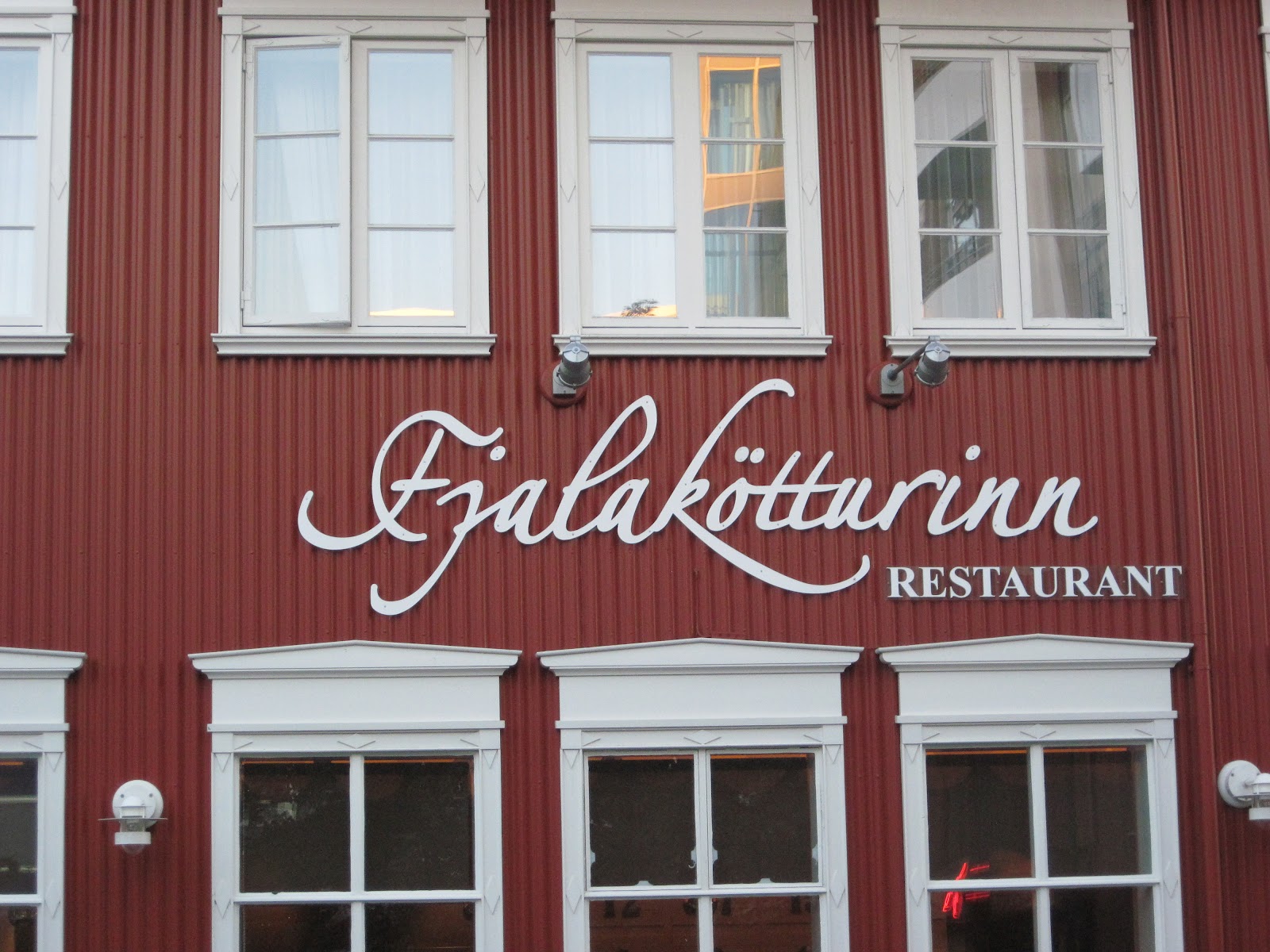
I, too, was well-fed in Iceland, about which the less said the better. More importantly, I photographed, but did not eat at, the splendidly-named restaurant Fjalakötturinn. This word seems to be a variant on the mousetrap-kenning I discussed in an earlier post, where the medieval version was a tréköttr 'wooden cat', whereas this one is better translated as 'plank-cat'. I'm not entirely sure it's the best name for a restaurant, but it's good as ever to see kennings still in use. Apparently, the building is modern, but built on the site of an earlier one with the same name (I haven't been able to discover why), and even earlier there was a Viking longhouse on the site, not surprisingly, as the restaurant is right next to the Reykjavík 871±² settlement exhibition.

 On my last evening I photographed this rather beautiful pussycat (right) on the seashore near my hotel. It is standing in front of a monument celebrating the fact that the football club Þróttur was founded on that very spot. The club's name means 'strength', and some think it is one of Odin's names. The word also appears mysteriously on some rune stones in Sweden, about which I have written recently, but I digress. The spot in the photograph is actually rather interesting, since there are some old (or not even so old) fishermen's huts, known as Grímsstaðavör, still standing (see below, in the romantic gloaming), the last remnants of the fishing heritage of the area before the complete suburbanisation of Reykjavík. What with cats, Norse mythology, ruins and much more, there was plenty to catch my interest in that short evening walk along Ægissíða. Even better than the Northern Lights, though I still hope to see those one day.


14 February 2012

Runic Valentine

This little weaving sword from Lödöse in Sweden bears the inscription:
mun : þu * mik : man : þik : un : þu : m(e)r : an : þRr

Think of me, I think of you! Love me, I love you!
It's from the first half of the twelfth century, and both the object and the inscription may have been made by a lover for his lass. Seemed appropriate for today...


23 December 2011

Kick-starting 2012

What with the weather wet and temperatures into double figures, we won't be doing winter sports here in Britain, that's for sure. This time of year always brings back happy memories of snowy times in Norway. Being a bit of a retromaniac in many things, I have a small collection of old-fashioned seasonal greetings cards. Not sure about the date of this one, probably early 1960s? Anyway, I append it here by way of seasonal greetings to all my loyal readers!

Thinking of Norwegian winters reminds me there was an article in the Guardian a week or so ago, on that most excellent means of locomotion, the 'sparkstøtting', or 'spark' for short. Apparently, the official English term is 'kicksled(ge)', though that's the first time I've heard it. I've seen a lot of them in Norway, and I suppose they must be used in other Scandinavian countries, as suggested by the 1890 Swedish drawing below, but I've never seen them anywhere else. But then where else has enough snow? I wonder if they were ever exported to Minnesota?

26 September 2011

Runic Tourism

Your intrepid Norse and Viking rambler has just returned from a runic ramble in Sweden, where perfect weather and congenial and learned company enhanced the already delightful process of the close study of runic inscriptions in a variety of media and with a variety of more or less comprehensible texts. Among many other delights, I offer you (left) a photo of what might be the only memorial inscription on a rune stone commemorating the commissioner's aunt. Fathers and sons, yes frequently; mothers and daughters, not so common but still quite a few; sisters and uncles are rare but there. But I think this is the only auntie, or father's sister in this case (if indeed that is what the text says - half the fun of runic inscriptions is that we are not always 100% sure), in the Swedish Viking Age corpus. Hurrah for aunties everywhere!

The runic theme of this short trip was enhanced by the only partially deliberate decision to stay in the Hotel Svava in Uppsala, possibly the world's only runic-themed hotel. As you can see from the photo to the right, every bedstead in the place is enhanced by a runic inscription - the runes are proper, but the message is in modern Swedish (I leave you to spell out the advertising message for yourself). A very distinguished runologist on the ramble admitted to me that she had devised the inscription many years ago when the hotel opened - despite the occasional ribbing she has received, I think it's splendid. It did make me wonder about other runic hotels. I do remember seeing a splendid runic banner at the Kettletoft Hotel in Sanday, Orkney, when I was there in I think 2000. I wonder if it's still there?

But the best bit of runic tourism is surely the airport at Kirkwall. Not only are the runes proper Viking Age ones, the spelling is pretty good (the place was called Grimsetter when the RAF built an airfield there in 1940), written in pretty good runic orthography as krimsitir (though in Old Norse it would ideally be krimsitr, or setr with a dotted i-rune). I haven't found out which runologist, if any, was responsible for this one, though. Now why can't the baggage tags be in runes when you fly to KOI-Kirkwall?

22 April 2010

The Long Way Round

As stranded travellers all over the world return home, I am happy to report that we too are now back, as of this morning. The various members of the large group that went to Selja (see previous post) all came home in different ways and by different means. Most of the Nottingham group (now known as the Snotlingar) came back to England by a slightly circuitous route which had, however, the benefit of extending the field trip element and giving us all a chance to view some Viking landscapes and, in particular, to visit three important runic sites.
The first leg was the train from Bergen to Oslo, over the beautiful snowy mountains, and a few moments' experience of a real blizzard when the train stopped at Finse for the smokers (though it was not really smoking weather). The next day, a morning in Oslo gave some a chance to visit the Viking Ship Museum, some a chance to observe the modern monumentality of the Vigeland park, and me a chance to photograph the mythological frieze by Dagfinn Werenskiold on the Oslo City Hall, which I have long meant to do. I particularly liked Thor in his goat chariot (see the picture above).
From Oslo we took the train to Sweden, where we picked up our own chariot in the form of a borrowed car (and a very nice one too, with quite a lot of goatpower), and spent the first night at Mjölby. More by accident than by design, it was a brilliant choice in that it enabled us the next morning to visit the nearby rune stones at both Högby and Rök. The drive through the Swedish countryside in the brilliant sunshine was also a highlight. We raced across the bridges to Denmark and then pressed on to our third and fourth rune stones of the day, at Jelling, which we saw in the soft and fading light of the day. It was good to see the stones before they are encased in their protective box (see my earlier post on this subject). I was also delighted with Erik the Red's very splendid modern rune stone outside the museum (see picture left). After a long day, we ended up just over the border in Germany, ready for our last road leg, to the Hook of Holland, where we gave the chariot back to its rightful owner, who had similarly been stranded in England. From the Hook we sailed to Harwich, happily meeting up with some others of the Seljumenn on the boat, and then arrived home at 3 am having first had to go to Gatwick to pick up my car that had been languishing there since we left.
All in all, a memorable trip, thanks to the Icelandic ash cloud!

12 November 2008

Viking Women


According to the BBC, Norway, Finland, Sweden and Iceland are the top four countries in the league table of nations 'closing the gender gap'. Is it any wonder we like studying the North? But where is Denmark?

10 April 2008

Viking Age Hoard Found in Sweden - No Fooling!


On the 1st of April, archaeologists working near Arlanda airport found a Viking Age silver hoard, deposited around 850 AD, containing many Arabic coins. The hoard was found during excavation of a much earlier burial site. See the report on the BBC website: http://news.bbc.co.uk/1/hi/world/europe/7330540.stm