Showing posts with label Hebrides. Show all posts

19 September 2020

The Children of Ash and Elm

In what now seems like a completely other world, less than a year ago I wrote blog post listing some recommended Viking reading. If I had been writing that blog post now, I would certainly have had to consider this very recent offering (it was published last month), all 599 pages of it, with the rather curious title The Children of Ash and Elm and the more prosaic subtitle A History of the Vikings. This book is by Neil Price, one of the best-known Viking specialists working today. He is professor of archaeology at the University of Uppsala in Sweden, and leader of a massive 10-year project called The Viking Phenomenon. By any account, this book, one of the outputs of that project, deserves serious attention.

I have to admit that not long ago I declined an opportunity to review the book, though this was only for practical reasons and not from any disinclination. Since then no one else has asked. So I thought I'd share some thoughts here. In fact, I rather like the freedom of writing as many (or as few) words as I like, and not having to follow the conventions of book reviews, or worry about who I was writing for, or explain the book to those who haven't read it and are wondering whether they should or not (the short answer is yes, though there's a longer and more complicated answer below). So this is not a review. Just some thoughts, mainly on those aspects of the book which particularly interest me, and which may or may not be of interest to others.

The first thing to note is that not only have I read it, but I have read it carefully and in its entirety and enjoyed doing so. You might think this goes without saying, but I can assure you that when it comes to popular or trade books about the Viking Age, this is very rarely the case for me... Too many books about the Vikings, aimed at a general audience, just say the same old things, in the same order, and in the dullest possible way. They might have their uses in providing the basics for those who know nothing, but I can rarely get past the first few pages... I assume this one is intended for a wide audience, as it is published by Allen Lane and will I guess eventually become a Penguin paperback, presumably to replace Else Roesdahl's The Vikings, which has now been around for quite a long time. So the very fact that I enjoyed reading it, and with attention, tells you a lot. However, its destiny as a popular book also makes it a bit difficult to review. How much should we expect of it? Who is it really for? We all know that it is really hard to encompass the whole of the Viking Age without making some mistakes, but how significant is that in this context? Does anyone care? I'm always being told that our first priority is to engage as well as inform the general public. But how far do we go in this process?

Well, this book is certainly very engaging. So what do I like about it? A variety of big and small things. Most important to me is how Neil's love of his subject shines through every word on these 599 pages. Here is someone who likes Vikings and the Viking Age a lot, as much as I do, almost certainly even more than I do, although probably for very different reasons. He resists the dreary tendency of some archaeologists to insist on the calling it the 'Viking period' and instead argues cogently (p. 9) for the validity of the notion of a 'discrete Viking Age'. He even admits that he is 'promoting the Vikings' worldview' (p. 26), something that sounds potentially dangerous these days. But it's not sinister, rather it is clear that his aim is deep understanding, an attempt to get inside the skin of the Vikings. Overall, I like this attitude. This is not a book for those who want battles and bling, rather I see it as an attempt to work out what motivated battles and bling (and of course much else).

Another good thing is that some of the book is about the centuries before the Viking Age, a period which is given a variety of names in different archaeological traditions (usefully tabulated on p. 66) and which is less well studied outside the circles of Scandinavian archaeology than the Viking Age itself. Very few books about the Viking Age consider this preceding period in any detail and it is illuminating to see both the continuities and the changes. In fact, you could argue that the author's idea of a 'discrete' and in many ways unified Viking Age is justified by that very contrast with the preceding period, with its multiple monikers and lack of a unifying narrative. Despite his over-fondness for Beowulf and the sixth-century 'dust veil', this focus on the pre-Viking period is still an important aspect of this book. I would also say the author is generally good on religion, even if I shudder at his adoption of the term 'religiolect' (p. 207), or when he overstates the evidence for worship of the Norse deities in England (p. 408).

I am of course very pleased that the author recognises the usefulness of the concept of 'diaspora' in understanding the Viking Age - this word is the title of the whole of chapter 13. Unlike many others, he is also alert to the fact that it is a difficult word to use and needs explanation and exploration rather than just appropriation (see especially pp. 363-5 and 555).

So, overall, this is a book which has many new and interesting things to say about Vikings and the Viking Age and already for that reason it is well worth reading. It's also a book which stimulates both thought and occasional disagreement, and I wouldn't be me if I didn't have some Thoughts about some of what Neil says.

The book is definitely the product of an archaeologist's mind, as indeed his predecessor Else Roesdahl's is. Allen Lane/Penguin still seems to belong to the class of publisher who believes only archaeologists are qualified to write about this topic. However, Neil is one of those archaeologists who is not only not embarrassed to use Old Norse texts to help understand his subject, but is also pretty knowledgeable about them. Indeed he has been supporting his archaeological interpretations with textual evidence for most of his career. This is laudable, but has some dangers. I have sometimes noticed that not only MA dissertations and PhD theses but also papers by more senior archaeologists have a tendency to use his work as a primary source to access these texts. While it is understandable that archaeologists cannot also be textual specialists, I think there is still some educating to be done here. But that is not this author's fault, rather that of those who use him in this way. This book is upfront about its use of sagas in particular, more than once urging its readers to 'read the sagas' - which can only be a good thing. I'm also totally with Neil when he notes (p. 23) that 'skeptical literary researchers' are probably too skeptical since they do not explain where all the Viking Age material in the sagas comes from, though his own justification (e.g. p. 222) is a bit thin. Let's by all means have more exchange and discussion of this topic which is sorely needed.

So I am disappointed to have to say that this book is not a particularly good advertisement for the use of sagas, or indeed any old texts, in archaeological narratives. At the most basic level, there are too many errors, often of a linguistic variety. So not only are we introduced to those weird Anglo-Norse hybrid dynasties the 'Ynglingas, Skjöldungas, and Völsungas' (p. 92) but, even more egregiously, the Saga of the Ljósvetningas (p. 160). I think our author has been reading too much Beowulf and not enough sagasConstantine Porphyrogenitos' De Administrando Imperio is, despite the title, written in Greek not Latin (p. 366). Miðjarðarhaf  is a literal translation of 'Mediterranean Sea' and nothing to do with Miðgarðr (p. 374). A few such errors are forgivable but there are a little too many for my taste. Especially because they could easily have been eradicated by asking someone who knows about these things to read through the manuscript. But despite two pages of Acknowledgements to the Great and the Good of Norse and Viking Studies (pp. 574-6), this appears not to have been done, at least not successfully. The hubris of thinking you know everything affects us all in the end...and it's those who really do know a lot who have to be particularly careful. (I'm looking at myself here, too).

Similarly, some of Neil's reading of Old Norse texts is at least debatable and sometimes just wrong. On p. 55, he conflates without notice the texts of the poem Darraðarljóð and the prose narrative of Njáls saga in which it is cited. This is a pity for the argument because many people believe the poem is a genuine Viking Age product, while the saga definitively is not, and is therefore unlikely to be a reliable guide to what the poem really means. (I've more than once heard archaeologists at conferences claim they are citing the saga when in fact they are using the poem - when making a point about textiles, for example, this is an important distinction). Individual texts are in danger of being overinterpreted. Thus, Neil says (p. 110) that  Rígsþula 'describes an elaborate high-status wedding with fine linens and much ceremony',  but there is no such thing, only a very sketchy reference in st. 38 (40 in Larrington's translation) to Erna marrying Jarl and wearing linen. On the same page, he refers to the 'impotence' of Hrútr in Njáls saga, whereas most readers would I think say this character's marital problem was too much potence. We're told that 'sagas and poems are utterly saturated in magic' (p. 221). Well, yes, there is a fair bit of magic in these texts but 'utterly saturated'? Not in my experience. 'Professional mourner' is an odd concept to link to the Eddic heroine Guðrún (p. 253) in a context in which it is clear that she is mourning her own daughter - surely a genuine tragic figure rather than a hired weeper. It all smacks a bit too much of making the evidence fit the argument.

Runes are also not well-represented in this book, despite many of them being, unlike the sagas but like some poetry, contemporary texts from the Viking Age or earlier. It's disappointing when the author misses several opportunities to mention that important archaeological finds he discusses actually have runic inscriptions on them, such as some of the pre-Viking weapon deposits at Illerup (p. 70). Even more scandalously, the carved stones of the Isle of Man are mentioned for their Christian iconography beside images from Old Norse cosmology (p. 417) without any reference to their (more frequent, but perhaps less obviously exciting) runic inscriptions. Two Swedish rune-stones which Neil alleges (p. 112) provide evidence for men having two wives simultaneously are not only rather slim evidence for polygyny but could also be read in a variety of ways, even before we consider the problems of using these laconic inscriptions to write social history. And no, Ingibjörg did not have 'sex with me when I was in Stavanger' (p. 192). The medieval (not Viking Age) Bergen rune-stick N B390 M says that Ingibjörg unni mér þá er ek var í Stafangri or 'Ingibjörg loved me when I was in Stavanger'. You might argue that the verb unna is a euphemism here (though not always in runic inscriptions where it does seem to indicate romantic love). But I would argue that is interpretation which needs to be argued for, ideally with a consideration of how the word is used in other contexts. In this context, what is needed rather is just to get the translation right. Norse-speaking people are not known for euphemisms and did not shy away from the f-word when they needed it, as can be seen from several runic inscriptions including a famous one in Maeshowe (also post-Viking Age). 

Any one of these slips, individually, is not significant on its own, but there are rather a lot of them when it comes to the texts. What is more concerning is the overall pattern, of exaggeration and dramatisation, of literally sexing up things that were originally perhaps more mundane. Too much of this ends up with a slightly cartoonish view of the Vikings which both feeds into and panders to the ways they are portrayed in popular culture. Boring as I am, I would argue that the Vikings are fun enough without having to exaggerate what they were up to, they don't need all this showmanship. The end result is that the book sits very uneasily on the border between scholarship and yet another 'popular' version of the Viking Age. This is a worrying tendency in several aspects of Viking studies today, one example being the controversial Viking display at the National Museum of Denmark, though this book is not I think in that league, mercifully. And yet many people will regard this book as the 'defnitive' view of the Viking Age (as can be seen from both journalistic reviews, and consumer reviews on Amazon). Once again, the drive to 'engage' the public seems to be at the forefront of all public-facing scholarship and is in danger of overshadowing the actual scholarship.

This popularising tendency may be responsible for the author more or less ignoring certain forms of evidence which are not so easily tied into a colourful narrative (though others do manage it). So, place-names, a really important source of evidence, get very short, and sometimes inaccurate, shrift. It is simply not true that there are 'no non-Norse place-names in the Hebrides' (p. 404). I wonder if the author meant the Northern Isles in this instance, but even there this is not true. According to him, place-names provide the 'greatest evidence for the Scandinavian presence' in Normandy, 'as in several areas in the British Isles' (p. 419), but this point regarding the latter (and especially England) is not taken up elsewhere. The author could, I would suggest, also do with reading up on some of the recent (and older) discussion about the  name of Norway which I,  in agreement with others, no longer believe means the 'North Way' (p. 86). It's perfectly understandable that this is an area in which our multi-talented archaeologist author feels less confident, but I would really have liked to have seen more about this in a 599-page book which calls itself 'A History of the Vikings'.

Even in areas where he is more knowledgeable, the author is not always entirely reliable. I didn't know that ringed pins were a 'uniquely Norse invention' (p. 135) and I doubt it, but admittedly that's not my area of expertise. Snaptun (the find location of a carving beloved of my students which ostensibly shows Loki with his mouth sewn up) is not 'near the Norwegian border' (p. 136) - Denmark does not share a land border with Norway. It did in the Middle Ages, but that is still not where Snaptun is. I do wonder how we can be sure that Sámi traditions recorded in early modern times go back to the Viking Age and beyond (p. 89). This could well be true, but I'd welcome some comment on the question, especially in light of the author's semi-skepticism about the (earlier-recorded) sagas. His disappointingly brief comments on genetic research (p. 381) add nothing to what is an important and current discussion.

So, despite the stated commitment to interdisciplinarity, and a voluminous bibliography (in which I have happily discovered many items I knew nothing about), I'm not convinced that the author has fully digested everything he has read, especially in other disciplines. The saga-references in particular read a bit like someone who once read a saga some years ago and is retailing it from memory. Personally, I do not mind these errors, they are easily made and I can recognise them and filter them out. I can also tell when the narrative slips from fact to speculation and I for one enjoy speculation even when I do not fully agree with it, because it stimulates thought. A case in point is the author's new-found conviction that the Vikings were non-binary or queer, which seems a bit tacked on here and there to a narrative which otherwise still assumes a highly gendered society (my considered views on shield-maidens will, I hope, be published elsewhere soon, in the meantime you can get an idea from this recent podcast). The speculation is not always signposted though careful reading will reveal it. But I do wonder how many students and less experienced readers will look at the range of evidence cited and assume the author is equally expert in all of it. And then continue to cite him, rather than the original sources, for literary and linguistic detail... I'm almost tempted to say that you should study the Vikings for a few years before reading this book - you'll get more out of it and not be led astray. But is this the right kind of book for The Penguin Book of the Vikings? I'm already dreading some of Neil's more colourful exaggerations turning up in student essays for years to come.

Despite these disappointments, I do still really like this book. I hope it is recognised that engagement at this level of detail is a form of praise for this book - there are very few books I would take so much trouble to write about, especially in this informal way. I fantasise that I could even use this slightly uneven character of the book to train students in distinguishing between old news, new news and fake news, but it wouldn't be easy. The narrative is, I imagine, pretty seductive to those (almost everyone) who have less knowledge than Neil Price.

To end on a more positive note, the book has some insights or generalisations that are sufficiently interesting and provocative that I want to take them away and really chew over them, which is one reason I like this book. While it should not always be taken literally, the following random selection of observations shows some of the ways in which this book successfully stimulated my thought processes at least:

  • 'trickster ... nomenclature may not help in understanding [Loki] from the point of view of the Vikings themselves' (p. 46)
  • 'The mythology of the Vikings is one of only a tiny handful in all world cultures in which the divinities also practised religion' (p. 50)
  • [with reference to the Migration Period, but also relevant to the Viking Age, and here's looking at you 2020] 'Some were fleeing, and others were those they fled from. Most were looking for economic security, safety, and a quieter life while a powerful minority were trying proactively to shape a world more to their liking' (p. 68)
  • 'it is the man's gender that was limited and intensive, while the gender of women was to a degree unlimited and extensive' (p. 172)
  • 'the Rök stone ... was deeply socially embedded (and visible) in a way that the book cultures of the Continent never wished to be' (p. 195)
  • the importance of planning and preparing for Viking expeditions (p. 308)
  • the 'armies' in England were 'continuously evolving migratory communities' (p. 339) or 'armed family migrations' (p. 357)
  • 'There is little evidence of racism in Viking society' (p. 398)
  • 'the Vikings live on today primarily as tourist magnets, as the draw of heritage trails and "experiences". The Scandinavians of the Viking Age were acutely concerned with memory; they might have been happy at this.' (pp. 498-9)


26 October 2019

Ardnamurchan Vikings

Lighthouse at the Point of
Ardnamurchan
As I have previously pointed out, many of the poetic-sounding names of the shipping forecast have Viking associations, as does the Point of Ardnamurchan, in the inshore waters section. Plus it sounds wonderful, too. So who could resist a little trip up there, especially when someone else was paying and there was a work reason to go? (More information on why exactly I was there will follow in its own good time). So last month I went and it turned out to be easier than I thought - fly to Glasgow, then it's a four-hour drive. Well, easy or easy. The drive is quite something, along Loch Lomond (the bonnie banks don't have room for more than a narrow road with lots of traffic), through Glencoe (stunning), a fun ferry crossing to Ardgour, and then the last thirty-five miles of single-track road, dodging confident locals, hesitant tourists, and a variety of fauna. You can see why the Vikings preferred to arrive by boat.

The Viking grave at Swordle Bay
The main reason for being there was in connection with the Viking grave found at Swordle Bay in the northern side of the Ardnamurchan peninsula a few years ago, which had me pretty excited. It's touted as being the first Viking boat burial found on the mainland of Britain, but that is somehow to see it with our contemporary landlubber eyes. Certainly modern technology makes it easy enough to get there overland, but even a few decades ago that would not have been the case, let alone a millennium ago. Even getting to Swordle by car from the south side of the peninsula involved quite a steep climb over the central ridge. The bay has excellent views of Eigg and Rum and other Hebridean islands - and for all practical purposes it might as well have been an island too. Certainly it was on a main Viking Age transport route.

Swordle Bay, Ardnamurchan
The burial is in a stunning location - a great place to spend all eternity. There are many interesting aspects of the grave (it was in all likelihood a man, buried with both weapons and practical items, in a boat) and you can read all about it in this academic publication from a couple of years ago. Or read a shorter presentation on the website of the Ardnamurchan Transitions project of which it is part. Now of course, there is not much to see, only the shape of the burial marked out in stones, and a sense of the site, which looks like an ideal spot for a Viking to settle in. Further archaeological investigations might reveal whether the person buried there also lived there or was just passing through when he decided to take a detour to Valhalla. I have my reasons for thinking the former is more likely. Or at least that there were Vikings living there at the time.

Sanna, a small settlement on the western
end of the peninsula
One of the reasons for thinking this is the small but significant number of place-names on the peninsula that have an Old Norse origin. Swordle Bay itself contains the element svörðr, cognate with English 'sward' (as in 'greensward'), plus dalr 'valley', and it is indeed very lush and green round about. Sanna, now a small settlement on the western end of the peninsula is indeed next to a sandy beach, and if it does come from Sandey 'Sand Island' as it seems to, then there are some small islands in the bay which this could I suppose refer to. The place-names have not been studied in any detail since Angus Henderson in 1915, so there's a job for someone!

Ockle
Many might think there's not much to do on Ardnamurchan, and certainly what we think of as civilisation is thin on the ground at its western end. But for me the landscape and seascape, the lighthouse, the place-names, the burial, were all of great interest. I was also taken by the tiny settlement of Ockle, where the sun came out, enhancing the faded colours of this derelict cottage. I also like old tractors, sheep, cast iron mileposts and many of the other things to be seen there and I know I could amuse myself there for more than the two days I had on this visit.

Strontian
One last little tidbit of information which I had not known until I travelled all the way there was the significance of the village of Strontian. It turns out that this place gave its name to the element strontium, which is key in so much Viking Age research these days, as the bioarchaeologists use isotopes to work out where people came from. If you want to know more about the element, then I recommend the Strontium video from the very fun series of videos about the periodic table made by my amazing colleague Professor Sir Martyn Poliakoff.

Just goes to show how educational following the Vikings can be!

23 August 2018

From Nottingham to Arnarfjörður

As regular readers of this blog know, I quite often go to academic conferences in the Viking diaspora and usually manage to stay on for a few days to have a bit of a busman's holiday. This summer's big conference was the 17th International Saga Conference in Iceland, held in Reykjavík and Reykholt. The conference was both enjoyable and useful but rather large (over 400 attended). And Iceland is a pretty popular tourist destination these days. So where to go to get away from it all? A colleague and I decided that a tour to the Westfjords (Vestfirðir) was in order. This region has only about 7000 inhabitants (everyone having moved to the Reykjavík area), but some of the most beautiful and wildest scenery in Iceland. The trip was a great success and if you like you can follow some of our adventures on Twitter.

The region resounds with saga-echoes, mainly many sites associated with Gísla saga, but I was also delighted to visit Hrafnseyri, the home of Hrafn Sveinbjarnarson, whose maritime adventures in the Hebrides I once wrote about. But we were mainly there for the scenery and there was certainly plenty of that. I totally fell in love with Arnarfjörður (pictured above), the views of which were some of the most magical I have ever seen. The fjord is named after a certain Örn, a noble man from Rogaland, who first settled there to escape the tyranny of Haraldr Finehair. Clearly, he was not so impressed with the beauties of Arnarfjörður, for Landnámabók relates that he spent the winter at Tjaldanes because there the sun did not disappear entirely on the shortest days of the year. And not long after that he moved to the more forgiving landscape of Eyjafjörður.

Still, some people continued to live in Arnarfjörður, and at some point in the fifteenth or sixteenth century they acquired an alabaster sculpture of the Trinity, which is now in the National Museum of Iceland. The caption there states that it was made in Nottingham and found in Arnarfjörður, but not where. The sculpture is mentioned in an article by Philip Nelson in the Archaeological Journal of 1920, but its provenance is not given. There may be more detailed information I can track down in which case I shall report back. Certainly, Nottingham was famous for its alabaster carvings and they were widely dispersed at the time. In the meantime, let's hope that the refurbishment of Nottingham Castle Museum now underway will acknowledge this Icelandic connection, for there are certainly more of these alabasters there than the 'one' that is mentioned in this article in the Nottingham Post last year. Maybe they will even borrow one or two for an exhibition, in which case it will be Nottingham to Arnarfjörður and back.

06 March 2016

The Poetry of the Shipping Forecast


Britannia Designs, Dartmouth
Despite being the world's greatest landlubber, I have always loved the Met Office shipping forecast, especially when broadcast late at night on Radio 4, and I know I am not alone. Undoubtedly my own reason for this lifelong devotion is partly its splendid litany of place-names, beginning with that most evocative word of all, Viking, followed by North and South Utsire, named after Norway's smallest municipality Utsira. The forecast then ends its ramblings round the rocks and waters of the northwest European archipelago (and some nautically nearby places) in suitably Norse and Viking fashion with Fair Isle, Faeroes and South-East Iceland.

But it's not just this abundance of Norse and Viking references that I love. I would go so far as to argue that the shipping forecast follows some rules that make it into a kind of poetry, the kind of poetry I like.

(1) It is formulaic. The basic structure of the shipping forecast is the same every time, and it makes use of a pre-determined and traditional vocabulary and phrases with which both author and listeners are familiar. Occasionally moderate. Showers. Good. Cyclonic. 6 or 7 at first in west.

(2) But like all good formulaic poetry it rings the changes through variation. Moderate or rough. Rain or showers. Poor. Variable 4 becoming northwesterly for a time.

(3) It has a fixed structure, each part introduced by a formula to keep the listener orientated: 'The shipping forecast is issued...', 'The general synopsis at midday', 'The area forecasts for the next 24 hours'. Within each part the content is formulaic and always in the same order, though making use of variation as described above.

(4) Its formulaic nature gives it a regular, fairly predictable, if somewhat staccato, rhythm.

(5) It is primarily oral, though you can also read it on the page.

(6) It has a function (even if not for me). I like poetry that has a function other than that of being poetry. Because of its important function the shipping forecast has to be read in clear and unemotional tones, which thereby emphasise the drama of 'rough or very rough', or 'severe gale 9'.

As you snuggle in your warm bed tonight, just spare a thought for those in peril on the sea.

P.S. I'm not the only lover of the shipping forecast who owns the charming little dish pictured above. Thanks to my ever-vigilant other half who found it for me.

26 December 2014

Viking Women

In my self-appointed role as Viqueen, I not unnaturally take a great interest in the doings of all my Viking sisters in this most apparently masculine or even masculinist of historical periods. But when I indulge this interest, I do sometimes feel like a still, small voice amidst all the popular (and even academic) fascination with the war and the violence, the boyish obsession with transport (horses and ships), and all the shiny, shouty stuff like bling and skaldic poetry. At a conference just over a year ago in connection with the Copenhagen leg of the great Viking exhibition (currently in its final days in Berlin), I was amused to hear from one of the curators that one topic that was firmly excluded from their exhibition concept was that of 'daily life on the farm'. (Another was Viking art, but that's perhaps another blog topic, one day). Which is a pity, because I find 'daily life on the farm' just as fascinating as all the violent and blingy stuff, and perhaps just as foreign to the modern world, if not more so. After all, we still live in a violent and blingy world but how many in the western world at least still have to produce their own food, build their own houses and make their own clothing from sheep or linseed through to garment?

If there are any budding scholars out there, there is certainly still plenty of scope to research the role of women in the Viking Age, along with children, men, animals and all the accoutrements of daily life. And there are signs of renewed interest in the roles of women, as evidenced in a book just out, Kvinner i vikingtid (Women in the Viking Age), edited by Nancy Coleman and Nanna Løkka. The book has seventeen articles, in Danish, English, Norwegian (both nynorsk and bokmål) and Swedish, on a wide range of aspects of women's experiences in the Viking Age and after. I particularly liked Pernille Pantmann's chapter on women and keys, deconstructing the hoary old chestnut that keys in female graves represent the mistress of the house (an old idea that I have been guilty of myself in the past...). I'm less convinced by Pernille's alternative explanation, but she is properly cautious about putting it forward, and her piece certainly opens up the whole question for renewed discussion. We need more work like this.

Another recent publication, In Search of Vikings: Interdisciplinary Approaches to the Scandinavian Heritage of North-West England, edited by Steve Harding, David Griffiths and Elizabeth Royles, also has a couple of papers relevant to the understanding of female roles and experiences. In particular, Christina Lee's chapter shows the range of information that can be gleaned from textiles and textile working implements. The production of clothing, and other textiles (such as sails for Viking ships) was probably the one job that took up most of most women's time in the Viking Age, and studying this evidence again opens up all kinds of interesting questions about craft production, agriculture, family life, and artistic expression, not to mention the symbolic roles of weaving and spinning in Old Norse mythology.

Which reminds me that, nowadays, the most obvious profile of Viking Age women in both the popular media and much academic research is that of the possibly more glamorous but certainly minority (and in some cases fictional) roles of sorceresses, valkyries and warrior women. Or queens. All of these have their interest, of course, and I have expressed my views about both valkyries and warrior women before. I blame Game of Thrones, myself. I have to confess I haven't read the books, but I have watched a few of the TV episodes and, from my limited watching, it is clear to me that the female characters are mostly a pretty clever, capable and attractive bunch, usually more so than the male characters. This is how we like to see women from the dark and distant past in the twenty-first century, and it is certainly an improvement on the embarrassingly almost female-free twentieth-century equivalent, the fantasy works of Professor J.R.R. Tolkien.

But fantasy is just that, it's fantasy. When it comes to studying the past, I always struggle, both for my own part and in my teaching, to understand and to explain the paradox that, while human beings are human beings and always have been and always will be, the past really is another country. That's what's so fascinating about studying it - in what ways were people then just like people now, and in what ways were they different? Pinning that down in detail is the fun part.

On the whole, I think it's a shame that those interested in the Viking Age find it less interesting nowadays to explore the lives of real women, both those who stayed at home to cook, clean and bring up the children, and those who went out on great adventures, as settlers in the Hebrides or Iceland, or traders in Russia, with or without their menfolk or children. Maybe these new books will bring some redress. And at least some of these questions will be addressed in The Viking Diaspora, to be published next summer. But there is still plenty to do!

09 August 2012

Old Stones

... are actually some of my favourite things, especially when fashioned by human beings into something meaningful to them. Yesterday was excursion day here at the Fifteenth International Saga Conference in Århus. I naturally chose the excursion likely to include the greatest variety of interesting stones. The excursion was to Djursland, the peninsula north-east of Århus, with lots of interesting features, including a dialect that has kept the three genders of Old Norse, that Danish has otherwise done away with. The lithic delights on offer went from the Stone Age right through to the medieval period. We started off with Poskær Stenhus (pictured), apparently the largest Neolithic cairn in Denmark. Not perhaps the largest Neolithic monument on the planet, but a very nice one in a lovely location on a sunny day, in one of the hillier parts of Denmark (more on this later).

The Danish landscape is littered with extremely handsome stone churches, mostly apparently first built around 1200, but then added to later. So there were plenty of medieval delights, like the wall paintings at Hyllested (the link will take you to a lovely picture of the church and detailed information on the paintings), or the Romanesque portal at Rimsø, (which I confess I missed, being too interested in the rune stone at the same place), or the oldest stained glass (c. 1300) in Scandinavia at Virring church. Stonewise, I particularly liked the two little heads (pictured) on an outside wall of Ålum church.

But the real reason for going on the excursion was, of course, the eight rune stones we were promised. I had seen most of them before, but that was nearly two decades ago, so it was great to revisit them. The two I'll mention are the two outside the church at Ålum (pictured). As usual when runologists are gathered, we stand around and discuss every aspect of both the object and the inscriptions and this pair offer much rich material for discussion. The larger one (which by the way has an image of a mounted warrior on its reverse) has the inscription 'Végautr raised this stone in memory of Ásgeirr, his son. May God well help his soul.' The smaller one says 'Þyrvé, Végautr's wife, had this stone raised in memory of Þorbjörn, son of Sibba, her sister's son, whom she cared for more than a dear son.' So many questions... Why did the two young men die? Were they together when they died, was it on an expedition abroad, a local accident, an illness? Were they young men or only children? But even more so, what was the family situation? Why did Þyrvé not participate in the raising of the larger rune stone? Was she not Végautr's wife at the time, or was Ásgeirr perhaps not her son but that of some concubine? Why was she so fond of her nephew Þorbjörn? Had her sister died and she perhaps looked after him? If Ásgeirr was her son, was she telling the world she preferred her nephew to her own son? These lapidary texts give no real clue, and various other possible explanations spring to mind.

My final old stone for today comes not from yesterday's excursion, but today's. After a full day of papers (several of them very interesting indeed), we went on an evening excursion to Himmelbjerget, apparently Denmark's third highest eminence at 147 metres (don't ask me about the other two, but they're certainly not much higher). Outside the hotel there, I saw this beautiful stone, which reminded me of the stones I had seen on the Isle of Lewis over two years ago, particularly those at Callanish. The little plaque on it had a trite little verse which nevertheless concludes with lines also appropriate for signing off this blog:
I en tid hvor alting forgår, er det visse ting som stadig består.
(When everything passes away, some things are here to stay.)
I guess that's just what I think of old stones, too.

20 January 2012

Ljóðhúsiana

All things seem to be Lewis this week. I have just read the second volume of Peter May's Lewis Trilogy, The Lewis Man, which I think I enjoyed even more than The Blackhouse, about which I blogged last year. And I was delighted to see that the third volume will be called The Chess Men - I wonder if that will be about those delightful little people of walrus ivory? Speaking of which, the Comann Eachdraidh Uig (or Uig Historical Society to you Sassenachs) has just produced a map of Lewis with the place names given in their Old Norse form. Well, it's really only the area around Uig, not even the whole of Lewis, let alone Harris, and I have to say that some of the spellings are more than a little wonky but, hey, Vikingologists can have fun correcting them. It might even be a good test one day of my students' Old Norse to see what they can do...students be warned!

17 September 2011

Digging for Vikings

At last, a TV programme on the Vikings that was coherent, and had both interesting and new information. Well done, BBC2 and Alice Roberts, and the Digging for Britain series. The only downside is the title - 'Invaders' - but otherwise the programme is highly recommended and can be viewed by readers in the UK for another 22 days on BBC iPlayer, if you haven't seen it already.

Dedicated readers of this blog will recognise many of my favourite Norse and Viking things on the programme. It managed to pack in many of several places (Lewis/Harris, Orkney), things (the Lewis chessmen) and finds (the St John's College skeletons) already mentioned here, some of them more than once. Place-names got a very brief mention (well, only Horgabost, really), as did runes.

There were in fact glimpses of two recent runic finds, one from the Brough of Deerness which has, alas, not yet revealed its linguistic meaning, and (unacknowledged, but clearly visible for a brief moment) a spindle-whorl from Lincolnshire. The latter could have deserved some more discussion for, as John Hines has noted, while 'there's quite an essay to be written over the uncertainties of translation and identification here; what are clear, and very important, are the names of two of the Norse gods on the side, Odin and Heimdallr...' Unusual enough in an Anglo-Scandinavian context, but especially so given the object seems to be from the eleventh century and made locally.

All in all, an excellent programme, though I do think these recent finds have some way to go before they match up to some of those from earlier years. Some grubby steatite from Horgabost, or a wonky gaming-board from Deerness, despite the cooings of Alice Roberts, don't quite set the pulse racing as do the fabulous finds from Scar (excavated in 1991) or even the delicate bone pins found at the Udal on North Uist, some made from bird-bones. The Udal was excavated between 1963 and 1995 and now looks like it will get a proper publication. So it's not surprising that the programme ended with these blasts from the past.

18 June 2011

Walls and Houses

The march of historical novelists continues. Back in March, I reported on a visit by Kevin Crossley-Holland, promoting his new children's novel, Bracelet of Bones. On the same occasion, one of the panellists had been Ian Mortimer (the time-traveller's guide), who has just reviewed the latest novel by another of our recent visitors, Shieldwall by Justin Hill, which is set in England at the time of Svein Forkbeard and King Knut. I have to confess I am not a huge fan of historical novels, but it is interesting to find out what draws novelists to the period I, in a rather different way, am interested in. It is, paradoxically, often the very same things. A review of Bracelet of Bones in the Guardian a few weeks ago noted that its author 'brought a poet's love of words to this Viking adventure'. Something of the same came across in Justin Hill's talk, and is also evident in Ian Mortimer's review, in which he picks out some historical inaccuracies, notes the relentless preoccupation with blood and gore, but praises the 'wonderful, poetic passages'. So it all comes down to poetry in the end. Hurrah. I look forward to reading it, and possibly the rest of the trilogy too.

Speaking of trilogies, I have just discovered the first volume of a projected Lewis Trilogy, The Blackhouse, by Peter May. Its only Viking connection is that it is set in Lewis (the author revelling in the Norse place-names, possibly unbeknown to himself), but readers will know of my addiction to 'Viking crime', which I define as any murder mystery set in a part of the world that us true Norse and Viking ramblers like to visit, whether or not it has a Viking theme. It's a very dark, psychological thriller, and I'm not sure what island reactions to it would be (the Stornoway Gazette has not reviewed it yet), but the descriptions of Lewis are well done, even if the plot is a bit lurid.

19 February 2011

Woods and Trees in the North?

I just caught the last few minutes of a programme on Radio 4 which sounded interesting, Woods and Trees - Iceland and the Scottish IslandsI went to Listen Again, to find out what they could say about trees in the largely treeless landscapes of Iceland and the Scottish islands! It turned out to be a composite programme, one bit about woods and trees and the other bit about Iceland and the Scottish Islands. Pity, it would have been interesting to hear a bit more about trees in these landscapes.
The second part of the programme was an interview with Sarah Moss, whose book Cold Earth I read a while ago. It's a thriller set in an archaeological dig in Greenland, with lots of strange happenings, in many ways not unlike the atmosphere conjured up by the Icelandic sagas that are set in Greenland. The archaeology bits are not especially credible, but it's an effective story all the same.
It turns out that Sarah Moss has lived in Iceland (which was what she was being interviewed about) and is currently writing a book about it. On following her up I see she just has a new novel out, Night Waking, set in the Hebrides, and on the programme she recalled her childhood holidays in Orkney. She is clearly a lady who likes all the right places! I shall check out this new novel and see what I think.

15 January 2011

Inspiration

In a philosophical mood today, and reflecting, as I often do, why these Norse and Viking Ramblings are so important to me. Many wonder why I like cold and windswept places rather than the olive groves of, say Crete - not that I don't like those, quite the opposite, I love them. But warm and soft places just don't inspire me. So I'm really pleased to see some of my favourite places mentioned in today's Guardian, in a feature  in which the great and the good (professors, librarians, artists, authors) write about their 'Inspiring Views'. Greenland, North Yorkshire (Ribblehead), the Outer Hebrides (Harris) and the Lake District (Wasdale) all get a mention. Greenland is certainly much in the media these days, what with Stephen Leonard's reports from there in the Guardian, and Bruce Parry's BBC programmes on the Arctic, and I've noticed it's lately become a very popular topic with PhD students in Norse and Viking Studies. Greenland is certainly majestic, awesome and endlessly fascinating. But the wild, but quieter, places are perhaps the ones that really inspire, me at least. As Robert Rowland Smith says of Wasdale, 'there's the Viking church reminding you that you might at some point need mercy from all those towering forces gathered round'. Quite so. He's a philosopher, too, so perhaps excused not realising it isn't really a Viking church.

16 December 2010

The Waif Woman's Brooch

The quotation from Robert Louis Stevenson in my previous post prompted me to read his little story, The Waif Woman, which has been sitting on my shelf for some time waiting for an appropriate moment, though it's not at all long. It was not published during his lifetime, but our library has a nice little edition from 1916 (if you haven't got such a good library, you can read it online from Project Gutenberg and elsewhere). The story begins 'This is a tale of Iceland, the isle of stories' and it is a fine example of Viking Victoriana, with lots of 'goodmen', 'goodwives' and 'fiddlesticks', and a few gratuitous alliterations and archaisms ('It was a wild night for summer, and the wind sang about the eaves and clouds covered the moon, when the dark woman wended'). The plot is quite closely based on the well-known and colourful story of the Hebridean woman Thorgunna in Eyrbyggja saga - RLS has a Thorgunna, too, a strapping lady of a certain age, like her literary predecessor (not quite how we imagine a 'waif' these days, though she is indeed a wandering, homeless person). But the other characters have different names, and some aspects of the story are different. In particular, a silver brooch plays a part in the plot:
Here was a cloak of the rare scarlet laid upon with silver, beautiful beyond belief; hard by was a silver brooch of basket work that was wrought as fine as any shell and was as broad as the face of the full moon; and Aud saw the clothes lying folded in the chest, of all the colours of the day, and fire, and precious gems; and her heart burned with envy.
There is no brooch in Eyrbyggja saga but clearly RLS knew how important they were in the Viking Age, and liked brooches too - the comparison here with the moon is not unlike his fancy that brooches were made 'of star-shine at night', quoted in my last post. I don't know how much RLS really knew about Viking brooches, but I have used a picture of a tenth-century Borre-style disc brooch from Gotland, which I found on the British Museum website, and which would surely have amazed Aud if she had seen it.

18 May 2010

The Islands to the South

The current bureaucratic, Scotocentric appellation for them is 'The Western Isles', while the more geographical, but still mainland-focused term is 'The Inner/Outer Hebrides', but I prefer the Old Norse term Suðreyjar, the Islands to the South. It all depends on your point of view, of course! In Gaelic they are the Innse Gall, the 'Islands of the Foreigners', i.e. the Vikings, I suppose. What other part of Britain has so many names? As the Norwegians say, 'kjært barn har mange navn', or 'a beloved child has many names'. But I couldn't claim to love the Hebrides until now, never having been there - they were one of the most obvious gaps in my gradually-being-ticked-off list of visited Viking-places. Now, at last, that lack has been remedied - your blogstress, dear reader, has just come back (a little later than expected, courtesy of that Icelandic ash-cloud, again) from a short but amazing break on the island of Lewis and Harris.
Even in only five days, I saw far too much to tell you about at length here. Suffice to say I was fair smitten! Three things stand out for me, though: (a) the stone circles and standing stones, (b) the sandy beaches and (c) the Norse place-names. The stones are amazing enough as arrangements, in themselves and in relation to other stones in what archaeologists like to call 'the ritual landscape'. But what distinguishes Callanish from, say, Stonehenge is not only the much smaller number of tourists visiting, but in particular the beauty of the stones themselves. They were clearly chosen for their amazing shapes and patterns (showing up nicely in the Lewisian gneiss), and every one is different, even in the same stone setting (see the picture, left, of one from Callanish).
As to the sandy beaches, they are every bit as lovely as they have appeared in all the photographs I have previously seen: golden sands, turquoise sea, mountains on the horizon, and hardly anyone else in sight. The guidebooks go on about the beaches of South Harris, which are indeed lovely, but my two favourite ones are in Lewis, Bostadh on Great Bernera (pictured above), which has great views of some offshore islands, and Tolsta on the north-east coast, which is particularly sandy.
The Norse place-names are sometimes hard to recognise for Gaelicless people like me, though you only need a smattering of linguistic nous to decode the elements -bost as -bólstaðr and -siadar as -setr or -sætr, or indeed Uig as -vík and -bhagh as -vágr. I've been mugging up some of the articles by Magne Oftedal and Ian Fraser, both of whom suggest that the majority of not only village-names, but place-names in general, in Lewis are of Norse origin. You will find plenty of Norse place-names throughout the Hebrides, but they are really thick on the ground here. It's also clear from what I've read so far that there is still a huge amount of work to be done there on these place-names, so if there are any aspiring PhD students out there, my advice is to go away, learn both Old Norse and Gaelic, and get to work!
Among the many photographs I took, an awful lot were of other small obsessions of mine, sheep, cows, post offices and tractors. Here is one of the many lovely little red Massey Fergusons still in use in Lewis. As to the post offices, there seemed to be more of those in Lewis than there are left here in Nottingham, after the most recent cull. All of them are small and multifunctional, but they clearly play an important role in the community.
A final word of recommendation, St Clement's Church in Rodel (Roghadal), South Harris has a fascinating range of sculpture, from an over-the-top sepulchre for Alexander MacLeod, who built the church, to a lovely simple crucifixion, and a tower decorated with both a bishop and two sheela-na-gigs. Now what was that about?


15 January 2010

Shakespeare Was a Lewisman

I bet you never knew that Shakespeare spent some of his youth in Stornoway... Neither did I, to tell the truth, but maybe I should take his collected works with me when I go there in May, to see if they resonate with the landscape. And I shall look out for more fragments of his juvenilia there, like his play MacLeod, recently discovered in a fish-box. The play provides a Lewis-eye view of the arrival of the Vikings, as seen by Murdo the hermit. As one would expect from juvenilia, the verse is a bit rocky, though it sometimes rattles along nicely, as in this scene in which Murdo tells Lord Stornoway and his factor what he has seen:

MURDO
My Lord I must impart to you grave tidings of lament

STORNOWAY
Don’t tell me that once again you’re behind with the rent?

MURDO
No my Lord its worse than that. I’ve seen the dragon prow!

FACTOR
You mean to say…?

STORNOWAY
In a roundabout way….

MURDO
That the Norse are coming now!

MURDO
I spotted sails last evens’ time, approaching like a sea beast, a longship with a dragons head and eighty oars at least.

FACTOR
What was their destination, could you perceive their plot?

MURDO
I didn’t feel to tarry, so fast away I got!

STORNOWAY
They could be in this bay by now in full view of this Castle

FACTOR
This pile is falling ’round our ears, they’ll capture it no hassle.

31 December 2009

The Viking In All Of Us


It seems there is still a bit of the old Viking spirit in the residents of the Wirral, who have successfully fought off local government plans to close most of their libraries. This news report on Channel 4 this evening notes that the library at Irby was one of those scheduled to close, and also shows this fine old signpost of the footpath to Thurstaston. Both Irby and Thurstaston are places that can trace their origins to the Viking settlement of Wirral in the tenth century, as you can read, if you are interested, in Paul Cavill et al., Wirral and its Viking Heritage, 2000.
Today's Guardian editorial is 'In praise of ... British cheeses' - hear, hear! I think we can all assent to that... News to me, however, is that a Scottish cheese called crowdie 'traces its origin to the Viking invasion'. I suppose this is part of the general tendency to ascribe all good things to the Vikings, so I can second that. However, the OED claims its derivation is unknown, merely noting that 'Jamieson conjectured some connexion with GROUT, and Icel. groutr [sic] porridge; this suits the sense, but leaves phonetic conditions unsatisfied'. Quite. Thus do scholarly conjectures turn into newspaper fact... The 'porridge' meaning, by the way, is now obsolete according to the OED, but the second meaning it lists is 'in some parts of the north of Scotland, a peculiar preparation of milk' (eh?). The northern distribution may I suppose reflect Viking influence, and here I must recall one of my earlier posts on this blog, just over a year ago, about Crowdie Vikings, so maybe there is something in it.
Happy New Year to one and all, Viking or no Viking!

06 December 2009

Lewis Chesspersons Again

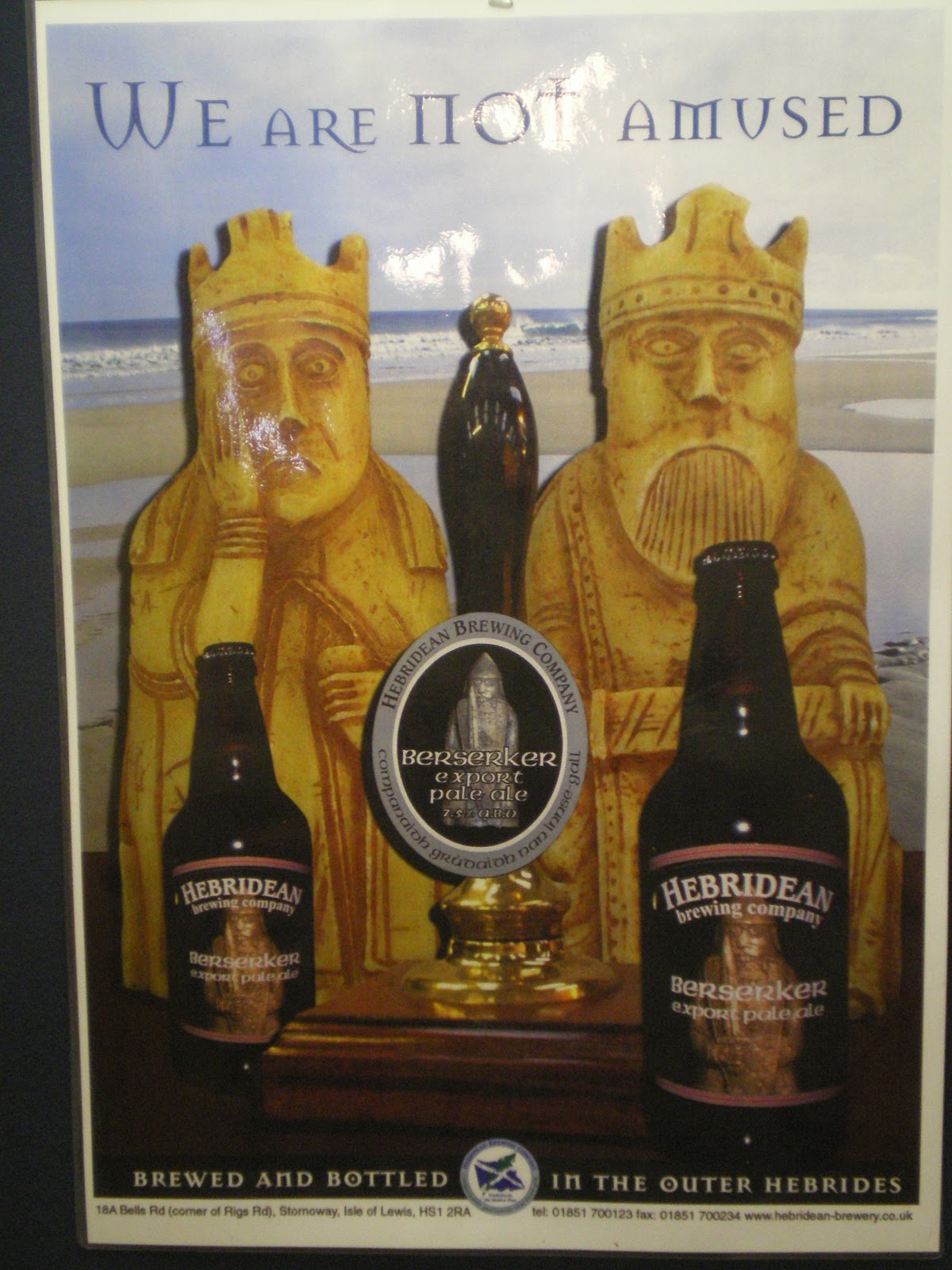
Everyone's favourite Vikings, the Lewis playing pieces, are in the news again. There is an article in Medieval Archaeology (which I haven't fully digested yet) propounding new theories about what kind of board game the pieces were used for (hnefatafl rather than chess), and why they were found on Lewis (belonged to a rich person who lived there, rather than just accidentally shipwrecked there). No doubt the press accounts (e.g. the BBC website) oversimplify a more nuanced academic article, so I am looking forward to reading that (there is also a bit more detail in the press release). The article is in fact available free online, so it will save me a trip to the library! I have a particular interest, because I have recently argued that one of Earl Rögnvaldr's verses contains a reference to chess, and draw the parallel with the roughly contemporary Lewis pieces.
The other bit of news is that a selection of the playing pieces will go on tour around Scotland in 2010-11: full details are available from the National Museums of Scotland website.

20 December 2008

Crowdie Vikings


I've been reading Finlay Macdonald's Crowdie and Cream (1982) after just catching a bit of the third episode on BBC4. As well as being a good example of Celtic Fringe autobiography, it has some interesting Harris folklore, in particular a story about how Viking invaders are bamboozled by the local fairies:

...long ago, an army of warriors from a foreign land had come ashore on the beach and had set about plundering and pillaging the land as they had done up and down the whole of the rest of our coast. But here, in this very hollow, they had come face to face with a host of little people - fairies who, instead of fighting the foreigners, made them welcome and made them sit down and rest and eat and drink their fairy food. And as the fierce Norsemen nibbled the tid-bits their tiredness and their fierceness left them, and they began to hear the most beautiful music that they had ever heard in their lives and they began to dream dreams of unsurpassed beauty. One by one the warriors fell asleep and when the last of them had nodded off the fairies pulled them down into their own world on top of which we were sitting now. It was a world of music and milk and honey and the wild men had liked it so much that they never came back from it again, and never again troubled the people of Harris.

This all takes place in Scarista, a Norse name if ever there was one...

08 March 2008

Lewis Chess Pieces


I am just catching up with the controversy about the Lewis chess pieces, which Alex Salmond, the First Minister of Scotland, is demanding are returned to Scotland. I do think it would be nice for the Isle of Lewis to have some, since they were originally found there (there are of course some in Edinburgh, in the National Museum). But these nationalistic arguments do tend to gloss over the fact that the chess pieces were almost certainly made in Norway, and were probably on their way to somewhere completely different, such as Dublin. There is a fairly balanced article in The Scotsman for 7 January 2008, citing very reasonable comments from Alex Woolf and James Fraser, and less reasonable ones by Ted Cowan, who argues that they should all be in Lewis.