27 July 2012

Jorvik Revisited

Some specialists are a wee bit sniffy, I'm told, about the Jorvik Viking Centre, but I've always thought it's rather a good thing. It has certainly been around for nearly three decades now, so it has had to have a few revamps along the way, and it's been a while since I last saw it. Taking a relative for a mini-break in York the other day gave me a welcome chance to view its latest incarnation, and I've come away with the conviction that it's still excellent edutainment. It simplifies, as it has to, but not in a bad way.

What's interesting is that the balance seems to be swinging more and more to the edu-, but still with sufficiently good -tainment for the punters to keep flocking there. The ride is more or less as ever, though regularly tweaked, and not so long ago spiced up with new dialogues (written and voiced by a colleague and students at the University of York). But the before and after the ride are both impressive, with some real nuggets of knowledge presented in an accessible way. The before gives you a useful summary of the excavations which form the basis of the ride, and lets you stand on the site, as it were. The after plays a bit to the gallery with skeletons, the famous Great Viking Turd, and so on, but also smuggles in a lot of useful stuff about palaeopathology, isotope analysis, metalworking techniques, and much more. All kinds of multimedia are used, prerecorded speakers, live intepreters with horns for you to blow if you dare, computer graphics, touch screens. The main criticism of the after bit is only that it's too small. It's a tribute to how interesting the stuff is that the rather narrow corridor with all this excitement was jammed with people looking, reading and learning, rather than heading straight for the shop.

We also dropped into the new temporary exhibition, Valhalla: In Search of the Viking Dead, around the corner. It had far fewer bells and whistles and for me it didn't fully explain the links between the various skeletons, sculpture and reconstructed artefacts on show, while the children's section had some nice things about Norse mythology, without for obvious reasons going too much into death and dying in Norse life and myth... Still, at least it was free with a Jorvik ticket, and the York Minster sculptures were well worth seeing.

24 June 2012

'I Must Go Down to the Sea Again...'

There is a veritable flurry of Viking ship reconstructions and launchings going on at the moment, no doubt inspired by the very successful Havhingsten fra Glendalough / Sea-Stallion from Glendalough, which sailed from Roskilde to Dublin and back a few years ago. Only a few days ago, a copy of the Oseberg ship was launched in Tønsberg. It's called Saga Oseberg and there is a good video of its rather less than smooth launch here - I do hope it sails a bit better than some of its predecessors! The so-called Dragon Harald Fairhair was launched on the 5th of June, though I do wish the people responsible for the latter had consulted more, both about calling it a 'dragon' and Harald's nickname. Grrr. Unlike most modern Viking ships, this is not a replica of any actual ship, but rather a reconstruction based on a variety of sources. Meanwhile, Archaeology4Schools has embarked on a copy of the Ardnamurchan boat, found last year, though since not much more than some rivets survived of the boat, I do wonder what the basis of this reconstruction really is. At any rate, it sounds like lots of people are having lots of fun, and the seas this summer will be alive with Viking ships!

02 June 2012

Kilroy Wasn't Here

One only of several reasons why I haven't been blogging much is that I've been doing too much Norse and Viking rambling. In April, as well as my trips to the Isle of Man, Orkney and Shetland, all recorded here, I went to a fun symposium on that quintessential Viking saga, Jómsvíkinga saga in Uppsala, and in May, I went to a symposium on the Jelling stone. The last has put me in a runic mood again, and an article that plopped on my doormat yesterday has prompted me to put on public record some thoughts that I have been having for years, and have tried to express more than once, but no one seems to take any notice.

Runologists frequently refer to the mythical graffito 'Kilroy was here' when talking about runic graffiti of the type 'X carved these runes'. This seems to me to be a fundamental misunderstanding based on inadequate research and I wish they would stop. When someone wrote 'X carved these runes', they used their own name and they really were there. Such a graffito is meant to be a proud (or otherwise) record of their presence and their ability to write runes (as evidenced by the fact that such inscriptions can be found on loose objects as well as walls and other fixed places). The Kilroy inscriptions are quite the opposite. There are a lot of stories, some possibly even true, about this phrase on the internet (with quite a sensible article here), while my trusty Brewer's Dictionary of Phrase and Fable merely says that 'Its origin is a matter of conjecture', but one thing seems clear. Whether or not a 'Kilroy' once existed, he was certainly not responsible for all the inscriptions with his name that appeared in many places around the world, especially during the high point of this craze in World War II and the 1950s. In runic inscriptions, X appears as many different names. QED.

The Sea Which Surrounds Us is Big

A few 'tweets' from a 'tweep' whom I follow (god, the terminology) reminded me that I failed to add a blog about my trip to Shetland, which followed on from the Orkney visit described in my last blog (shamefully over a month ago). Although I've been to Orkney many times, this was my first visit to Shetland in over a decade, and only my second visit ever (about time too). It's always good to be reminded of both how similar and how different the two island groups are. Visually, they are linked by Fair Isle - I could see it both from North Ronaldsay, and then again from the living-room window of the friends I was staying with on Westside in Shetland. The visit was quite a short one, though I managed to see lots of interesting things. Here, I'll just mention a couple of places well-known to me through sagas and poetry, and then another wee couple of things.

Girlsta Loch (pictured left) is quite a gloomy and forbidding place, and it's easy to imagine the death by drowning there of Geirhildr, daughter of Flóki, the víkingr mikill who, according to Landnámabók, was one of the three main discoverers of Iceland. The name is oddly appropriate, though the 'Girl-' in Girlsta has nothing to do with her maidenhood, as the name seems to be the reflex of an original Geirhildarstaðir. This means then, of course, that the story doesn't quite add up, since Geirhildarstaðir implies that she was there long enough to give her name to the farm and not, as Landnámabók suggests, that she just fell into the loch while her father was anchored in Flókavágr, wherever that is. But then the anecdotes of Landnámabók are generally lapidary, and you get a sense that they convey some fundamental truth, even though they don't know all the details. At any rate, it shows that 13th-century Icelanders knew that there was a place of that name in Shetland.

Especially exciting for me was to see Gullberwick (pictured right), where, according to Orkneyinga saga, Earl Rögnvaldr was shipwrecked, probably in the autumn of 1148, and composed several witty stanzas about it and the aftermath - they lost all their goods, but luckily no lives, so he could laugh about it. I particularly like the stanza in which he complains about the deleterious effect of the shipwreck on his clothing, and his promise to be properly dressed next time he arrives somewhere by ship:
Skekk hér skinnfeld hrokkinn;
skrauts mér afar lítit;
stórr, sás stendr of órum,
stafnvöllr yfirhöfnum.
Nærgis enn af úrgum
álvangs mari göngum
- brim rak hest við hamra
húns - skrautligar búnir.
I shake out here a wrinkled leather garment; it provides me with very little finery; the prow-field [sea] which surrounds our outerwear is big. Some day we'll go more finely dressed from a spray-swept horse of the eel plain [sea = ship]; surf drove the stallion of the mast-head [ship] onto cliffs.
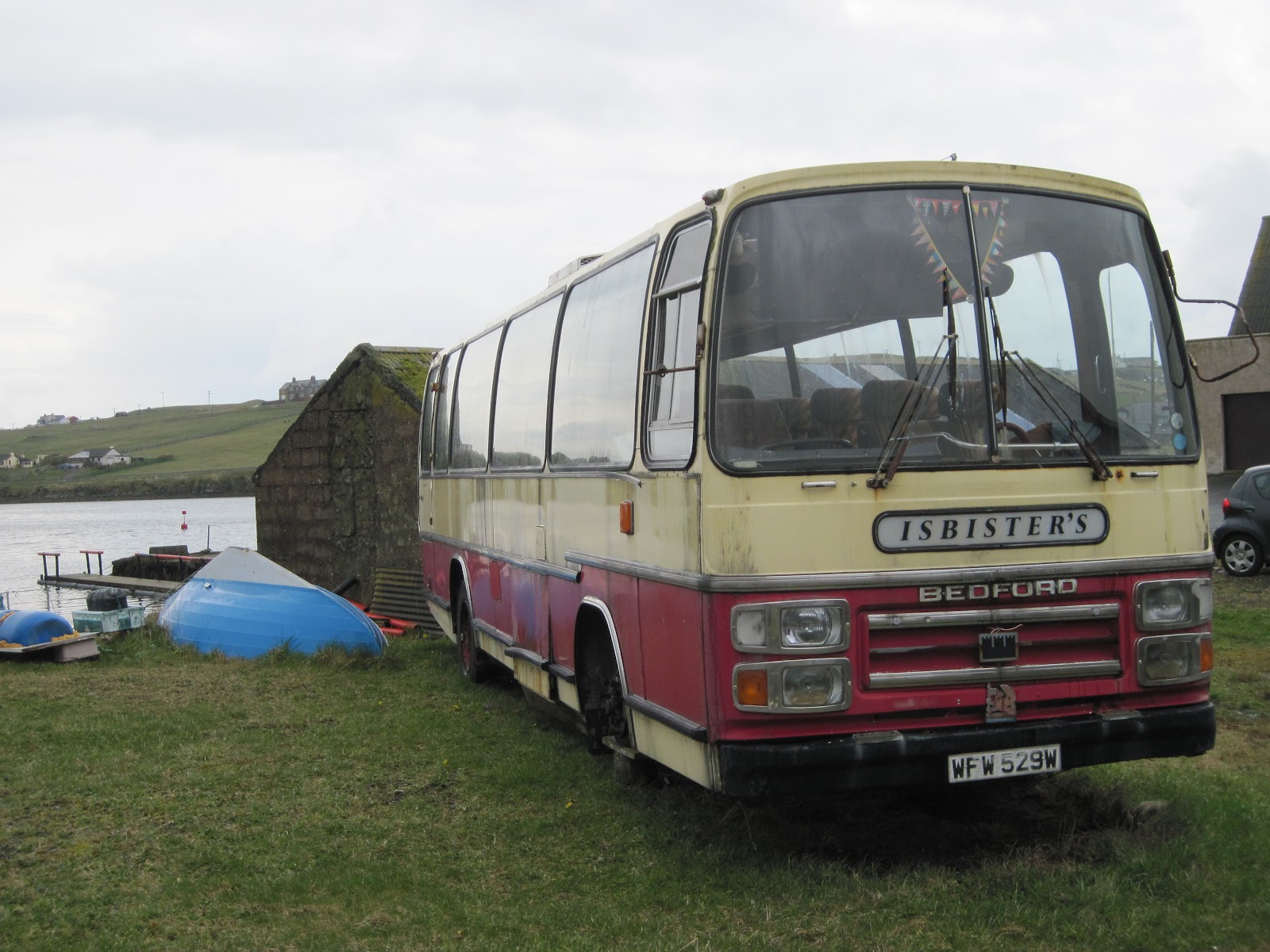
Regular readers of my blog will know I like coming over old buses and tractors on my island voyages. This time round, I not only got to see a lovely old bus (pictured left), but to meet the gentleman (Pat Isbister) who used to drive it and own the company. Pat is the husband of my friend's Cousin Betty, who gave us coffee and cakes and, most wonderful of all, a copy of the calendar depicting many of their old buses through the years - heaven! The calendar was made for a worthy cause, the Shetland Stroke Support Group - check them out if you can. And thanks to everyone for their wonderful Shetland hospitality.

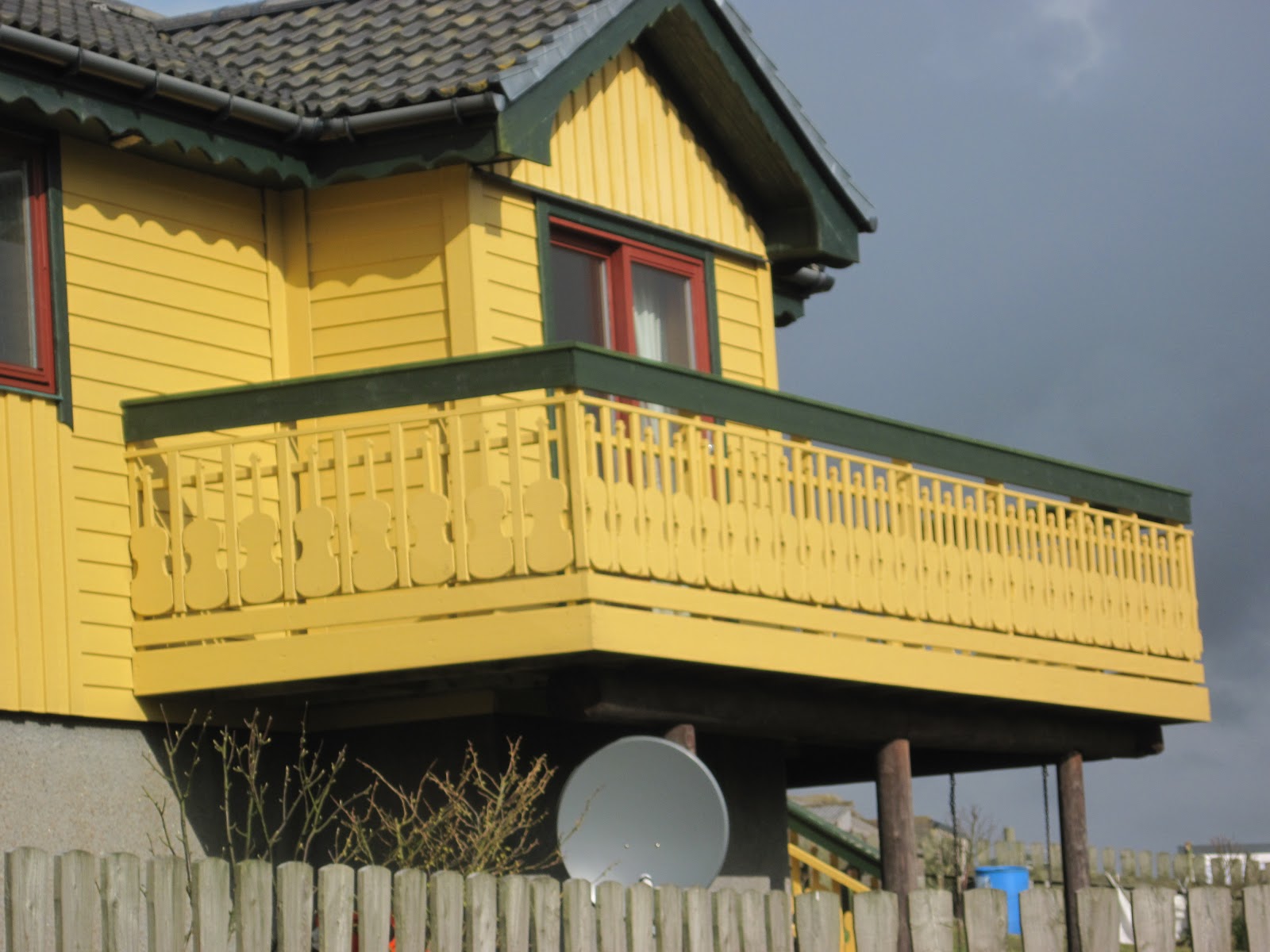
One final thing which I hope will raise a smile is this house, built for a well-known fiddler, proclaiming his passion to everyone who passes by:

18 April 2012

Lights of the Isles

Like all good teachers (I hope), I don't have any real favourites among my Norse and Viking rambling locations - from Newfoundland to Estonia, I have loved them all. But careful readers of this blog may nevertheless have noticed I have a bit of a soft spot for Orkney. So I am delighted to report that I am here again! The kind folk of the Thing project have invited me to give lectures in both Orkney and Shetland this week. And I wouldn't be me if I didn't tack on a few days extra to make it a proper busman's holiday...

This time I decided the extra in Orkney was to be North Ronaldsay, the northernmost of their isles, a place I visited once before in 2003, and home to some seaweed-eating sheep and the really rather colourful Ragna, about whom Earl Rögnvaldr composed a very strange poem (see ch. 81 of Orkneyinga saga, or my edition in Skaldic Poetry of the Scandinavian Middle Ages vol. 2).

Having arrived in glorious sunshine on Monday evening, my one whole day on North Ron was wiped out by the really rather atrocious weather that pummelled the whole of Orkney pretty much all of Tuesday, necessitating a day spent indoors with some academic work. I cannot complain, since I consider the weather to be an essential part of the authentic Viking experience, but I was disappointed.

Today, I was to leave on the 11 am flight and the weather was of course heart-wrenchingly better. But thanks to two of my fellow-guests at the North Ronaldsay Bird Observatory (an excellent place to stay, by the way), my last few hours were saved and I got a little adventure to boot.

It transpired that my two fellow guests were the engineers who maintain the lighthouses of Orkney and Caithness for the Northern Lighthouse Board. They, too, were leaving on the 11 am flight, but had a few things to clear up at the lighthouse before going, and graciously allowed me to accompany them. So I had a special tour of the highest land-based lighthouse in Britain, managing to climb all 176 steps to the top, where there was a splendid view of the whole island, glinting in the sunshine. There is a webcam, if you want to get an idea, and the two keepers' cottages have now been turned into very nice self-catering accommodation.

So what's all this to do with the Vikings, you ask? They who sailed without benefit of lighthouses (and therefore probably got shipwrecked a lot)? Well, it transpired that one of the lighthouse engineers was none other than Hrolf Douglasson, a Viking re-enactor I had met once before, now leader of the Norðreyjar branch of Regia Anglorum, author of several books about Vikings, and now with this really rather cool job of looking after the lighthouses of Orkney and Caithness. So thanks Hrolf, and your colleague Rob, for the tour!

14 April 2012

Viking Cats and Kittens III

A little booklet I picked up on the Isle of Man provides five different popular 'myths' about the origins of the tailless, or nearly so, Manx cat, known as a Manxie. One of these is that 'mother cats bit off the tails of their kittens when the Isle of Man was invaded by Scandinavians to stop the invaders taking their tails to decorate their helmets'... Hmm. You'll have spotted this as a tall tale or urban myth (the helmets are the clue) even before learning that the breed is the result of a genetic mutation only 200-300 years ago. But I can't help wondering how old this popular misconception is, it certainly is an odd one.

05 April 2012

Runic Ramblings

When the budget allows, as this year it did, the best place to take runology students for a field trip is the Isle of Man. It's been a few years since I've been myself, so I was keen to go too! As we were taking the ferry from Heysham, it seemed appropriate to get in the Viking mood by visiting the antiquities there, in particular the hogback at St Peter's. It really is one of the most extraordinary examples of its type and I was very pleased that we could arrange to see it (thanks to the kind gentleman who made this possible). In pictures and drawings it often looks tacky and naive, but I found it rather beautiful, quite carefully carved and very well-preserved. The images are as enigmatic as they come, and give rise to much speculative interpretation, but I am convinced that serious work would elucidate at least some of its mysteries. Sigurd? Sigmund? Ragnarök? The four dwarves holding up the world? That's just for starters... Heysham has many other attractions of the early medieval variety, so do visit if you can, and lunch at Squirrel's Bistro (especially the chips!) is highly recommended.

After a very smooth crossing (unusual for the Irish Sea!) we arrived at our Viking-themed B&B in Foxdale (Old Norse foss-dalr 'waterfall valley'), and very nice it was too, well supplied with Manxies. A delicious and convivial dinner with some old friends in Castletown set us up very nicely for the following runic day.

It is possible to see all of the accessible rune stones in the Isle of Man in one day if you have a car and are determined, but we took it a bit more slowly, as the aim was to train the students in the skills of field runology - so quality rather than quantity was the name of the game. Still, we saw everything there was to see, runic or non-runic, 'Celtic' or 'Viking' (or even 'Anglo-Saxon') at Braddan, St John's, Kirk Michael, Ballaugh, Jurby, Andreas and Maughold. By the end of the day everyone was quite proficient in distinguishing their Manx bs from their fourth runes, and had learned how to record and interpret these often fragmentary or confused inscriptions. The late Ray Page was constantly in our minds, as we referred constantly to his notes and interpretations; he has done more work than anyone on these inscriptions, and the lucky person who in the end does the definitive scholarly edition (still awaited) will relay heavily on his spadework.

And of course we couldn't ignore the wonderful pictures on so many of the stones, and wondered at the rich mixtures of geometrical and figural ornament, Norse and Celtic names, runes and ogham, and much else. Sigurd, Odin and Christ were obviously the top chaps in tenth-century Man, along with their attendant figures of various kinds, but also so many animals - goats, rams, boars, stags, horses, wolves, dogs ... What does it all mean? By the end of the day, our heads were spinning with ideas and questions.
Man has the advantage of being able to play up both its Viking and its 'Celtic' heritage, depending on which is more fashionable at any given moment. We of course noticed the Viking stuff more, such as this splendid modern stained-glass at Jurby, taking its theme from one of the Andreas crosses. The day ended with a meal at the appropriately-named The Viking hostelry on the outskirts of Castletown, with its most inappropriate collection of smiling Viking heads adorned with horned helmets.

The runic thumbscrew was loosened slightly on our final day and we did a bit of site visiting (Balladoole) and museum study in the fine Viking room of the Manx Museum. We admired the snow on the appropriately-named Snaefell, which had come on the cold (and I mean cold) wind of the night before. This usefully blew the clouds away but also threatened a rough crossing back, as it proved, exacerbated by the fact that we were on the catamaran to Liverpool rather than the ferry. Some indeed suffered. It may not be much consolation, but I always advise those who are seasick that some of the best Vikings were too - in fact the Faroes are said to have been populated entirely by those Vikings who were too seasick to carry on to Iceland!