29 January 2013

Sword-Girl

Most Vikingologists will already be aware of the small metal figurine (apparently it's silver) found by a detectorist last year on the island of Fyn in Denmark, and depicted on Martin Rundkvist's Aardvarchaeology blog earlier this month (from where I have 'borrowed' the photo, taken by Jan Hein). It is there described as a 'valkyrie' and indeed the figure, as far as I can tell from the photo, has long hair and is wearing a long dress with an apron (?), while carrying a shield in its left hand and holding a drawn sword in its right. I say 'its' because I do think we always have to reserve judgement, and I was amused to see that the first comment on Martin's blog post asks whether we are sure it isn't a man. Good question. Having said that, it looks fairly female to me, so let's go with the idea that it does indeed represent a valkyrie, that enigmatic figure who plays a wide variety of roles in Old Norse literature and mythology. The interesting question is, how to link the various material 'valkyries' found in recent years with their literary sisters. Now there's a fruitful topic for some aspiring student...
 
One thing that struck me about the Hårby figure is that it is holding a sword, as is the one on another, rather indistinct, brooch from Jutland also pictured in Martin's blog (where I do think there is a greater chance the figure is intended to be male). For some reason, I had always had it stuck in my head that swords were very much a male weapon, and that valkyries, when armed, were armed with shields and spears (the latter a weapon particularly associated with Odin), as well as protective armour, but not swords. I'm not sure where I got this idea from, though probably from st. 15 of Helgakviða Hundingsbana I. There, the valkyrie Sigrún arrives with some of her mates in the middle of Helgi's battle with Hundingr, and they are said to have helmets, blood-spattered mailcoats, and shiny spears. Later on, in st. 54, the valkyries are said to be 'helmet-creatures'.
 
But clearly I wasn't paying that much attention, since there is in fact a valkyrie-kenning sverðman 'sword-girl' in a poem I once wrote an article about. Oops. The poem is Hallvarðr háreksblesi's Knútsdrápa (to be published next month, edited by Matt Townend in vol. I of Skaldic Poetry of the Scandinavian Middle Ages). There, the valkyrie-kenning is embedded in a raven/eagle kenning ('gull of the sword-girl'), but the sword is clearly there. There is at least one other valkyrie kenning with a sword-word as a determinant in a Viking Age poem, so the connection exists, even if it is not especially common.
 
Finally, I did wonder whether this detectorist find was genuine - it's almost too good to be true. But archaeologists I have asked seem to have no doubts. It will be great to read a detailed analysis of it some time. In the meantime, it provides lots of food for thought in the emerging discipline of valkyrieology.

18 November 2012

More Cats and Killings

I could go on, though I try not to, about the various mistranslations I notice when Scandinavian programmes are aired on British TV. A particularly annoying one is of course when Forbrydelsen whether I, II or III) is translated as 'The Killing', when 'The Crime' would be more accurate, though obviously less dramatic. Clearly, the Danish producers of the programme have noticed this too and are having a bit of a laugh at the Brits, since killing is the Danish word for 'kitten' (cf Old Norse kettlingr), and they have accordingly introduced a sub-plot revolving around a kitten into the latest, and last series. Still, I happily settled down last night to watch Forbrydelsen III wearing my very own Faroese woollie (pictured). Not quite as glamorous as Sarah Lund's snowflake or more modern zigzag versions, but purchased in the Faroes as long ago as 2001, long before the words Nordic Noir were on everyone's lips.

29 October 2012

Three Daughters Deprive Me of Sleep

Although my recent visits to Norway (see the previous post for more on these) were not made in a particularly runological frame of mind, I kept coming across interesting runic inscriptions, in particular several involving women. So here's a quick tour of some of these, in the order of their chronology, rather than the order in which I saw them. Most obscure was probably the Tune stone (side B pictured right), well-lit and displayed in the Prehistoric Norway section of the Museum of Cultural History in Oslo, which basically includes everything up to and including the Viking Age. The inscribed stone itself contradicts the OED definition of 'prehistoric' as 'Of, relating to, dating from, or designating the time before written historical records', though I suppose you could argue about what was or was not a 'historical record'. Anyway, pedantry aside, it is a lovely stone with an intriguing inscription. I quote the English translation from Terje Spurkland's Norwegian Runes and Runic Inscriptions (now available in paperback, by the way):
(A) I, WiwaR, in memory of WoduridaR the master of the household, made these runes. (B) I entrusted the stone to WoduridaR. Three daughters arranged the funeral feast, the dearest / most devoted / most divine of the heirs.
Much of the detail is obscure, so do read Terje's discussion of this 'extraordinary piece of writing' to find out what it might all mean.  But there are two particular points of interest. Sometime around 400 AD, daughters could inherit property (Terje suggests that WoduridaR was the father of the three daughters, but had no son, and that WiwaR was his grandson). Secondly, the inscription is metrical, in something not unlike the ljóðaháttr of the Eddic poems. Both the supposed inheritance patterns and the verse form of the Tune inscription have their counterparts in the Viking Age and even later (since the laws and the poems were not written down until after the Viking Age). This means that either we have important evidence for an astounding longevity of certain cultural patterns in Scandinavia, or some odd coincidences.

Skipping the Viking Age, for once, it's interesting to note the presence of women in the medieval churches of Norway, both as the subject and object of the statements made in the inscriptions. A wooden pillar now in the Historical Museum in Bergen was originally in Stedje church in Sogndal. Stedje was one of those stave churches that did not survive the rebuilding craze of the nineteenth century, but the pillar at least was saved, along with a finely carved portal, also in the museum. The inscription records that 'Sigríðr of Hváll gave this staff for mercy towards the souls of Arnþórr and herself.' Arnþórr was presumably her husband, and Hváll is the farm Kvåle near the church. A man of that name at that place is mentioned in Sverris saga in the winter of 1183-4, and the saga also mentions the burning of Stedje by Sverrir's Birkibeinar, though the church itself was saved. How all this fits with the runic inscription, if it does, is impossible to tell. Magnus Olsen came to the conclusion that  Sigríðr and Arnþórr were the grandparents of the saga's Arnþórr and dates the inscription to c. 1175. The runes were at about head height and are deeply carved - Sigríðr clearly wanted the world to know about her gift to the church.

Much less obvious, and only discovered in 1966, is a more casual inscription in Bø gamle kyrkje, on the wooden panel of a repositorium, a kind of nook in the south wall of the chancel. The inscription puzzled many learned minds, though eventually Jonna Louis-Jensen arrived at the very ingenious solution. The Old Norse text reads:
Svefn bannar mér, sótt er barna,
fjón svinkanda, fjalls íbúi,
hests erfaði, ok heys víti,
þræls vansæla. Þat skulu ráða.
which can roughly be translated as 'It deprives me of sleep, it is a children's disease, the enemy of the worker, inhabitant of the mountain, toil of the horse and danger to hay, the bad luck of the slave; people need to work it out.' The simple alliterative stanza poses a question, 'what deprives me of sleep?' and gives the answer in riddling form. Each of the following phrases works out as a word which is also the name of a particular rune, so the 'inhabitant of the mountain' is an ogre, or Old Norse þurs - the name of the third rune. The six phrases give the runes k u þ r u n giving, of course, the female name Guðrún. So that is clear enough. But who was she and who was she depriving of sleep? Normally, only priests went into the chancel... Was he in love, or is it just an intellectual exercise? Is it the effort of working out the riddles that keeps the writer awake? If only we could tell... The inscription is dated to around 1200, when love poetry certainly was in fashion.

My last inscription comes from this fine pair of wrist-warmers I purchased in Heddal and knitted by a local lady who does other runic knits, too. Unfortunately, the runes don't say anything intelligible, which might be because they are based on an inscription in the gallery of Heddal stave church, which also does not say anything intelligible. Despite unconvincing attempts to make out that the runes represent the date 1242, all we can say for certain is that the runes say either -m-rn or mmrn (by interpreting the last, and possibly the first and third, runes as cryptic runes). Which could, I suppose be a cack-handed attempt to write Maria, to whom the church is in fact dedicated, or, more charitably, an abbreviation for some kind of phrase involving her name. I append a picture of the runic inscription, too, so you can compare, though it was hard to photograph through the protective glass.
 

26 October 2012

A Church is Made of Many Assembled Parts

Twice in October conference invitations drew me to Norway and I can resist anything except temptation. One conference was in Bergen, where my cool Søs Jensen raincoat (bought quite cheaply in Nottingham) made a return visit to its birthplace and came in very handy indeed. Bergen is lovely, but I have been there quite a lot over the years. Bø i Telemark, on the other hand, is a place I hadn't been to for around twenty years, so it was a real pleasure to go there, and to think about Viking women, a topic I similarly hadn't thought much about in twenty or so years. Both trips were full of visual delights, despite the gloomy autumnal weather, and I saw so many lovely things, I might try to get more than one blog out of them. So today's blog is about churches, and its title is a quotation from the sermon In dedicatione tempeli, popularly known as the 'Stave Church Homily', and found in a manuscript written around 1200 in Bergen, no less.
 
Norwegian churches and church art are special, partly because of their very abundance. Stave churches are nowadays thought to be typically Norwegian, but there were probably many such elsewhere in the world (or in Northern Europe) which have not survived. Even in Norway, only 26 remain out of originally many hundreds. But the stone churches are wonderful too (more on this below), and the church furniture, altar frontals and statues from the 12th to 14th centuries combine spirituality and aesthetics in a most pleasing way. A good place to see a lot of this stuff is the Historical Museum in Bergen, very well worth a visit if you're ever there. Its medieval exhibition is beautifully presented and awash with painted altar frontals, statues of saints, including several wonderful St Óláfrs, carved portals and much else. But probably my favourite object is the model of a church pictured above - they don't know what its function or purpose was, though it might have been a reliquary. I like to think it had no real function except to be lovely.
 
The event in Bø  was one of those in which the organisers properly recognised that the key to a successful conference lies in some good excursions. So the very first item on the programme was a visit to Bø gamle kyrkje (follow the link for some nice pictures of it in winter), a stone church from the 12th century dedicated to our favourite St Óláfr. The church is lovely in itself, sitting on a very prominent hill with views all around, and was particularly atmospheric in the gloaming, illuminated inside only by candlelight. Most of the surviving furniture is 17th-century, but medieval pieces included a splendid candelabra, a crucifix, some fascinating runic inscriptions (more on this in a future blog), and a painted altar frontal just as good as those in the museum in Bergen. It's a bit damaged (see picture above), but it was wonderful to see this one in its original location rather than a museum.
  
The high point was the second day of the conference when we were all bussed to Heddal, one of Norway's largest surviving stave churches, though much rebuilt. We had some of the lectures in the church itself, then some in the nearby former parsonage barn, now transformed into a 'barn church' where most religious activity now takes place. Sitting in the church was very atmospheric again, even though illuminated by electric light rather than candles this time. I guess they can't risk candles in wooden churches (!), though they must have done in the Middle Ages. No doubt that's why 1000 got reduced to fewer than 30... The best thing in Heddal was not so much the church itself, fine though that is, nor its one measly runic inscription (more on this in future), but the amazing episcopal chair still kept in the church. There are several of these around the country, mostly in museums, so again it was good to see this one in its original location. It is beautifully carved all over, and includes a scene (pictured above) which has plausibly been related to the Sigurðr legend. The figure in the middle seems to be Brynhildr, welcoming either Sigurðr or Gunnar, depending on which one you think she thinks is riding the encircling flame to spend the night with her, and ignoring the other one.
 
What's fascinating is that the Sigurðr legend was so popular in this part of Norway (Agder and Telemark) in the 13th and 14th centuries. It is, as is well known, depicted on several of the famous carved stave church portals, as well as on various bits of church furniture, somewhat less well known. Although it is usual to link these objects with other depictions of this legend, such as the 10th-century carvings from the British Isles, or the 11th-century Swedish runestones, it was argued, recently and plausibly, by Gunnar Nordanskog that the Norwegian examples of this phenomenon served a rather different cultural purpose and came from rather a different cultural context than those earlier representations. By this time, of course, we are well within chronological reach of known written versions of the story. Thinking about Sigurðr brings me back to Bergen, and one of my favourite sights there, now a bit faded, this advertisement for Per O. Moe's machine-tool shop, wittily based on the Hylestad portal.


23 September 2012

Icelandic Cats Etcetera


I'm just back from a lightning visit to Iceland. The educational business that took me there and the shortness of the trip didn't allow for too much sightseeing, and my biggest disappointment was missing the Northern Lights which apparently put on a good show on the first night I was there, while I was too ensconced in the hotel bar to notice. It's embarrassing in my profession never to have seen the Northern Lights, but there was at least a certain Northern Cats theme to my visit. The picture shows a sachet of the Icelandic cat food I brought back for my own little friend - notice that even this is marketed using a Viking ship! Iceland has to import quite a lot of things, but I guess all their livestock farming gives them the wherewithal to make their own ekta íslenska framleiðsla fyrir köttinn þinn 'genuine Icelandic product for your cat' from the more unspeakable bits of sheep and cows. I think my own furry friend prefers Sheba, but she didn't entirely turn her nose up at Murr kattamatur.

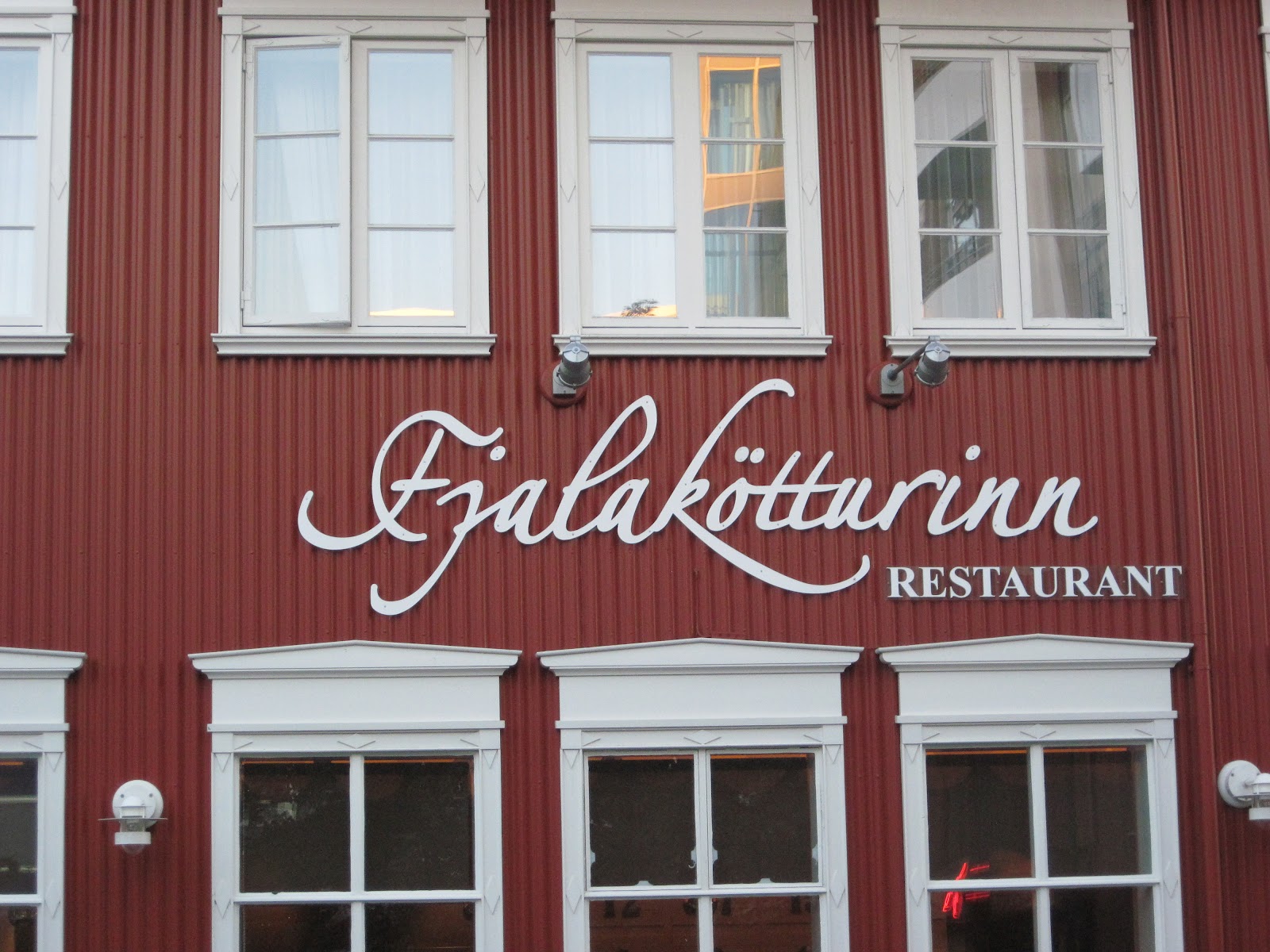
I, too, was well-fed in Iceland, about which the less said the better. More importantly, I photographed, but did not eat at, the splendidly-named restaurant Fjalakötturinn. This word seems to be a variant on the mousetrap-kenning I discussed in an earlier post, where the medieval version was a tréköttr 'wooden cat', whereas this one is better translated as 'plank-cat'. I'm not entirely sure it's the best name for a restaurant, but it's good as ever to see kennings still in use. Apparently, the building is modern, but built on the site of an earlier one with the same name (I haven't been able to discover why), and even earlier there was a Viking longhouse on the site, not surprisingly, as the restaurant is right next to the Reykjavík 871±² settlement exhibition.

 On my last evening I photographed this rather beautiful pussycat (right) on the seashore near my hotel. It is standing in front of a monument celebrating the fact that the football club Þróttur was founded on that very spot. The club's name means 'strength', and some think it is one of Odin's names. The word also appears mysteriously on some rune stones in Sweden, about which I have written recently, but I digress. The spot in the photograph is actually rather interesting, since there are some old (or not even so old) fishermen's huts, known as Grímsstaðavör, still standing (see below, in the romantic gloaming), the last remnants of the fishing heritage of the area before the complete suburbanisation of Reykjavík. What with cats, Norse mythology, ruins and much more, there was plenty to catch my interest in that short evening walk along Ægissíða. Even better than the Northern Lights, though I still hope to see those one day.


09 August 2012

Old Stones

... are actually some of my favourite things, especially when fashioned by human beings into something meaningful to them. Yesterday was excursion day here at the Fifteenth International Saga Conference in Århus. I naturally chose the excursion likely to include the greatest variety of interesting stones. The excursion was to Djursland, the peninsula north-east of Århus, with lots of interesting features, including a dialect that has kept the three genders of Old Norse, that Danish has otherwise done away with. The lithic delights on offer went from the Stone Age right through to the medieval period. We started off with Poskær Stenhus (pictured), apparently the largest Neolithic cairn in Denmark. Not perhaps the largest Neolithic monument on the planet, but a very nice one in a lovely location on a sunny day, in one of the hillier parts of Denmark (more on this later).

The Danish landscape is littered with extremely handsome stone churches, mostly apparently first built around 1200, but then added to later. So there were plenty of medieval delights, like the wall paintings at Hyllested (the link will take you to a lovely picture of the church and detailed information on the paintings), or the Romanesque portal at Rimsø, (which I confess I missed, being too interested in the rune stone at the same place), or the oldest stained glass (c. 1300) in Scandinavia at Virring church. Stonewise, I particularly liked the two little heads (pictured) on an outside wall of Ålum church.

But the real reason for going on the excursion was, of course, the eight rune stones we were promised. I had seen most of them before, but that was nearly two decades ago, so it was great to revisit them. The two I'll mention are the two outside the church at Ålum (pictured). As usual when runologists are gathered, we stand around and discuss every aspect of both the object and the inscriptions and this pair offer much rich material for discussion. The larger one (which by the way has an image of a mounted warrior on its reverse) has the inscription 'Végautr raised this stone in memory of Ásgeirr, his son. May God well help his soul.' The smaller one says 'Þyrvé, Végautr's wife, had this stone raised in memory of Þorbjörn, son of Sibba, her sister's son, whom she cared for more than a dear son.' So many questions... Why did the two young men die? Were they together when they died, was it on an expedition abroad, a local accident, an illness? Were they young men or only children? But even more so, what was the family situation? Why did Þyrvé not participate in the raising of the larger rune stone? Was she not Végautr's wife at the time, or was Ásgeirr perhaps not her son but that of some concubine? Why was she so fond of her nephew Þorbjörn? Had her sister died and she perhaps looked after him? If Ásgeirr was her son, was she telling the world she preferred her nephew to her own son? These lapidary texts give no real clue, and various other possible explanations spring to mind.

My final old stone for today comes not from yesterday's excursion, but today's. After a full day of papers (several of them very interesting indeed), we went on an evening excursion to Himmelbjerget, apparently Denmark's third highest eminence at 147 metres (don't ask me about the other two, but they're certainly not much higher). Outside the hotel there, I saw this beautiful stone, which reminded me of the stones I had seen on the Isle of Lewis over two years ago, particularly those at Callanish. The little plaque on it had a trite little verse which nevertheless concludes with lines also appropriate for signing off this blog:
I en tid hvor alting forgår, er det visse ting som stadig består.
(When everything passes away, some things are here to stay.)
I guess that's just what I think of old stones, too.

29 July 2012

The Feast of St Óláfr

It is the feast day today of Óláfr Haraldsson, warrior, king, saint and eventually rex perpetuus Norvegiae, killed in 1030 at the battle of Stiklarstaðir in Trøndelag by an army including many of his own countrymen. The best place to celebrate this feast is in Tórshavn, where it is also the national day of the Faroe Islands. On this day every year the Faroese celebrate their Ólavsøka by racing traditional rowing-boats (men and women), wearing patterned knitted socks and jumpers (men) and mass chain-dancing to the old ballads in the streets (everyone, including tourists) - an experience highly to be recommended, even if, like me some years ago, you had to do almost all of it in the driving rain. But what's weather to a true Viking?

One of the interesting things about St Óláfr is how quickly his saint's cult spread, especially in the British Isles. By no means the earliest reference to it is in the Anglo-Saxon Chronicles which say that when Earl Siward of Northumbria died in 1055 he was buried in the church that he himself had built at Galma(n)ho, and which (according to version D) he had consecrated to St Óláfr. This is presumably the ancestor of the present St Olave's church in Marygate in York, which has a fifteenth-century stained glass window almost certainly depicting the Norwegian saint. There are also some more modern representations of him in both stained glass and sculpture, and a large Norwegian flag.

On my recent visit to York, we stayed in the Coach House Hotel, on the corner of Marygate and Galmanhoe Lane, and just yards from St Olave's. According to A.H. Smith's Place-Names of the East Riding of Yorkshire and York the name 'Galmanhowe' is lost, though there is a variety of evidence other than the Anglo-Saxon Chronicles to support its erstwhile existence.The current street-name appears to be a result of modern antiquarianism, and apparently dates from only the 1970s.