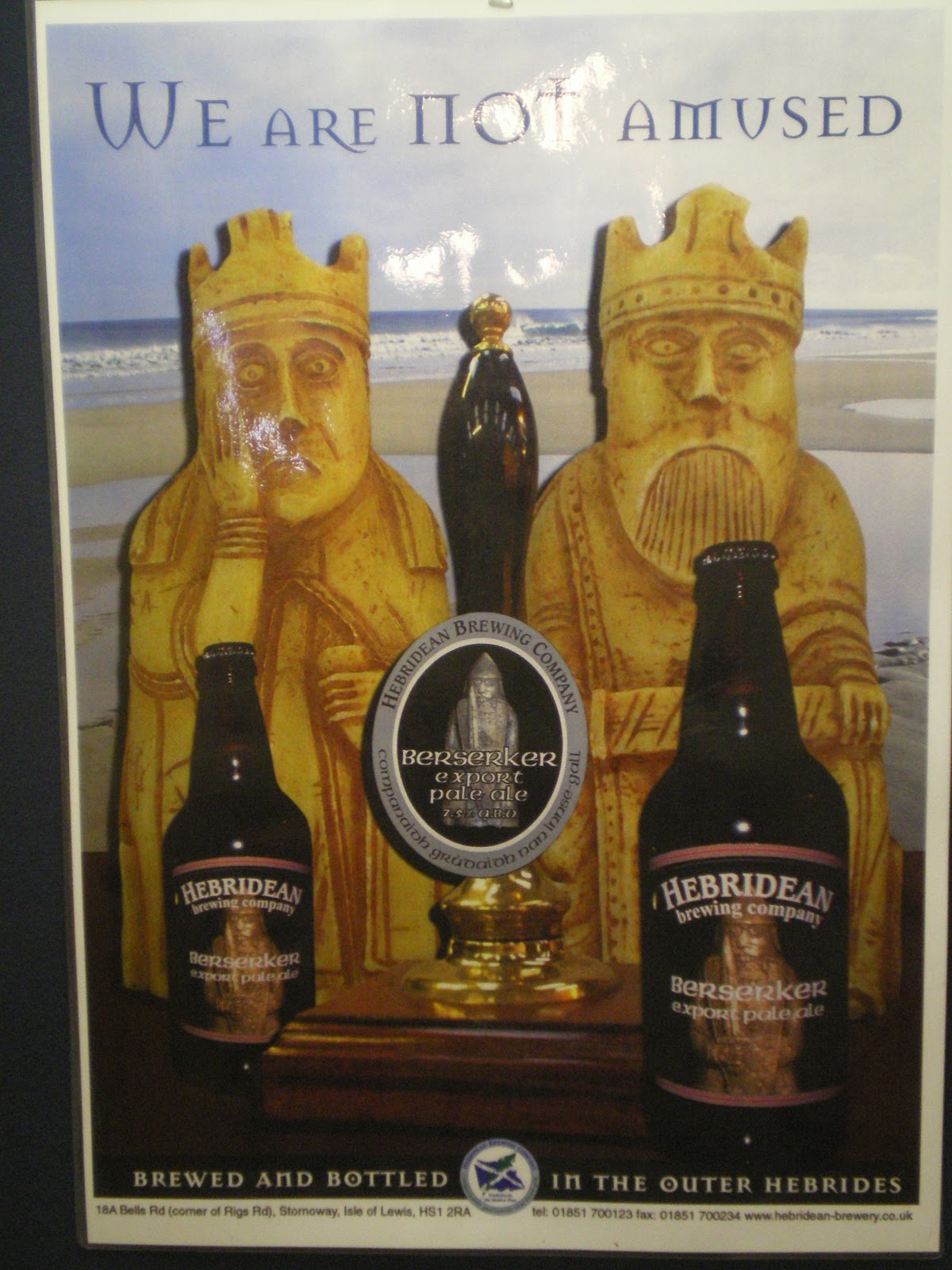
 All things seem to be Lewis this week. I have just read the second volume of Peter May's Lewis Trilogy, The Lewis Man, which I think I enjoyed even more than The Blackhouse, about which I blogged last year. And I was delighted to see that the third volume will be called The Chess Men - I wonder if that will be about those delightful little people of walrus ivory? Speaking of which, the Comann Eachdraidh Uig (or Uig Historical Society to you Sassenachs) has just produced a map of Lewis with the place names given in their Old Norse form. Well, it's really only the area around Uig, not even the whole of Lewis, let alone Harris, and I have to say that some of the spellings are more than a little wonky but, hey, Vikingologists can have fun correcting them. It might even be a good test one day of my students' Old Norse to see what they can do...students be warned!
20 January 2012
Ljóðhúsiana
All things seem to be Lewis this week. I have just read the second volume of Peter May's Lewis Trilogy, The Lewis Man, which I think I enjoyed even more than The Blackhouse, about which I blogged last year. And I was delighted to see that the third volume will be called The Chess Men - I wonder if that will be about those delightful little people of walrus ivory? Speaking of which, the Comann Eachdraidh Uig (or Uig Historical Society to you Sassenachs) has just produced a map of Lewis with the place names given in their Old Norse form. Well, it's really only the area around Uig, not even the whole of Lewis, let alone Harris, and I have to say that some of the spellings are more than a little wonky but, hey, Vikingologists can have fun correcting them. It might even be a good test one day of my students' Old Norse to see what they can do...students be warned!

23 December 2011
Kick-starting 2012

Thinking of Norwegian winters reminds me there was an article in the Guardian a week or so ago, on that most excellent means of locomotion, the 'sparkstøtting', or 'spark' for short. Apparently, the official English term is 'kicksled(ge)', though that's the first time I've heard it. I've seen a lot of them in Norway, and I suppose they must be used in other Scandinavian countries, as suggested by the 1890 Swedish drawing below, but I've never seen them anywhere else. But then where else has enough snow? I wonder if they were ever exported to Minnesota?

15 December 2011
Hardy Hoards
 The Viking Age hoards that keep being discovered in northern, especially north-western, England, are coming in so thick and fast in recent years that I can't be bother to log every one in this blog. But I thought I'd give a quick mention to the latest, found at Silverdale in north Lancashire, and reported today in the Guardian and on the BBC in connection with the publication of the annual reports for treasure and portable antiquities (though found in September). The PAS website also has a detailed article on the hoard.
I find this one particularly interesting because there is one previously unknown coin type in it (pictured above), apparently issued by an unknown king called AIRDECONUT. The jury is still out on whether or not this really represents the name 'Harthacnut', as currently suggested, but it will keep numismatists and onomasts happy for some time to come. In case you were wondering, the date of the hoard (c. 900-910) precludes that well-known Harthacnut, son of Cnut.
26 November 2011
Look North More Often
 A sentiment with which all readers of this blog will concur, I hope. It comes from a piece by Kevin Crossley-Holland in 'The Week in Books' column in the Guardian (it's apparently not on their website, so you'll just have to go out and buy the paper!). He is a spokesperson for the Norwegian Christmas tree project in Trafalgar Square ('Look North More Often' being their motto), and writes evocatively of going deep into the forest to select and remove the big tree, and the 'death-in-life, life-in-death' feeling you get at such a moment, when the tree of life is felled but comes to a kind of new life with its lights for the festive season. At such moments, we think of the dreadful year the Norwegians have had, and how bravely they have borne it.
And just to cheer things up, though it is a bit early for the festive season, I append a photo of a delightful tree-bearer I picked up in the Sally Army shop in Majorstua, on my most recent visit to Oslo.
11 November 2011
Vatnsdœla Saga
 After a lightning trip to Oslo on academic business last week, your intrepid blogstress was off on her rambles again, this time the annual postgraduate field trip to the north-west of England with some enthusiastic students. The cultural high point, as ever, was the Gosforth Cross, though all the familiar old hogbacks, runes and place-names we visited were also wonderful. But for a stunning landscape, the undoubted gem was, as ever, our overnight stay in Wasdale.
Although Wasdale in Cumberland is not so very like Vatnsdalr in Iceland (about which I blogged recently), it is after all the same name, and since my return I have amused myself by seeking out some parallels between the two. It had always struck me that the account in ch. 15 of Vatnsdœla saga of Ingimundr's arrival in Vatnsdalr must represent the reactions of many a Viking settler to their new homeland, wherever that may have been. As Ingimundr said:
'... ek sé nú ok land at víðleika með vexti, ok ef þar fylgja kosti, þá má þat vera, at hér sé vel byggjanda.'After a brief interlude in which Ingimundr's wife gives birth to a daughter by the riverside, they proceed in their explorations:
'... I now see a land expansive in its spaciousness, and if the conditions are as good as the size, then it may be that this is a good place to settle.'
Síðan sótti liðit upp í dalinn ok sá þar góða landakosti at grösum ok skógum; var fagrt um at litask; lypti þá mjök brúnum manna.Driving from Gosforth to Wasdale Head reveals both woods and pastures, the latter populated by large numbers of sheep (pictured above). Ingimundr, too, had lots of sheep, indeed a valley called Sauðadalr is said to have taken its name from some of his sheep which disappeared but were then found later on in the woods having spent the winter out of doors. The Herdwick sheep of Cumbria, too, are famous for their hardiness and for knowing their way around their patch. Ingimundr also had some problematic swine, and the Lake District is awash with Swin(e)dales and Grisedales. Natural resources are good too. In ch. 22 of the saga, we're told that there was veiðr mikil ... í Vatnsdalsá, bæði laxa ok annarra fiska 'much fishing ... in Vatnsdalsá, of both salmon and other kinds of fish'. Near Wasdale is Waberthwaite, the first element of which seems to come from an ON veiði-búð or 'fishing hut'.
Then the party made their way up into the valley and saw good agricultural conditions with respect to pastures and woods; it was beautiful to look at; people's brows unfurrowed.
When he died, Ingimundr was given a boat burial, presumably with a mound (ON haugr) over it. The EPNS volume for Cumberland lists some 17 minor names with 'how' in Wasdale alone, though, as Diana Whaley points out in A Dictionary of Lake District Place-Names, the element is prolific and can be used for both natural and artificial features, the latter including burial mounds. Disappointingly, the first element in the evocative Boat How was nothing to do with a burial but is from búð 'booth, hut' again.
Not that any of this proves anything at all, only that Viking settlers sought out similar landscapes, and used their well-established vocabulary to name those landscapes. But it's fun, and it's no wonder that those 19th-century antiquarians found themselves inspired by the links between Iceland and Lakeland.
23 October 2011
The Vikings are Coming!
 That was the headline in my copy of this morning's Observer which has quite a large feature on the cultural invasion of Britain by a number of forthcoming 'TV sagas, epic novels and a major exhibition' which 'testify to a fascination with all things Norse'. All of that is excellent news. But OK, dear Observer, if only you'd been reading this blog, you'd have known that they never really went away!
20 October 2011
Gimme, Gimme, Gimme Dat Ding
 Some years ago, on one of my rambles to Orkney, I stopped off in Dingwall, Ross-shire. As all Viking aficionados know, the place-name comes from an Old Norse word for an assembly site, found most notably at Þingvellir in Iceland, but also at several places in these islands, the two Thingwalls on either side of the Mersey, or Tynwald on the Isle of Man, plus a few scattered about the Scottish islands. On that brief visit to Dingwall, I wandered into the museum, and saw a few signs of Viking awareness, but not many. Otherwise, it was a charming place.
Now I read in The North Star that the very town centre car park in which I parked my car on that day is reported to be the site of the Viking Age assembly mound, according to some rather vaguely unspecified archaeological investigations (though not yet excavations) carried out last month. The various worthy persons interviewed in the article all foresee a great future for Dingwall as a Viking tourist hotspot. How things change in a few years...
While searching for a suitable image for this post, I came across the above golden bull on a handsome black plinth. If you look carefully, there is an attempt to render the name Dingwall in both Old Norse and runes, but, oh so sadly, such a dismal attempt, especially the runes. They are really neither one thing nor tother, and I'm not even that sure what exactly they are meant to spell. I predict a rash of dodgy 'runic' inscriptions in Viking tourist spots around the country, each one feebler than the last. Please, please, please guys, if you want to do something like that, get in touch with a real runologist, like those splendid chaps at Hotell Svava and Kirkwall Airport did.
Subscribe to:
Posts (Atom)